

Why Aluminum for CNC Machined Components
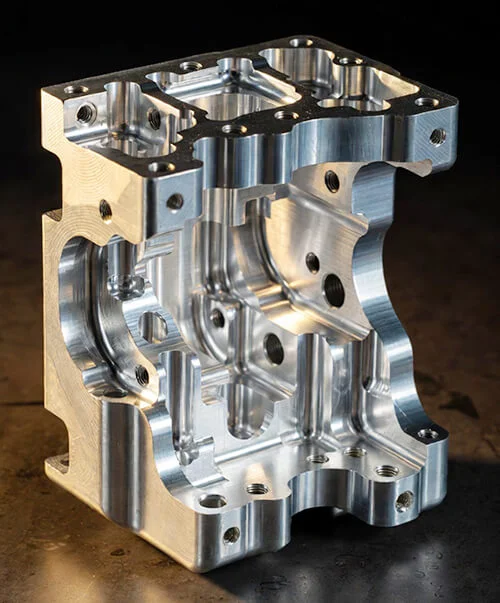
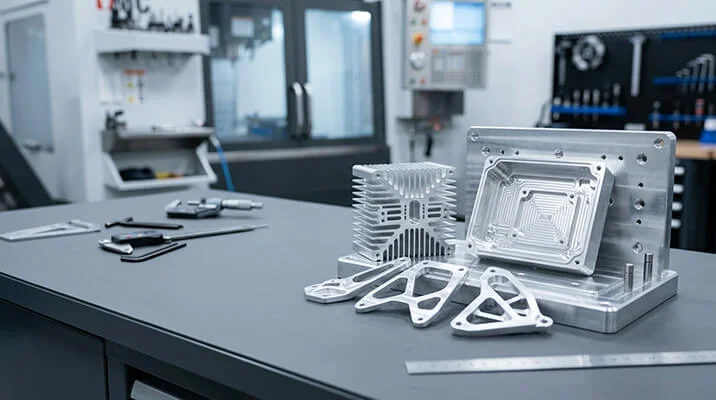
Aluminum alloys are widely selected for CNC machining because they combine low density, high machinability, and strong performance-to-cost. They excel in lightweight structures, thermal management parts, and precision housings—while also supporting protective finishes like anodizing or chem film for corrosion and wear control.
Lightweight Performance
High strength-to-weight in alloys like 6061 and 7075 helps reduce mass without sacrificing stiffness—useful for frames, brackets, and moving assemblies.
Thermal + Electrical Conductivity
Aluminum’s conductivity makes it a natural fit for heat sinks, thermal plates, RF enclosures, and EMI shielding designs where heat and signal integrity matter.
Finish Flexibility
Type II and Type III anodizing add wear and corrosion resistance; chem film can preserve surface conductivity for bonding, grounding, and shielding interfaces.
Aluminum Alloys We Machine
Choose the alloy based on strength-to-weight, fatigue behavior, corrosion environment, finish requirements, and flatness needs for plates and tooling. When cost and lead time matter, selection should also consider cycle time, tool access, and finishing complexity.
| Best For | Strength / Cost | Machining Notes | Typical Parts |
|---|---|---|---|
| General-purpose machined parts and prototypes | Balanced strength-to-cost; great default choice | Very machinable; consistent anodize appearance; good corrosion behavior | Housings, brackets, heat sinks, fixtures, RF enclosures |
| Best For | Strength / Weight | Machining Notes | Typical Parts |
|---|---|---|---|
| High-stress structural components where weight is critical | Higher strength than 6061; premium alloy cost | Excellent for thin, stiff structures; plan finish expectations and critical datums | Aerospace brackets, UAV frames, precision mounts |
| Best For | Fatigue Behavior | Machining Notes | Typical Parts |
|---|---|---|---|
| Applications emphasizing fatigue performance | Often used in aerospace-style duty cycles | Use when fatigue drives selection; confirm corrosion and finishing requirements early | Gears, shafts, fittings, fatigue-loaded brackets |
| Best For | Flatness | Machining Notes | Typical Parts |
|---|---|---|---|
| Tooling plates, fixtures, and base plates | Excellent flatness and dimensional stability | Ideal when repeatable setup and low distortion matter; great for dowel + threaded patterns | Fixture plates, vacuum tooling, inspection bases |
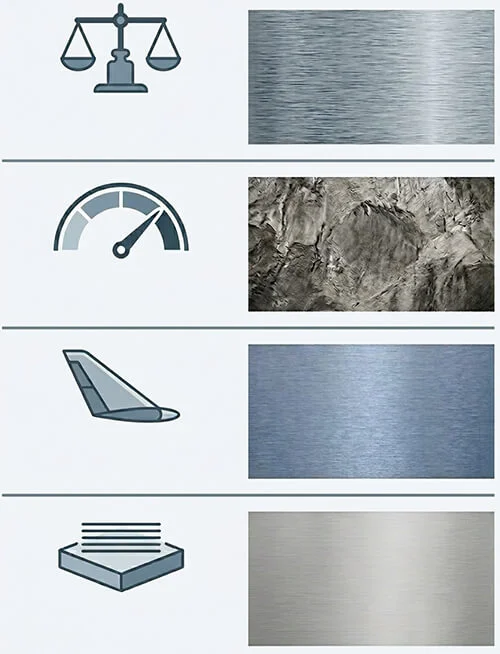
Alloy Selection Snapshot
Use strength-to-weight, fatigue duty cycle, flatness needs, and finishing requirements to choose the right aluminum for CNC machining.
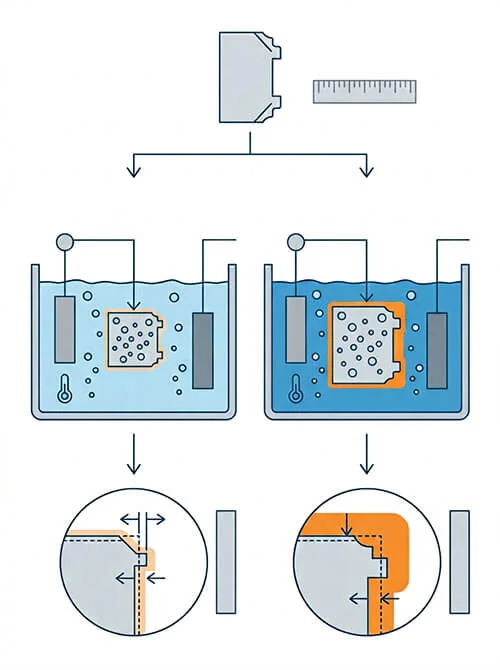
Anodizing Thickness Planning
Plan thickness-driven growth on close fits and threads. For precision parts, decide early: mask, machine allowance, or post-finish rework.
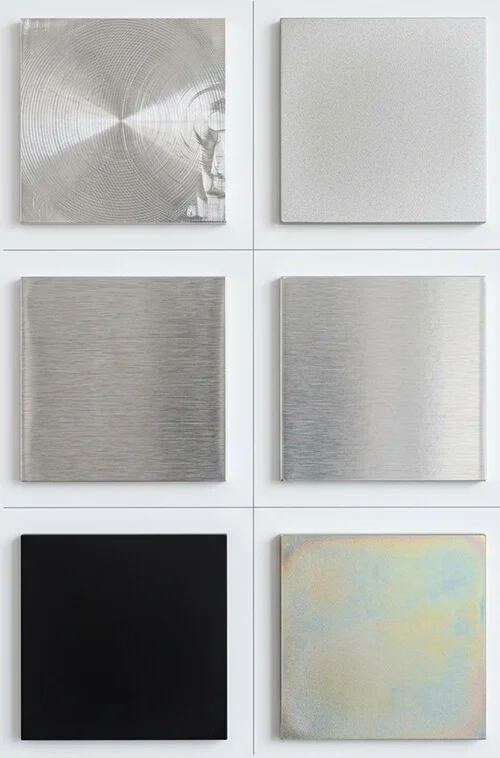
Finish Options
From as-machined Ra targets to anodizing and chem film—choose the finish that matches wear, corrosion, conductivity, and cosmetic needs.
6061 vs 7075 (Quick Rule)
If your main goal is a reliable, cost-effective aluminum part with excellent machinability and consistent anodize appearance, default to 6061. If your design is strength- or stiffness-limited and weight is the constraint, consider 7075 and validate finishing + tolerance strategy early.
- 6061: general-purpose, prototypes, enclosures, heat sinks
- 7075: high-strength brackets and lightweight structures
- 2024: fatigue-driven aerospace-style duty cycles
- MIC-6: flat tooling plates and precision fixtures
Our Capabilities for Aluminum CNC Machining
We machine aluminum parts across prototypes and production, with process planning focused on stable datums, predictable surface finish, and cost control through setup reduction and cycle-time optimization.
3/4/5-Axis Milling
Pockets, enclosures, manifolds, and complex datums—optimized toolpaths for clean walls and consistent surface integrity.
Turning / Swiss Turning
Shafts, bushings, fittings, and concentric features—built around efficient chip evacuation and repeatable runout control.
Secondary Ops
Deburr, edge break, bead blast, brushing, Type II/III anodizing coordination, chem film, and assemblies.
DFM Guide: Precision, Finish, and Cost in Aluminum
Aluminum is forgiving compared to many metals, but the highest ROI comes from aligning tolerances and finishes to function. This reduces cycle time, avoids secondary rework, and keeps pricing competitive.
| Design Item | Recommendation | Why It Matters |
|---|---|---|
| Finish-driven dimensions | Flag critical fits and threads that will be anodized; define masking or allowances | Type II/III anodizing adds thickness; close fits may need post-finish machining or protected surfaces |
| Internal corner radii | Use radii that match standard cutters; avoid sharp internal corners | Reduces cycle time and tool changes; improves surface finish consistency |
| Deep pockets | Limit depth-to-width; add tool access; avoid ultra-narrow channels | Long tools increase deflection and chatter—driving slower feeds and higher cost |
| Thin walls | Add ribs; choose stable datum faces; allow finish stock if cosmetic | Thin walls can vibrate and “print” tool marks; good fixturing and geometry improve cosmetics |
| Cosmetic surfaces | Define what is cosmetic vs functional; specify direction for brushing if needed | Clear definition reduces handwork and keeps lead time predictable |
Cost Lever 1: Reduce Setups
Consolidate datums and allow access for one or two primary setups. Fewer setups means faster turnaround and more stable tolerances.
Cost Lever 2: Match Tolerance to Function
Use tight tolerances only where they gate assembly or performance. Over-specifying tolerances multiplies inspection and process time.
Cost Lever 3: Choose the Right Finish
If conductivity is required (EMI, bonding), avoid full anodize and choose chem film or selective masking—this prevents costly rework.
Surface Finishes for Aluminum CNC Parts
Finishes change more than appearance: they affect wear resistance, corrosion performance, electrical conductivity, friction, and dimensional stack-up. Align the finish to the real functional requirement, then design tolerances around it.
| Finish | What It Does | Best For | Notes |
|---|---|---|---|
| As-machined (Ra target) | Controlled roughness and toolpath texture | Functional parts, internal features | Lowest dimensional change; ideal for tight tolerances |
| Bead blasted | Uniform matte surface | Cosmetic housings and glare reduction | Can soften sharp edges and reduce toolpath visibility |
| Type II anodizing | Protective oxide layer; dyeable for color | Consumer-visible parts, general corrosion protection | Plan thickness on fits; dyed colors vary by alloy and batch |
| Type III hardcoat anodizing | Thicker, wear-resistant coating | Sliding contact, abrasion, harsh environments | Most important to plan machining allowance for close fits and threads |
| Chem film (chromate conversion) | Corrosion protection with conductivity | EMI shielding enclosures, bonding/grounding interfaces | Preferred when anodize non-conductivity is a problem |
Quality Documents for Aluminum Parts
For aluminum components used in critical assemblies, quality evidence is part of performance. We can align inspection deliverables to your drawing revision, datums, and acceptance criteria.
Material Traceability
Material certifications and alloy/temper traceability when required by your supplier quality plan.
Inspection Evidence
FAI packages, dimensional reports, and CMM/fixture-based measurement strategies tied to GD&T and datums.
Finish Certifications
Anodizing and chem film documentation from approved processors when requested (process certs + lot tracking).
Case Study: Lightweight + Thermal + EMI Aluminum Program
A customer needed a family of aluminum CNC machined parts that spanned lightweight structure (7075), thermal management (6063/6061), and conductive EMI shielding (6061 with chem film). The key was aligning alloy and finish choices to performance, then controlling cost with setup consolidation and finish-aware tolerancing.
| Program Goal | Constraint | Batnon Approach | Outcome |
|---|---|---|---|
| Best part performance at competitive pricing | Tight datums + mixed finishing requirements | Alloy-by-function mapping, finish-aware tolerances, reduced setups, inspection plan matched to risk | Stable fit, consistent cosmetics, predictable lead time and cost |
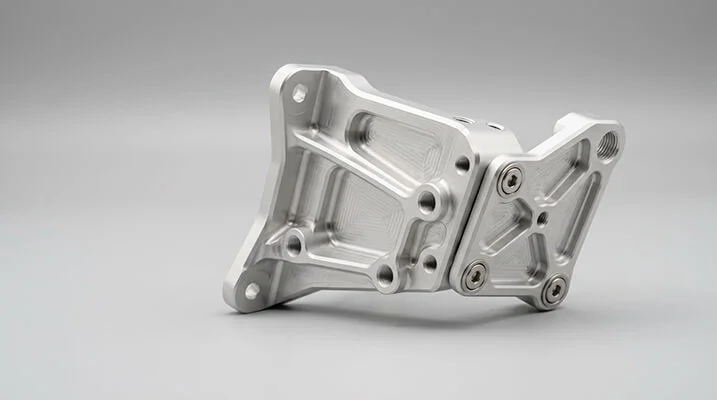
7075 Structural Bracket
Weight-critical geometry with pocketing and fillets. Datums were protected and finish was planned so alignment features stayed true.
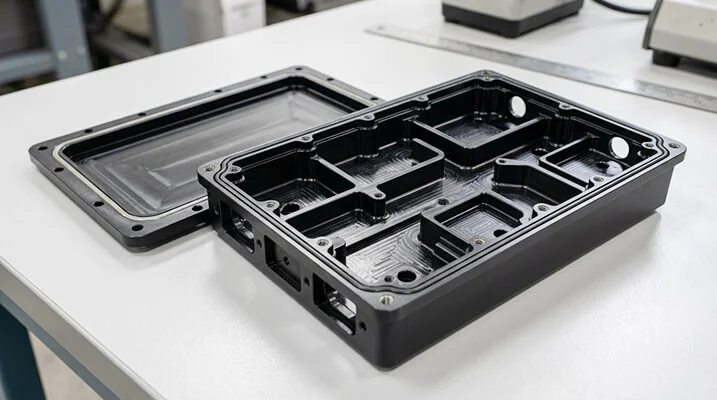
6061 EMI Enclosure
Conductive interfaces were preserved for shielding and grounding. Chem film and selective masking prevented non-conductive anodize where it would break performance.
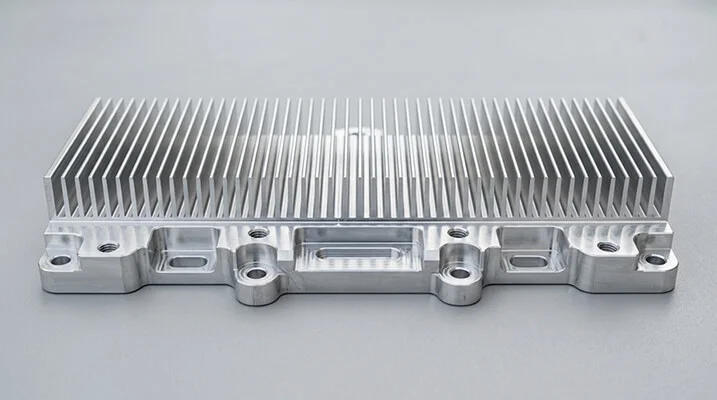
Thermal Management Heat Sink
Fin geometry and mounting datums were controlled to protect thermal contact. Surface finish targets were tied to function, not aesthetics.
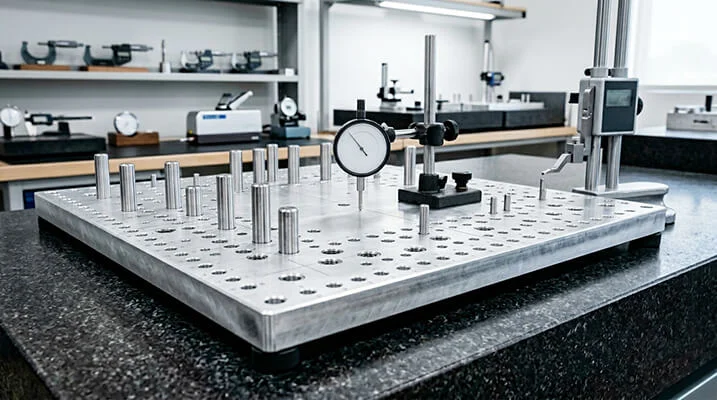
MIC-6 Tooling Plate + Inspection Base
Flatness and repeatability reduced assembly variation. Dowel + threaded patterns were machined with an inspection-first datum scheme to speed line setup and reduce rework.
What Made It Work (Transferable Lessons)
Competitive cost came from engineering choices, not just cutting rates: selecting 6061 where it met performance, using 7075 only where strength-to-weight was truly gating, and planning anodize/chem film early so tolerances weren’t accidentally “consumed” by coating growth.
- Finish-aware tolerances: protect precision fits from coating growth
- Conductive surfaces: avoid full anodize when EMI/grounding matters
- Setup consolidation: fewer setups improves both cost and accuracy
- Risk-based inspection: measure what gates assembly and performance
FAQ: Aluminum CNC Machining
Common questions about alloy selection (6061 vs 7075), anodizing and dimensional growth, conductive finishing, and cost control.
Which aluminum is best for CNC machining—6061 or 7075?
6061 is the general-purpose default because it balances strength, machinability, corrosion resistance, and consistent anodize appearance. Choose 7075 when strength-to-weight is the gating requirement for structural or aerospace-style components.
When should I choose 2024 aluminum for machined parts?
Choose 2024 when fatigue performance is the primary driver and your environment/finishing requirements are compatible. If corrosion exposure is high or cosmetics after anodize are critical, 6061 or 7075 may be preferable.
What is MIC-6 and why is it used for fixtures?
MIC-6 is a cast aluminum tooling plate known for excellent flatness and dimensional stability. It’s commonly used for fixture plates, base plates, jigs, and tooling where repeatable setups matter.
What’s the difference between Type II and Type III anodizing?
Type II is generally thinner and can be dyed for aesthetic color. Type III is thicker and wear-resistant (hardcoat), often used for abrasion and sliding contact. Both add thickness that must be considered for close fits and threads.
Does anodizing change dimensions on precision parts?
Yes. Anodizing adds an oxide layer. For precision bores, threads, and sealing surfaces, plan masking, machining allowance, or post-finish rework. A practical planning rule is that growth is about half the coating thickness per surface.
Can aluminum parts stay electrically conductive after finishing?
Anodized surfaces are non-conductive. For EMI shielding, grounding, and bonding, chem film (chromate conversion) or selective masking strategies may be a better fit.
What aluminum parts are a good fit for CNC machining?
Heat sinks, RF/EMI enclosures, brackets, housings, manifolds, optical mounts, fixture plates, and lightweight structural frames are all good fits—especially when tight tolerances and controlled surface finish are required.
How do you keep aluminum CNC machining cost-competitive?
We reduce cycle time and setups with DFM: avoid unnecessary deep pockets, use standard tool sizes, allow reasonable radii, and choose finishes based on function. A smart datum and inspection plan also reduces rework and accelerates throughput.
Aluminum CNC Machining (Global Supply, Local Expectations)
Batnon supports aluminum CNC machining programs for teams building products across North America, Europe, and Asia—shipping prototypes and production parts worldwide. If you’re searching for aluminum CNC machining services, 6061 aluminum CNC machining, 7075 aluminum machining, Type II anodizing, or Type III hardcoat anodizing, our quoting workflow is designed for fast engineering alignment: alloy selection, finish planning, tolerance review, and QA documentation.
- Typical applications: RF/EMI enclosures, heat sinks, optical mounts, brackets, housings, fixture plates
- Industries served: robotics & automation, aerospace-style structures, industrial electronics, instrumentation
- Finish options: clear/black anodize (Type II), hardcoat (Type III), chem film for conductivity
- Engineering handoff: DFM feedback, datum strategy, inspection plan, material/finish documentation
Tip for fast quoting: include your target alloy/temper, finish spec, critical datums, and any conductive surface requirements (EMI/grounding).