
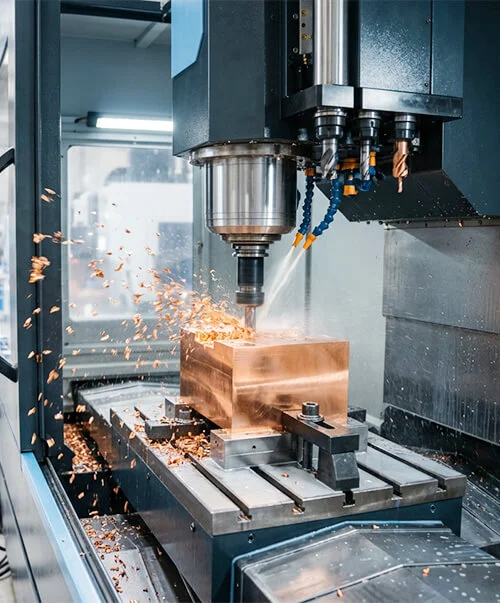



Why Copper for CNC Machined Components
Copper is selected when the part’s job is to move electrons or move heat. That makes copper a first-choice material for busbars, connectors, heat spreaders, and cold plates—especially in EV power electronics, data-center cooling, industrial automation, and RF systems. Great performance, however, requires disciplined process control: copper can smear, burr, and build up on cutting edges. Our copper cnc machining services focus on tool/material pairing, chip control, and inspection strategy so you get performance and predictable cost.
Conductivity That Matters
When electrical performance is the KPI, copper’s conductivity is hard to beat. For example, Copper Development Association (CDA) lists C14500 tellurium copper at 93% IACS conductivity—high enough for many current-carrying components while machining much cleaner than pure copper.
Thermal Performance
Copper’s high thermal conductivity is why it’s common in cold plates and thermal spreaders. In practice, the value varies by grade and temper; we align alloy choice and surface requirements to your thermal interface and cooling design.
Precision + Pricing Together
Cost control in copper comes from DFM: choose the right alloy (often C110 or C145), minimize fragile edges, and define what’s truly critical (flatness, sealing faces, contact pads). That’s how precision copper CNC machining stays competitive.
Copper at a Glance (Useful Numbers)
These reference values help early selection and DFM. Exact values depend on product form and temper; confirm against your spec and required certifications.
- C14500 (tellurium copper): machinability rating 85, electrical conductivity 93% IACS (CDA alloy data).
- C17200 (beryllium copper): machinability rating 20, electrical conductivity 22% IACS (CDA alloy data). Often chosen for strength/spring performance more than conductivity.
- Free-machining copper concept: adding ~0.5% tellurium/sulfur can raise machinability from ~20 to ~90 on a scale where free-cutting brass is 100 (CDA Innovations newsletter).
- Best-fit parts: busbars, connector bodies, heat sinks, cold plates, RF hardware, welding/soldering tips, high-current terminals.
Sources: Copper Development Association (CDA) alloy profiles for C14500 and C17200; CDA Innovations: Types of Copper.
Copper Alloys We Machine
In cnc machining copper parts, alloy selection is the biggest lever on surface quality, burr risk, and cost. Pure/near-pure coppers excel at conductivity but can be gummy. Free-machining copper grades (like tellurium copper) balance conductivity with chip breaking—often a sweet spot for production.
| Best For | Conductivity Focus | Machining Notes | Typical Parts |
|---|---|---|---|
| Maximum conductivity / low oxygen content needs | Excellent electrical + thermal performance | More prone to smearing/burrs; benefits from sharp tooling, stable workholding, and finish planning | RF components, vacuum-compatible parts, high-end thermal interfaces |
| Best For | Speed / Cost | Machining Notes | Typical Parts |
|---|---|---|---|
| General-purpose conductive components | Great value for many programs | Still ductile; we optimize tool geometry and chip breaking to control burrs and edge quality | Busbars, terminals, heat spreaders, housings |
| Best For | Production Stability | Machining Notes | Typical Parts |
|---|---|---|---|
| High-repeatability precision conductive parts | Faster cycle time than pure copper; stable chips | Excellent chip breaking and finish for copper; a strong default for tellurium copper C14500 machining | Electrical connectors, torch tips, soldering tips, precision turned pins |
| Best For | Strength / Spring | Machining Notes | Typical Parts |
|---|---|---|---|
| High strength, fatigue resistance, spring contact behavior | Conductivity lower than pure copper | Used when mechanical performance dominates. Machinability depends on condition; safety practices and dust control apply. | Spring contacts, clips, aerospace/industrial wear components |
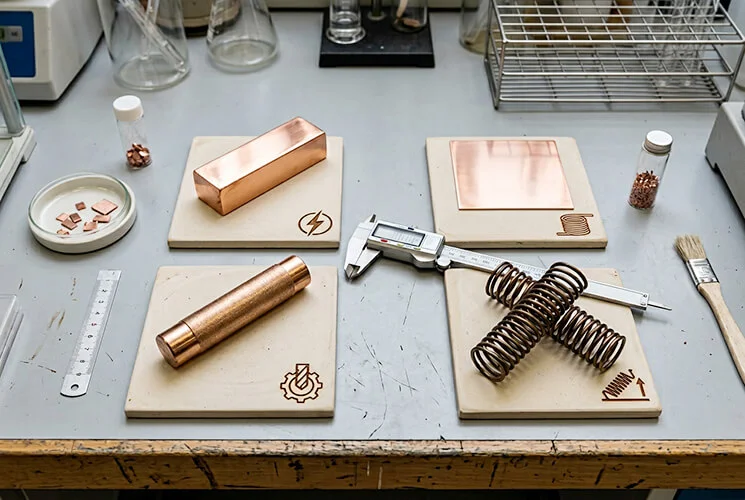
Alloy Selection Snapshot
Choose the copper grade based on the real gate: maximum conductivity (C101), general value (C110), machinability + conductivity balance (C145), or strength/spring behavior (C172).
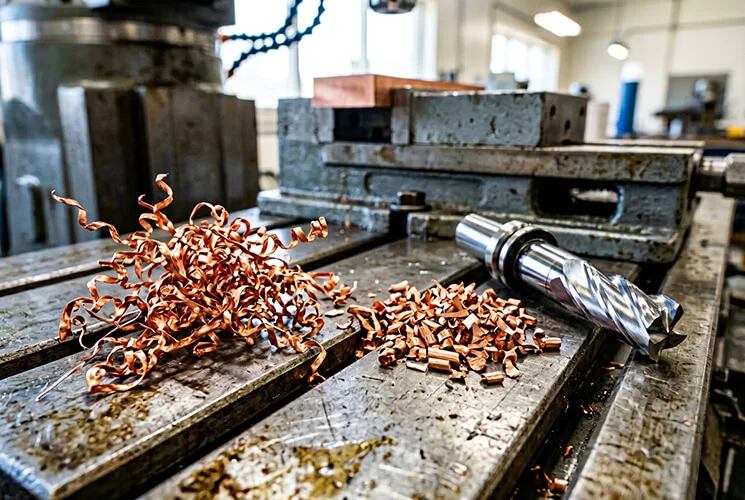
Chip Control = Surface Control
Copper’s ductility can create long chips and built-up edge. We use sharp positive rake tools, polished/DLC surfaces, and chip-break geometry to stabilize surface finish and edges.
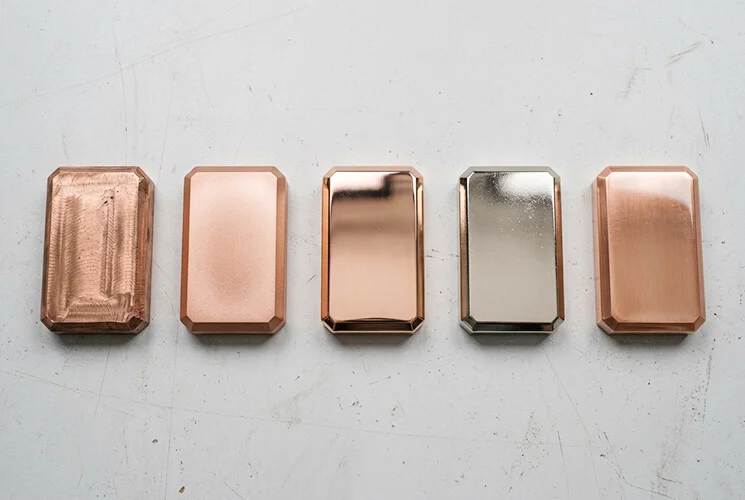
Finish Options
From as-machined to bead blast, polish, and nickel plating—finish planning protects functional contact areas while keeping cosmetic cost targeted.
C110 vs C145 (Quick Rule)
If your priority is cost-effective conductivity, start with C110. If you’re fighting burrs, smear, or unstable cycle time on tight tolerance features, C145 is often the better production alloy. For maximum conductivity requirements (or oxygen-control needs), consider oxygen free copper C101 machining and plan extra attention to surface integrity.
- C110: general-purpose busbars, terminals, heat spreaders
- C145: best-fit for repeatable machining + high conductivity; ideal for turned and threaded conductive parts
- C101: maximum conductivity / low oxygen; requires tighter machining discipline
- C172: choose when strength/spring performance is the main requirement
Our Capabilities for Copper CNC Machining
We support cnc milling copper and cnc turning copper for prototypes and production. The process plan is built around chip control, surface integrity, and dimensional stability—so your conductive parts perform at the assembly level (not just on the drawing).
High-Precision Milling
Pockets, manifolds, heat spreaders, and cold plates. We tune workholding + toolpath to protect flatness and functional surfaces.
Production Turning
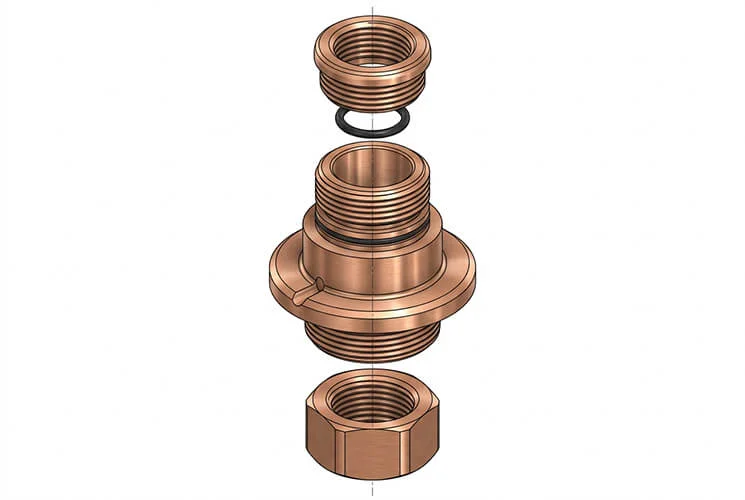
Threaded conductive components, pins, bushings, and tips—optimized for stable diameters and controlled burrs.
Secondary Ops
Deburr/edge break, polishing, media blasting, and plating coordination (nickel/electroless nickel). We treat coating thickness as a dimension, not a surprise.
DFM Guide: Burr Control, Contact Surfaces, and Cost in Copper
Copper rewards good DFM. Most cost and schedule risk comes from burrs, smeared finishes, and rework on functional contact areas. Use this checklist to keep copper cnc machining services fast and predictable—without sacrificing performance.
| Design Item | Recommendation | Why It Matters |
|---|---|---|
| Electrical contact pads | Define the contact faces (flatness + surface condition); avoid placing burr-prone edges inside the contact footprint | Contact quality affects resistance and heat generation in high-current assemblies. |
| Edge break callouts | Specify “break sharp edges” or a controlled chamfer; avoid micro-chamfers that force hand deburr | Copper burrs can be stubborn; clear intent prevents overwork and variability. |
| Thin walls & fins | Add support ribs or increase thickness where possible; keep critical fins accessible to tooling | Copper can deflect and smear; stable geometry improves finish and dimensional repeatability. |
| Microchannels (cold plates) | Share channel depth/width, cover method, and leak-test plan early | Cold plates combine geometry + sealing risk; early DFM avoids trapped burrs and leakage. |
| Plating-aware tolerances | If nickel plating is required, identify functional fits and mask/allowance as needed | Plating thickness can change fits and thread performance. |
Cost Lever 1: Pick the Right Copper
C110 is a strong default for many programs. For production stability and better chip breaking, tellurium copper C14500 machining often reduces deburr effort and scrap risk.
Cost Lever 2: Protect Contact Faces
Call out the mating surfaces and measure them. Don’t pay for ultra-tight tolerances on faces that never touch, seal, or conduct.
Cost Lever 3: Minimize Handwork
Geometry that controls burr formation reduces manual finishing—usually the hidden cost driver in copper.
Surface Finishes for Copper CNC Parts
Finishing changes corrosion appearance, contact behavior, and sometimes dimensions. The key is to match finish to function: electrical contact, thermal interface, cosmetics, or corrosion environment. For many programs, the best finish is simply a well-controlled toolpath with a defined Ra target.
| Finish | What It Does | Best For | Notes |
|---|---|---|---|
| As-machined (Ra target) | Controlled toolpath texture | Functional conductive parts, internal features | Great default for cost. Define critical faces to avoid unnecessary polishing. |
| Bead blasted (matte) | Uniform low-glare texture | Visible housings, non-contact faces | May slightly change surface condition—avoid on electrical contact pads unless specified. |
| Polished | Bright smooth appearance | Decorative copper parts / visible hardware | Higher cost; specify which faces are cosmetic. |
| Nickel plated / electroless nickel | Corrosion protection + stable appearance | Wear faces, connector bodies, harsh environments | Plan masking/allowance on tight fits and threads. |
| Anti-tarnish clear coat | Reduces oxidation color change | Cosmetic copper surfaces | Confirm temperature/chemical exposure compatibility. |
Quality Documents for Copper Parts
For conductive and thermal parts, quality is more than dimensions—it’s traceability, surface intent, and evidence that the functional features were controlled. We can align inspection depth to your risk level and supplier quality plan.
Material Traceability
Material certifications and traceability when required (e.g., C101/C110/C145/C172). We align to your drawing notes and compliance requirements.
Inspection Evidence
FAI packages, dimensional reports, and CMM/fixture-based measurement tied to critical datums, contact surfaces, and sealing geometry.
Finish / Plating Documentation
Plating/coating documentation from approved processors when requested, with lot tracking and thickness planning for critical fits.
Case Study: Copper Program for Power + Thermal Components
A customer launched a product family that included high-current busbars, a compact cold plate, and a precision turned conductive interface part. The objective was best performance and precision while holding cost. The key was separating “must-be-perfect” surfaces from everything else—and selecting alloys to match production reality.
| Program Goal | Constraint | Batnon Approach | Outcome |
|---|---|---|---|
| Best part performance at competitive pricing | Contact resistance, flatness, burr control, leak-risk ports | Alloy-by-function mapping (C110 vs C145), contact-surface definition, burr-control DFM, plating-aware tolerances, risk-based inspection | Stable assembly, predictable cost, consistent functional surfaces |
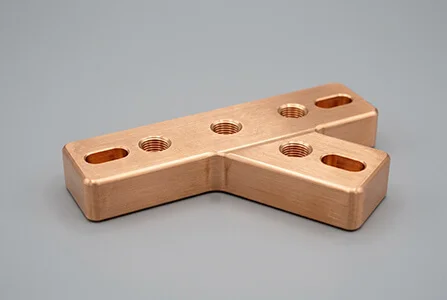
Power Connector / Busbar Interface
Built around controlled edge break and hole position accuracy—ideal for copper busbar machining programs with repeatable assembly torque.
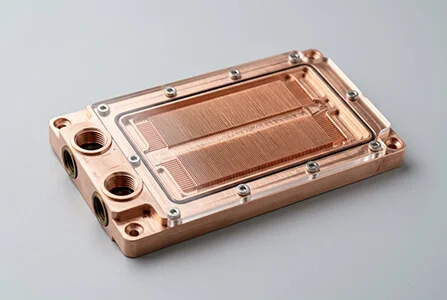
Cold Plate with Microchannels
DFM focused on tool access, burr management, and sealing geometry—typical in copper heat sink machining and liquid cooling parts.
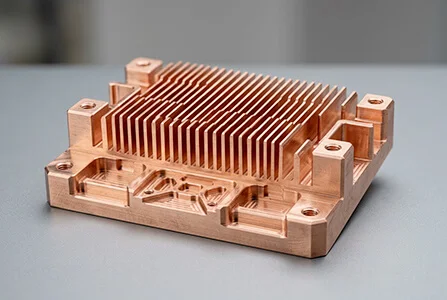
Thermal Spreader / Heat Sink
Flatness and surface condition were controlled only where it mattered for thermal interface performance.
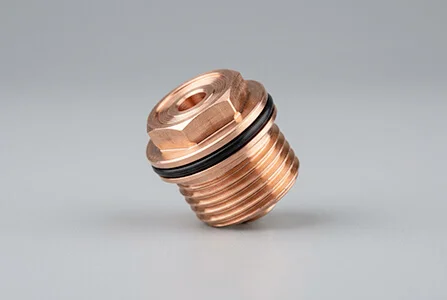
Precision Turned Conductive Part
For tight tolerance threaded features, tellurium copper C14500 machining improved chip breaking and reduced hand-deburr—supporting both quality and cost.
What Made It Work (Transferable Lessons)
Copper is a premium material; the best programs treat process planning as part of the design. Competitive pricing came from three practical moves: selecting C145 where burr/finish risk was high, reserving tight tolerances for contact and sealing surfaces, and defining finishing intent to avoid unnecessary handwork.
- Alloy-by-function: C110 for value, C145 for stable machining, C101 for maximum conductivity requirements
- Contact-first tolerancing: flatness and surface intent where the electrons actually flow
- Chip/burr strategy: reduce rework and protect assembly reliability
- Inspection that matches risk: measure what gates contact resistance and leak risk
FAQ: Copper CNC Machining
Common questions about alloy selection (C101 vs C110 vs C145), built-up edge, burr control, plating effects, and how to keep pricing competitive while meeting precision requirements.
Which copper alloy is best for machining—C101, C110, or C145?
If maximum conductivity is your #1 requirement, start with C101 and plan extra attention to finish/burr control. For general conductive components, C110 is a cost-effective choice. If you want better chip control and production stability while maintaining high conductivity, C145 is often the best fit—especially for turned and threaded parts.
Why is pure copper difficult to CNC machine?
Pure copper is ductile and can smear; it also tends to form built-up edge (material sticking to the tool) which can worsen surface finish and create burrs. The solution is sharp positive-rake tooling, polished/DLC tool surfaces, stable workholding, and process parameters tuned to chip breaking.
Can you support both prototypes and production for copper parts?
Yes. We support prototype-to-production scaling for copper cnc machining services, including process standardization to keep geometry, finish, and inspection consistent as volumes increase.
Do you do copper busbar machining for EV and power electronics?
Yes. We machine busbars, terminals, and current-carrying connectors. The key controls are flatness on mating faces, consistent edge break, and accurate hole positions for reliable assembly and stable contact resistance.
Can you machine copper heat sinks and liquid cooling cold plates?
Yes—copper heat sink machining and cold plates are a strong fit. Provide your channel geometry, cover method, and sealing approach (O-ring, gasket, brazed cover) so we can plan burr control and leak-risk inspection.
Will nickel plating change dimensions on tight-tolerance copper parts?
Yes. Plating adds thickness. For tight fits, threads, and sealing faces, we plan masking or machining allowances so the post-plating dimensions remain within spec.
How do you keep copper CNC machining services cost-competitive?
We keep cost down by selecting the right material (often C110 or C145), reducing setups, designing for burr control, standardizing tooling, and applying tight tolerances only where they gate function (contact pads, sealing faces, critical hole patterns).
Copper CNC Machining (Global Supply, Local Expectations)
Batnon supports copper cnc machining services for engineering teams across North America, Europe, and Asia—shipping prototypes and production parts worldwide. If you’re searching for precision copper CNC machining, custom copper machined parts, cnc machining copper parts, cnc milling copper, cnc turning copper, tellurium copper C14500 machining, oxygen free copper C101 machining, copper heat sink machining, or copper busbar machining, our quoting workflow is designed for fast engineering alignment: alloy selection, finish planning, tolerance review, and QA documentation.
- Typical applications: busbars, connector bodies, heat sinks, cold plates, RF hardware, welding/soldering tips
- Industries served: EV & energy storage, data center cooling, industrial automation, electronics, RF & telecom, aerospace
- Common alloys: C101 (OFHC), C110 (ETP), C145 (tellurium copper), C172 (beryllium copper)
- Finish options: as-machined Ra targets, bead blast, polish, nickel plating / electroless nickel, anti-tarnish clear coat
- Engineering handoff: DFM for chip/burr control, contact-surface strategy, plating-aware tolerances, inspection plan, material/finish documentation
Tip for fast quoting: include your target alloy/spec, critical contact/sealing faces, finish requirements, and any microchannel/cold-plate details (ports, sealing method, leak test expectation).