
DFM Complete Guide — Section 01 Hero
ResourceDesign for ManufacturabilityCNC Machining

DFM Complete Guide for CNC Machining

A practical, engineer-to-engineer guide to reducing cost, lead time, and risk by designing parts that machine cleanly the first time—without sacrificing function.

Includes: review workflow, cost drivers, CNC-specific rules-of-thumb, checklist, case study, and FAQ schema.
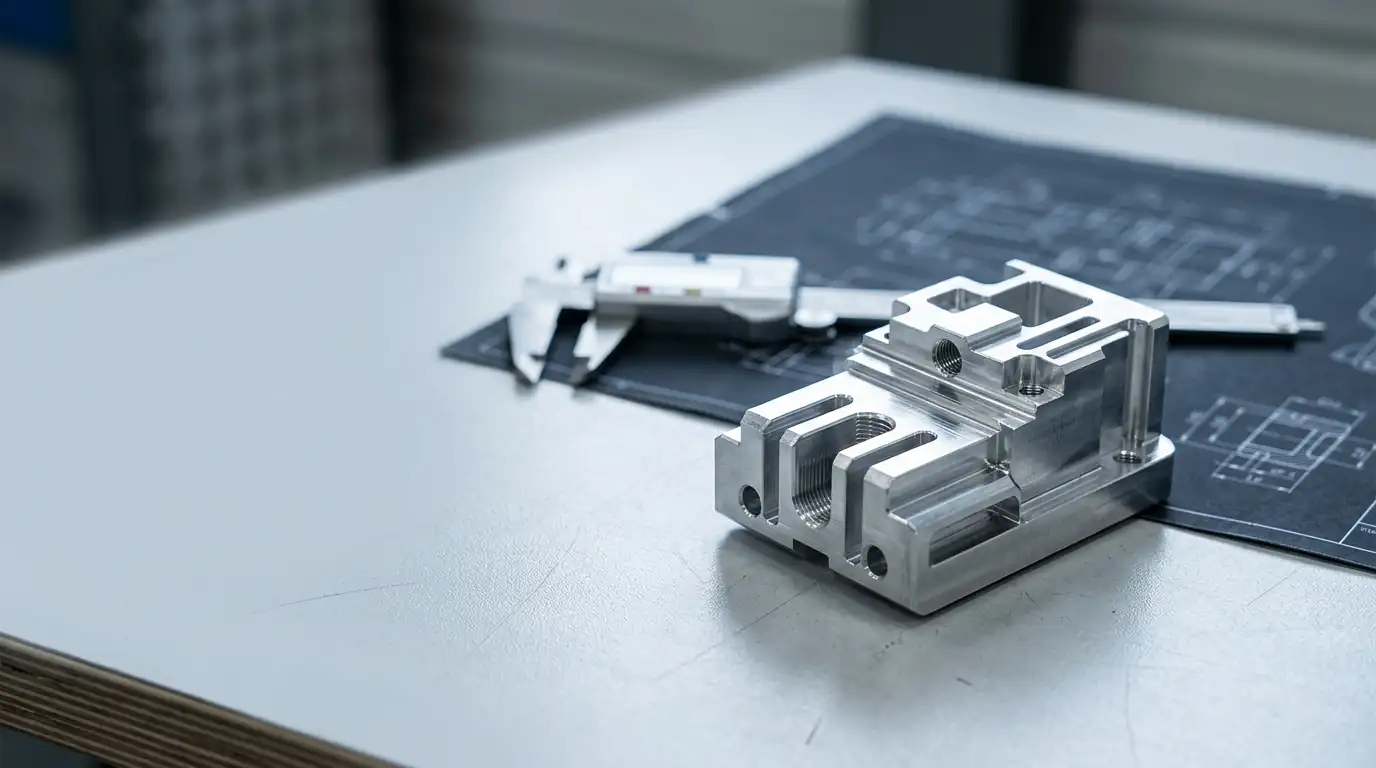
Precision CNC part with blueprint overlay
DFM Complete Guide — Section 02 What & Why

What is DFM (Design for Manufacturability)?

DFM is the practice of shaping a part’s geometry, tolerances, and callouts so it can be produced reliably with standard tooling and stable machining setups. For CNC machining, DFM focuses on tool access, stiffness, feature depth ratios, radii, wall thickness, and inspection strategy.

Why DFM matters before you release a drawing

Lower cost

Standard tools + fewer setups reduce cycle time, scrap, and special-process adders.

Shorter lead time

Cleaner machinability means fewer ECO loops, less back-and-forth, and faster first articles.

Less risk

DFM surfaces hidden failure modes early: chatter, distortion, burr traps, weak walls, and hard-to-inspect features.
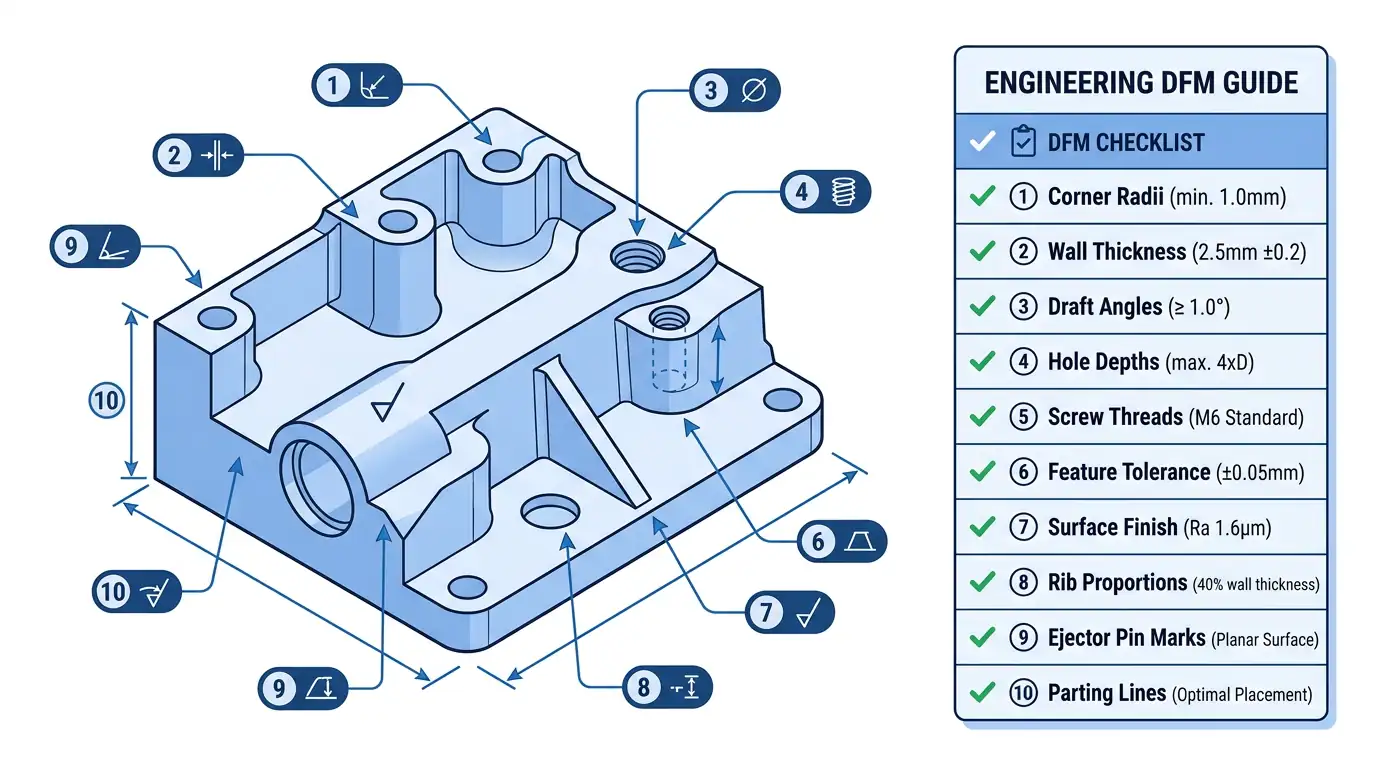
DFM review checklist diagram

Tip: Treat DFM as a design input, not a late-stage “manufacturing comment.”

DFM Complete Guide — Section 03 DFM Review Workflow

DFM review workflow (how a CNC shop evaluates your model)

This is the typical path from “CAD received” to “quote you can trust.” A good DFM review doesn’t just flag problems—it proposes changes that preserve function while improving manufacturability.

1) Setup & datum strategy

Identify stable datums, clamping faces, and how many setups are required to reach all features.

2) Tool access

Check cavities, pockets, deep features, and undercuts for standard tool reach and collision clearance.

3) Feature ratios

Review hole depth-to-diameter, pocket depth-to-width, thin walls, and narrow slots that drive chatter and deflection.

4) Tolerance & finish

Separate functional tolerances from “nice-to-have” callouts; align finish with process capability and inspection plan.

5) Material & heat treat

Confirm stock form, machinability, distortion risk, and whether heat treat should occur before or after machining.

6) Secondary ops

Deburr, anodize, passivate, bead blast, laser marking—each can add handling and tolerance implications.

7) Inspection plan

Define how critical dimensions will be measured (CMM, pins, optical), and adjust geometry for inspectability.

DFM Complete Guide — Section 04 CNC DFM Rules

CNC DFM rules-of-thumb (fast checks that prevent expensive surprises)

These guidelines help you decide what to loosen, round, or re-architect before RFQ. Exact limits depend on material, machine rigidity, part size, and inspection requirements—but these are solid starting points for manufacturable CNC part design.

Design feature Rule-of-thumb DFM improvement Reference
Wall thicknessMetals: recommend ≥ 0.8 mm; feasible down to ~0.5 mm depending on geometry and setup.Increase thickness, add ribs, shorten unsupported spans; consider machining from thicker stock.Hubs CNC design guidelines
Pocket depthKeep cavity depth roughly ≤ 4× cavity width when possible; deep pockets require long tools and increase chatter.Open the pocket, add tool relief, split into two features, or redesign as two parts.Hubs
Internal corner radiiPrefer radii that allow standard end mills; a practical guideline is corner radius ≥ ⅓ of cavity depth.Increase fillet radius or add dogbone relief if the mating part needs a sharp corner.Hubs
Hole depth (drilled)Recommended ~4× diameter; typical up to ~10× diameter. Holes deeper than ~6× diameter are often considered challenging.Increase diameter, reduce depth, drill from both sides, or change to a counterbore + through hole.Hubs + Protolabs
ThreadsThread length recommendation ~3× nominal diameter; ~1.5× is often a minimum for strength. Add unthreaded relief at blind-hole bottoms.Use standard thread sizes (e.g., M6+ when possible), avoid tiny threads in hard materials.Hubs
TolerancesTypical CNC tolerance is often around ±0.1 mm; tighter (e.g., ±0.02 mm) can be feasible but drives process and inspection cost.Apply tight tolerance only where function needs it; use GD&T to control form/position efficiently.Hubs
Text / markingEngraving requires sufficient stroke width and depth; sans-serif fonts and larger sizes improve machinability.Use laser marking or increase text size/line width; avoid tiny engraved text on hard metals.Protolabs

References used for general rules-of-thumb: Hubs (“How to design parts for CNC machining”) and Protolabs (“Design for Machining Toolkit”). Always confirm with your chosen manufacturer for your specific material and geometry.

DFM Complete Guide — Section 05 Cost Drivers

Why DFM reduces CNC machining cost (and when it matters most)

CNC cost is mostly a function of time and risk: spindle time, setup time, tool wear, and the probability of scrap or rework. DFM doesn’t mean “loose everything”—it means spending tolerance, complexity, and finishing only where the part’s function actually needs it.

Setup count

More orientations = more fixturing, touch-offs, and opportunity for stack-up errors.

Long-reach tooling

Deep pockets and tiny radii demand slender tools that chatter, slow down, and break.

Inspection burden

Tight tolerances often require more measurement time, more fixtures, and more documentation.

Surface finish

Fine finishes can add extra finishing passes and slower feeds.

Material machinability

Hard or gummy materials increase tool wear and slow cutting parameters.

Secondary ops

Anodize, passivation, deburr standards, marking, and cleaning add handling time.

Cost driver curve diagram

Rule of thumb: small “tightness” increases can create large cost jumps once tooling and inspection change classes.

DFM Complete Guide — Section 06 DFM Checklist

DFM checklist for CNC parts (use this before RFQ)

Run these checks in order. If you can’t justify a tolerance or a feature, you’ve probably found a cost and lead-time opportunity.

Datums & alignment

Define primary/secondary datums and ensure they are machinable and measurable.

Tool access

Can every feature be reached without exotic tooling or extra setups?

Radii & relief

Increase internal radii; add relief where sharp corners are function-critical.

Depth ratios

Avoid deep pockets/holes and narrow slots that force long, slender tools.

Wall stiffness

Avoid thin unsupported walls; add ribs or thickness for stability.

Threads

Use standard thread sizes and provide runout/relief for blind holes.

Tolerances

Apply tight tolerances only where required; use GD&T when it reduces ambiguity.

Surface finish

Specify finish only where needed; confirm compatibility with anodize/bead blast.

Burr management

Identify edges that must be burr-free; add chamfers to reduce deburring cost.

Inspection

Make critical features accessible to probes and gauges; avoid hidden internal requirements.

Drawing clarity

Avoid over-constraining; include notes for edge break, finish, and critical features.

Material & treatments

Confirm stock form and whether heat treat/finish should happen pre/post machining.

DFM Complete Guide — Section 07 Production Impact

How DFM impacts production (beyond getting a lower quote)

DFM is a production control tool. It improves repeatability, reduces variation, and prevents “heroic machining” that works once but fails at scale.

Repeatability

When geometry is stable to machine, you get consistent parts across operators, shifts, and machines—critical for ongoing builds and spares.

Yield

DFM reduces scrap risk from chatter, distortion, thin-wall breakage, and tolerance stack-up—especially on first articles.

Supply chain resilience

Parts designed around standard tools and accessible features are easier to dual-source and less sensitive to a single shop’s special fixturing.

Quality documentation

Clean datum schemes and measurable features reduce ambiguity, inspection time, and nonconformance disputes.

Prototype stage

DFM prevents “works in CAD” parts that turn into multi-week iterations.

Pilot builds

DFM reduces variation and accelerates process tuning.

Production

DFM increases throughput and makes quoting & scheduling more predictable.

DFM Complete Guide — Section 08 Case Study

Case Study: Reworking a deep-pocket bracket for faster machining

A representative example showing how small geometry changes can remove long-reach tooling and tighten up quality predictability—without changing the part’s functional intent.
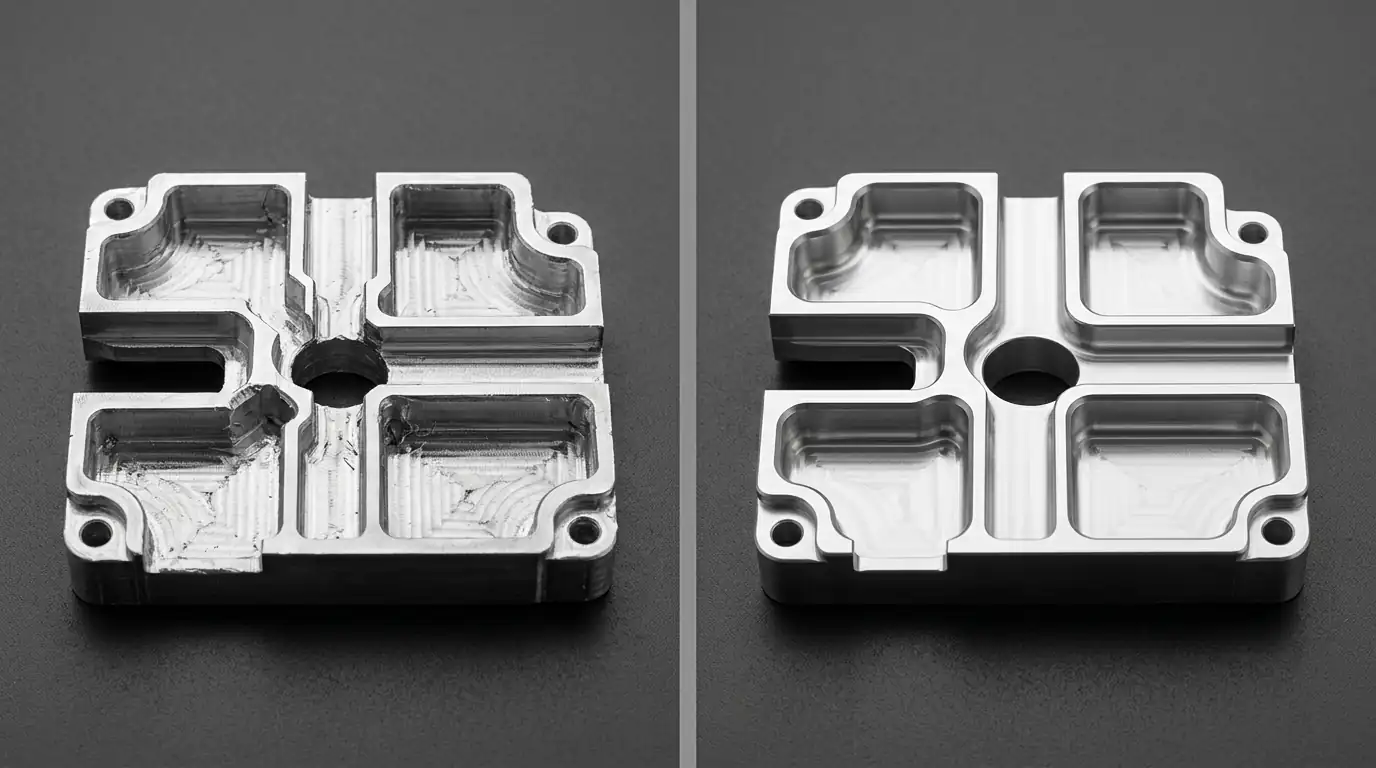
Before and after DFM comparison

Left: hard-to-machine geometry. Right: DFM-friendly geometry with larger radii and better tool access.

Problem

  • Deep pockets with sharp internal corners forced long-reach tooling and slow feeds.
  • Tight tolerances were applied broadly, increasing inspection time and rework risk.
  • Burr-prone edges and hidden corners made deburring inconsistent.

Solution

  • Increased internal radii and added tool relief where mating geometry required sharp corners.
  • Rebalanced tolerances: kept tight control only on functional interfaces and datums.
  • Added chamfers/edge-break notes and redesigned pocket depths to reduce slender tool use.

Result

  • Fewer setups and a more stable toolpath strategy.
  • Lower cycle time and reduced risk of chatter-driven scrap.
  • Clearer inspection plan for critical dimensions.

Impact

  • More predictable lead time and smoother ramp from prototype to production.
  • Easier to dual-source thanks to standard tooling and accessible geometry.

DFM Complete Guide — Section 09 FAQs

DFM for CNC machining — FAQs

Quick answers to common engineering and purchasing questions when you’re preparing a machinable design for RFQ and production.

What does a CNC DFM review include?
A CNC DFM review typically checks setup strategy and datums, tool access, feature depth ratios (holes/pockets/slots), internal radii, wall stiffness, tolerance/finish callouts, and an inspection plan. The output is usually a list of recommended design changes and any quote/lead-time implications.
When should I request DFM—before or after a drawing is released?
Earlier is better. Request DFM when the CAD is stable enough to represent function, but before you lock tolerances and release drawings. That timing prevents costly ECO loops and avoids building prototypes that can’t scale to production.
Do tighter tolerances always mean better quality?
Not necessarily. Tight tolerances can increase inspection burden, drive special tooling/processing, and sometimes reduce yield. The goal is to apply tight tolerances only to functional interfaces, while letting non-critical features use standard machining capability.
What are common CNC features that drive cost the most?
Deep pockets, sharp internal corners, thin walls, very small holes/threads, multi-setup geometries, and broad “tight everywhere” tolerancing are frequent drivers. These features often force long-reach tools, slow feeds, and more measurement time.
How deep can I drill a hole in CNC machining?
A common rule-of-thumb is to keep standard drilled holes around 4× diameter when possible; deeper holes may still be feasible but can require special drills, peck cycles, or drilling from both sides. The deeper the hole, the more it impacts time and straightness control.
How do internal corner radii affect machinability?
Internal corners are limited by cutter diameter. Small radii often force smaller tools, which increases cycle time and risk of chatter/deflection. Increasing internal radii (or adding relief features) usually lowers cost and improves repeatability.
Can DFM help with surface finish and anodizing?
Yes. DFM can identify areas where finish is function-critical versus cosmetic, recommend attainable Ra targets, and highlight geometry that traps media or creates uneven anodize appearance. It also helps plan edge breaks so parts deburr cleanly before finishing.
What should I send a machine shop for an accurate quote and DFM feedback?
Send a STEP file (or native CAD), a drawing with critical dimensions and GD&T (if used), material/spec, finish requirements, quantity, and notes on functional interfaces. If there are “must-not-change” areas, call them out so DFM suggestions stay within design intent.
DFM Complete Guide — Section 10 CTA

Ready for a DFM review?

If you’re quoting a CNC-machined part and want higher confidence on cost, lead time, and manufacturability, send your CAD + critical requirements. Batnon’s team can provide design-for-manufacturability (DFM) feedback, highlight CNC machining DFM guidelines that matter most, and propose changes that protect your functional intent.

What to send (for faster, better feedback)

STEP file, drawing (critical dims/GD&T), material/spec, finish, quantity, and any “must-not-change” areas.