



Why Steel for CNC Machined Components
Steel is the default when you need high strength at competitive cost, reliable threads and bearing fits, and a broad range of heat-treat and finishing options. For brackets, shafts, manifolds, fixtures, and machine components, steel CNC machining services can deliver excellent mechanical performance—if the grade, condition, and tolerance strategy are chosen with intent. This page is written for engineers and buyers comparing alloy steel CNC machining options such as 4140 machining, 1045 machining, and 4340 machining, plus practical guidance for steel CNC milling and steel CNC turning.
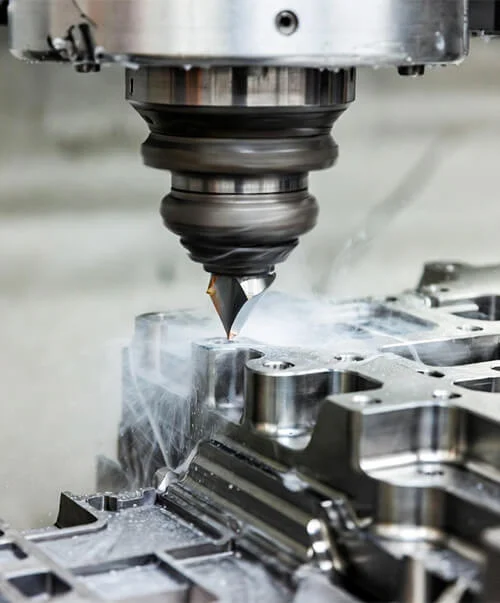
Strength-to-Cost Advantage
steel CNC machining is a go-to choice for high-volume screw machining and tight-tolerance turned parts. Industry references list 104500 with a machinability rating of 100 (the benchmark for copper alloys), which helps reduce cycle time and improve consistency.
Heat Treat + Wear Options
Steel is chosen when you need higher yield strength, fatigue performance, and wear resistance—especially for shafts, fixture plates, brackets, and load-bearing machine components. The right grade/condition is what keeps performance high without inflating cost.
Tolerance Strategy = Cost Strategy
Steel supports a broad finishing toolkit: as-machined Ra targets, bead blasting, black oxide, zinc plating, phosphate, and (when required) heat treat + grinding on critical journals. Planning finish build-up and heat treat early prevents tolerance surprises.
Steel at a Glance (Useful Numbers)
Reference values help early selection and quoting. Exact properties vary by supplier and heat treatment; confirm with material certifications when required.
- 1045 carbon steel: machinability rating ~65% in annealed condition (Xometry resource on 1045).
- 4140: commonly used in a prehard condition around 28–34 HRC to avoid post-machining heat treat distortion (industry practice; see alloy steel guidance and machining guides).
- 4340: chosen when you need higher strength/fatigue and deeper through-hardenability than 4140 (alloy steel guidance).
- Typical CNC baseline tolerances: ISO 2768 for metals; e.g., ISO 2768-f for many metal parts (Protolabs Network ISO-based tolerances guide).
- Typical as-machined surface finish: around Ra 3.2 µm unless specified (Protolabs Network ISO-based finishes guide).
Citations: Protolabs Network CNC machining ISO-based tolerances & finishes; Xometry 1045 carbon steel material resource; Associated Steel 4140 machining guide.
Steel Grades We Machine
In custom steel CNC machined parts, grade and condition determine strength, machinability, heat-treat response, and distortion risk. Start with the real requirement—load, fatigue, wear, environment, and tolerance stack—then we map the right steel (1045/4140/4340/1215) and process route so you get consistent dimensions at competitive cost.
| Best For | Cost / Availability | Machining Notes | Typical Parts |
|---|---|---|---|
| General-purpose mechanical parts | Great value; widely available | Good machinability in annealed/normalized conditions; responds to induction hardening for wear surfaces | Shafts, pins, brackets, plates, fixtures |
| Best For | Strength | Machining Notes | Typical Parts |
|---|---|---|---|
| Higher-strength components with toughness | Strong, durable; good heat-treat response | Often bought as prehard (~28–34 HRC) to reduce post-HT distortion risk; plan finish allowance if heat treated | Fixtures, gears, shafts, manifolds, structural brackets |
| Best For | Fatigue / Hardenability | Machining Notes | Typical Parts |
|---|---|---|---|
| High-load parts needing deep hardenability | Higher strength potential than 4140 | Lower machinability; typically rough machine then heat treat, then finish machine or grind critical journals/bores | Drive shafts, high-strength bolts, spindles, heavy-duty brackets |
| Best For | Machinability | Machining Notes | Typical Parts |
|---|---|---|---|
| High-volume turned parts without heat treat | Very fast cycle time | Excellent chip breaking and surface finish; choose when strength/HT is not the driver | Bushings, spacers, fasteners, simple fittings |
Alloy Selection Snapshot
Pick the steel grade by the real constraint: general strength and value (1045), higher strength/toughness (4140), deep hardenability and fatigue performance (4340), or ultra-fast turning when heat treat is not required (1215).
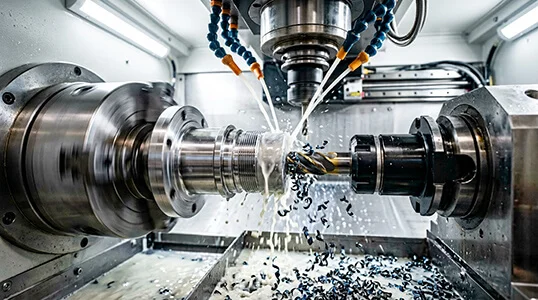
Machinability = Cost Control
Good chip control and stable tool engagement reduce tool wear and improve surface finish—especially on alloy steels. That’s a key lever for keeping alloy steel CNC machining cost-competitive at scale.
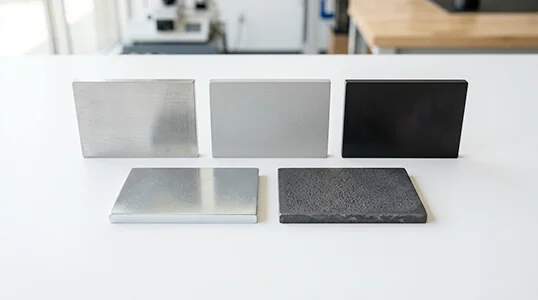
Finish Options
From as-machined to bead blast, black oxide, zinc plating, and phosphate—choose the finish that matches corrosion and appearance needs, and plan any dimensional build-up on tight fits.
1045 vs 4140 vs 4340 (Quick Rule)
If your priority is cost-effective general strength, start with 1045. If you need higher strength and good toughness with a predictable process route, 4140 is the workhorse—often specified in a prehard condition to reduce heat-treat distortion risk. If your design is high-load or fatigue-driven and needs deeper hardenability, consider 4340 and plan the machining sequence around heat treat and finishing.
- 1045: general shafts, plates, brackets; great value
- 4140: higher strength; fixtures, gears, manifolds; prehard option
- 4340: high-load/fatigue; deep hardenability; rough-HT-finish workflow
- 1215: high-volume turned parts where strength/HT is not the driver
Our Capabilities for Steel CNC Machining
We support steel CNC milling and steel CNC turning for prototypes and production. Our process planning focuses on stable datums, predictable fits, and heat-treat-aware stock allowance—so you receive precision steel components that assemble cleanly and stay cost-competitive.
High-Volume Turning
Perfect for high-volume turned steel parts like bushings, spacers, pins, and shafts—optimized for short cycle time, stable diameters, and consistent threads.
3/4/5-Axis Milling
Manifolds, blocks, and multi-face datums—clean edges and controlled surface finish for sealing and assembly interfaces.
Secondary Ops
Deburr/edge break, polishing, nickel plating coordination, clear coat (anti-tarnish), and assemblies—built around your functional surfaces.
DFM Guide: Heat Treat, Tolerances, and Cost in Steel
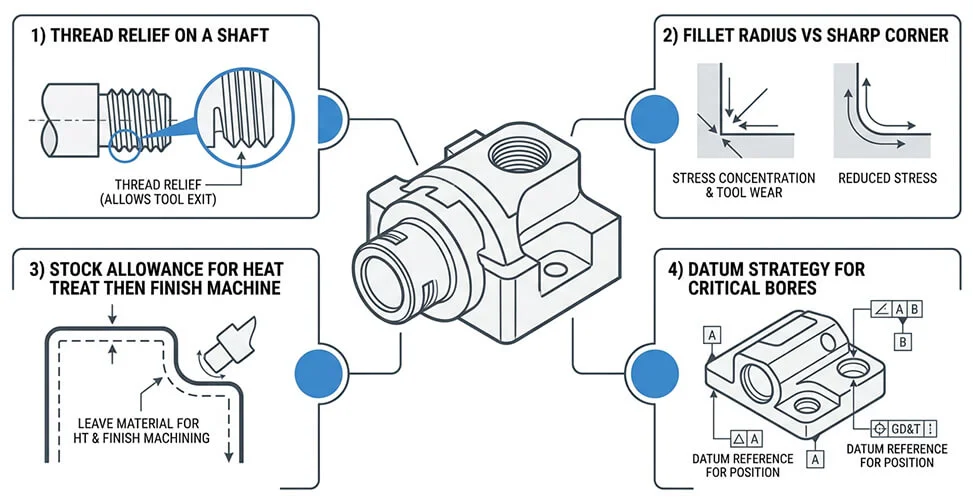
Steel rewards heat-treat-aware DFM. The highest ROI comes from choosing the right condition (annealed vs prehard vs Q&T), leaving finish stock for post-heat-treat critical surfaces, and applying tight tolerances only to CTQ fits. This is how you keep steel CNC machining cost-competitive.
| Design Item | Recommendation | Why It Matters |
|---|---|---|
| Threads + thread relief | Add thread relief where possible; standardize thread series; avoid overly deep blind taps | Reduces tap risk, improves thread quality, and stabilizes cycle time. |
| Sealing faces / O-ring grooves | Call out the sealing face and groove dimensions as critical; protect them from over-deburr | Sealing performance is usually the real functional risk; measure and protect those surfaces. |
| Burr control | Specify “break sharp edges” vs controlled chamfer; avoid micro-features that require handwork | Over-deburr can damage threads and sealing edges; clear requirements reduce variability. |
| Thin walls near threads | Keep adequate wall thickness around tapped ports; add ribs if needed | Prevents cracking or deformation during assembly torque. |
| Plating-aware design | If nickel plating is required, identify functional fits and mask/allowance as needed | Plating adds thickness; planning prevents fit issues and rework. |
Cost Lever 1: Standardize Threads
Standard threads and tool sizes reduce tool changes and scrap risk—key for high-volume steel CNC turned parts.
Cost Lever 2: Control Burr at the Source
Geometry choices that avoid fragile edges cut handwork. Clear edge-break callouts prevent over-deburr on sealing faces.
Cost Lever 3: Finish Only What Matters
Polish/plating can dominate cost. Define cosmetic faces vs functional faces so you don’t pay for unnecessary finishing.
Surface Finishes for Steel CNC Parts
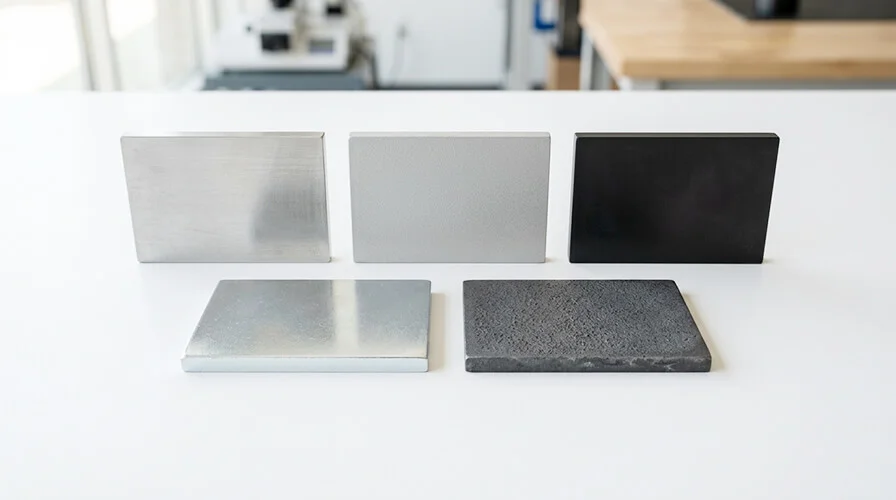
Steel finishes affect corrosion protection, friction, and paint/coating adhesion. Choose a finish that matches the real requirement—conductivity, cosmetics, cleaning, or corrosion exposure—then design around any dimensional impact from plating/coatings.
| Finish | What It Does | Best For | Notes |
|---|---|---|---|
| As-machined (Ra target) | Controlled toolpath texture | Functional parts, internal features, crisp threads | Great default for cost; define cosmetic faces if you need polish. |
| Bead blasted (matte) | Uniform low-glare texture | Decorative hardware, visible housings | Can soften sharp edges slightly; plan around sealing edges. |
| Polished | Mirror-like reflective surface | Visible steel hardware and enclosures | Higher cost; specify which faces require polish to keep pricing competitive. |
| Zinc plated | Bright corrosion-resistant plated layer | Wear + cosmetics, tarnish control, premium appearance | Plating adds thickness; mask/allowance on tight fits and threads. |
| Phosphate / parkerizing | Slows tarnish while preserving steel color | Decorative parts and hardware | Best for cosmetics; confirm temperature/chemical exposure compatibility. |
Quality Documents for Steel Parts
For steel components used in machinery, automation, and critical assemblies, documentation is part of performance. We can align inspection and material evidence to your drawing and supplier quality plan.
Material Traceability
Alloy confirmation and material certifications when required (e.g., specifying C360/C260/C464 or lead-free requirements).
Inspection Evidence
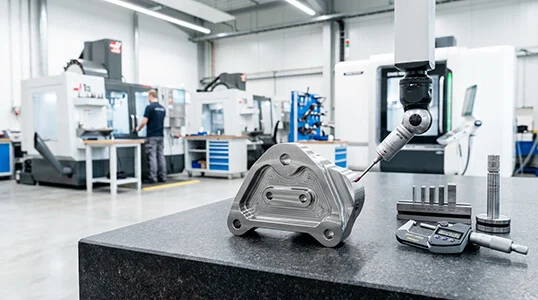
FAI packages, dimensional reports, and CMM/fixture-based measurement tied to critical datums and threads/sealing faces.
Finish Certifications
Plating/coating documentation from approved processors when requested (e.g., nickel plating) with lot tracking.
Case Study: Steel Program for Shafts + Manifolds + Fixtures
A customer needed a family of CNC machined steel parts spanning a hydraulic manifold, a precision shaft with bearing seats, and fixture plates for assembly. The key was aligning alloy and finish to function—then controlling cost with thread standardization, burr control, and plating-aware tolerancing.
| Program Goal | Constraint | Batnon Approach | Outcome |
|---|---|---|---|
| Best part performance at competitive pricing | Tight threads + sealing faces + cosmetic requirements | Alloy-by-function mapping, thread standardization, burr control plan, plating-aware tolerances, risk-based inspection | Stable assembly torque, consistent cosmetics, predictable lead time and cost |
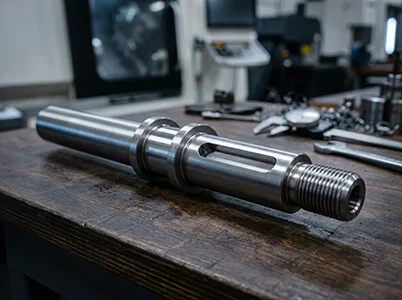
Steel Part (Feature-Rich)
Port position, thread quality, and sealing faces were controlled with a datum-first process plan and risk-based inspection.
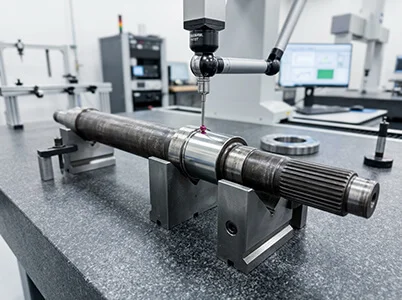
CMM Measurement
Heat-treat-aware stock allowance and a post-process grind strategy protected runout and fit on critical journals.
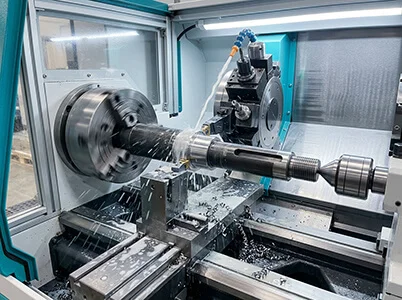
Production Lathe Run
Datum strategy and stable clamping reduced distortion and kept hole patterns repeatable across lots.
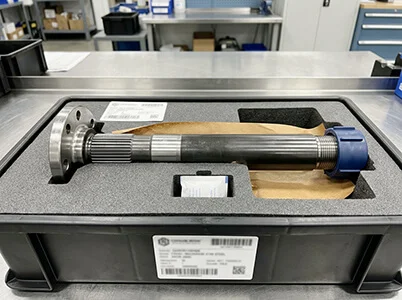
Finished + Packaged Delivery
Finish build-up was planned around threads and fits to maintain tight tolerance performance.
What Made It Work (Transferable Lessons)
Steel is one of the best materials for cost-effective precision machining—when the grade/condition and process route are chosen with intent. Competitive pricing came from engineering choices: using C360 where allowed, applying tight tolerances only to threads/sealing faces, and treating plating as a dimensional feature (not an afterthought).
- Thread standardization: fewer tools, faster cycle time, lower scrap risk
- Burr control plan: protects sealing faces and assembly torque consistency
- Plating-aware tolerances: prevents fit problems after nickel plating
- Risk-based inspection: measure the features that gate leaks, torque, and conductivity
FAQ: Steel CNC Machining
Common questions about steel grade selection (1045 vs 4140 vs 4340), heat treatment, tolerances, finishes, and cost control.
What steel grade is best for CNC machining—1045, 4140, or 4340?
Choose by the real driver: 1045 for cost-effective general mechanical parts, 4140 for higher strength with good toughness and heat-treat response, and 4340 for high-load components needing deeper hardenability and fatigue performance. If post-machining heat treat is required, plan the machining sequence for distortion control.
Do you offer alloy steel CNC machining for 4140 and 4340?
Yes. We machine common alloy steels including 4140 and 4340 for shafts, gears, fixtures, brackets, and manifolds. Share your required condition (annealed, prehard, quenched and tempered) and any hardness targets.
How do you manage distortion risk for heat treated steel parts?
A common best-practice route is rough machining, stress relief or heat treat as required, then finish machining or grinding on fit-critical features. Avoid abrupt section changes, define datums/CTQs, and leave finish stock so final dimensions can be brought back into spec.
Will black oxide or zinc plating change dimensions on tight-tolerance steel parts?
Zinc plating adds measurable thickness; black oxide is typically thinner. For tight fits, threads, and sealing faces, plan masking or allowances and call out which surfaces are functional so dimensions remain in spec after finishing.
What finishes are common for CNC machined steel parts?
Common options include as-machined (Ra callout), bead blast, black oxide, zinc plating, phosphate (parkerizing), and paint/powder coat prep. The right choice depends on corrosion exposure, appearance, and whether the finish affects fits.
What steel parts are a good fit for CNC milling and turning?
Shafts, manifolds, brackets, fixture plates, valve bodies, machine components, and load-bearing frames are strong fits—especially when you need controlled tolerances, repeatable datums, and robust threads.
How do you keep steel CNC machining cost-competitive?
We keep costs down by selecting a machinable condition (often prehard 4140), standardizing tooling and datums, applying tight tolerances only to CTQ fits, and planning heat treat/finish early to prevent rework. That’s how we keep a steel parts machining quote accurate and competitive.
Steel CNC Machining (Global Supply, Local Expectations)
Batnon supports steel CNC machining services for engineering teams across North America, Europe, and Asia—shipping prototypes and production parts worldwide. If you’re searching for steel CNC machining, alloy steel CNC machining, 4140 CNC machining service, 1045 steel machining service, 4340 CNC machining service, steel CNC milling service, steel CNC turning service, or a fast steel parts machining quote, our quoting workflow is designed for engineering alignment: grade/condition selection, finish planning, tolerance review (ISO 2768 vs CTQs), and QA documentation.
- Typical applications: shafts, brackets, manifolds, fixture plates, machine components, load-bearing frames
- Industries served: industrial automation, energy, automotive, aerospace supply chain, robotics, semiconductor equipment
- Common alloys: 1045, 4140, 4340, 1215; specify condition (annealed/normalized/prehard/Q&T)
- Finish options: as-machined Ra targets, bead blast, black oxide, zinc plating, phosphate; heat treat + grinding for critical journals
- Engineering handoff: DFM for cycle time, thread/sealing strategy, plating-aware tolerances, inspection plan, material/finish documentation
Tip for fast quoting: include target grade + condition/hardness, critical datums & tolerances, surface finish (Ra) requirements, and any post-process (heat treat / black oxide / plating) so we can plan stock allowance and inspection.