
Materials • Stainless Steel •304 • 316 • 303 • 17-4 PH • Passivation (ASTM A967)
Stainless Steel CNC Machining Services
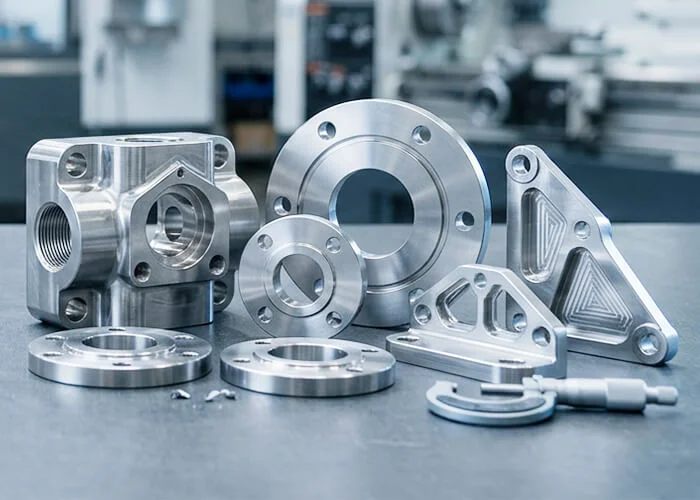
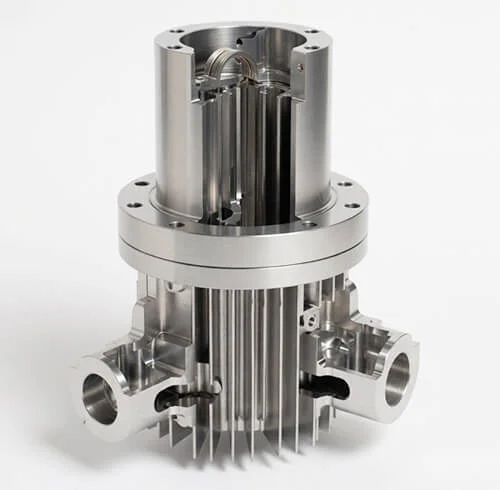
Precision CNC milling and turning of stainless steel parts for corrosion resistance, strength, and cleanability. Built for prototypes and production: manifolds, brackets, valve bodies, sensor housings, fixture plates, and alignment-critical frames.
STEP / IGES / SLDPRT / PDF accepted
- ±0.00019" tol. • Titanium • Magnesium • 5-axis CNC • ISO 9001

ISO 9001

Material traceability

CMM reporting

Revision Control
Why Stainless Steel for CNC Machined Components
Stainless steels (austenitic and precipitation-hardening families) are chosen when parts must resist corrosion, hold strength at temperature, and maintain surface integrity after cleaning. Typical drivers include chloride exposure, washdown chemicals, galvanic interfaces, and long service life in harsh environments.
Corrosion Resistance
Grades like 304 and 316 form a chromium-rich passive oxide film; 316 adds molybdenum for improved pitting resistance in chloride environments.
Strength + Toughnes
17-4 PH (AISI 630) supports high strength after precipitation hardening (e.g., H900/H1025) while remaining more corrosion-resistant than many alloy steels.
Cleanability
Surface finish control (Ra targets), passivation (ASTM A967), and electropolishing can support hygienic designs and reduce contamination risk.
Stainless Steel Grades We Machine
Select the grade family based on corrosion environment, machinability, weldability, and strength requirements. Austenitic grades (304/316) can work-harden; free-machining 303 improves chip control; 17-4 PH adds heat-treatable strength.
| Best For | Strength / Form | Machining Notes | Typical Parts |
|---|---|---|---|
| General-purpose corrosion resistance in mild environments | Austenitic stainless (non-magnetic in annealed condition) | Prone to work hardening; avoid rubbing, keep chip load, sharp tooling, stable fixturing | Brackets, housings, fixtures, manifolds for non-chloride exposure |
| Best For | Corrosion Environment | Machining Notes | Typical Parts |
|---|---|---|---|
| Chloride exposure, marine service, aggressive cleaning chemicals | Improved pitting resistance due to molybdenum (Mo) | Similar work-hardening behavior as 304; plan toolpaths to reduce dwell and heat | Valve bodies, pump components, marine brackets, chemical equipment parts |
| Best For | Tradeoffs | Machining Notes | Typical Parts |
|---|---|---|---|
| Cycle-time reduction and improved chip control | May be less ideal for welding and some corrosion-critical applications | Excellent machinability vs 304/316; good for turning and complex milled features | Shafts, fittings, threaded components, high-mix turned parts |
| Best For | Heat Treat | Machining Notes | Typical Parts |
|---|---|---|---|
| High strength with good corrosion resistance | Precipitation hardening conditions (e.g., H900, H1025) to tune strength vs toughness | Common route: rough machine → heat treat → finish machine critical datums to manage distortion | Structural brackets, load-bearing frames, shafts, actuator components |
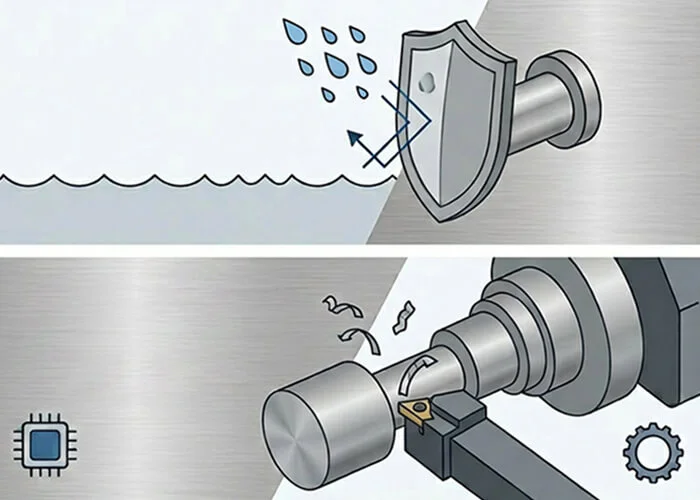
Grade Selection Snapshot
Use environment + strength + machinability to choose between austenitic, free-machining, and precipitation-hardening stainless steels.
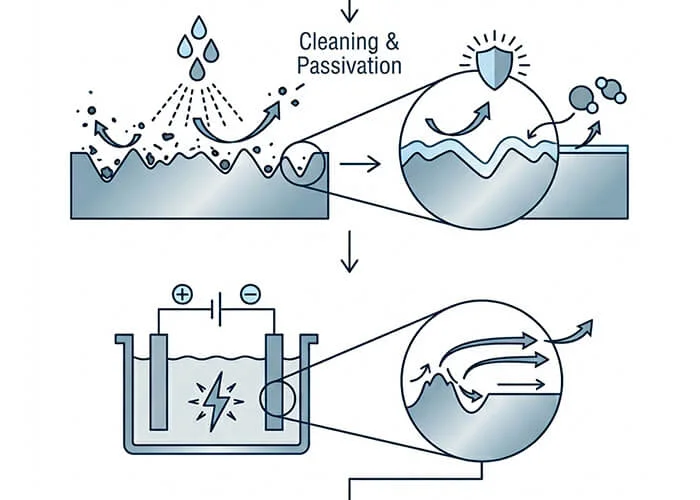
Passivation & Electropolishing
Post-processing options that help with corrosion performance and cleanability for stainless steel CNC machined parts.
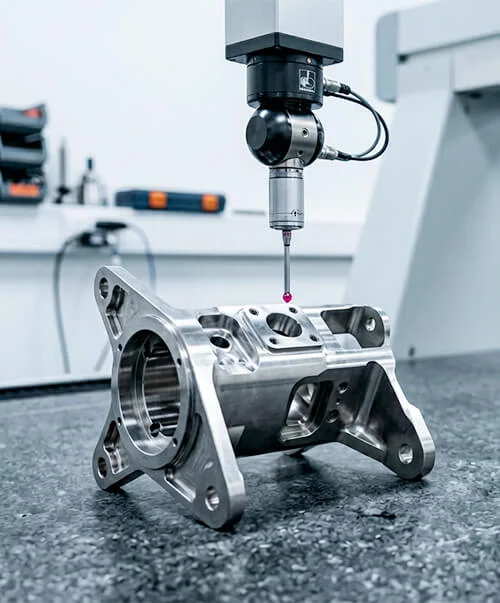
Precision Verification
Dimensional inspection strategy aligned to GD&T, datums, and measurement uncertainty.
304 vs 316 (Quick Rule)
If your stainless component sees chlorides (salt, seawater, sweat, de-icing chemicals) or strong washdown chemistry, default to 316/316L. Otherwise, 304/304L is often the cost-effective standard.
304: general-purpose brackets, housings, fixtures
316: marine/chemical environments, clean-in-place and harsh cleaners
303: choose when machinability dominates and welding/corrosion constraints allow
17-4 PH: choose when strength is the gating requirement
Our Capabilities for Stainless Steel CNC Machining
We machine stainless steel parts across prototypes and production, with process planning focused on work-hardening control, stable fixturing, and predictable surface integrity.
3/4/5-Axis Milling
Prismatic parts, pockets, manifolds, and precision datums with controlled tool engagement to reduce heat and edge wear.
Turning / Swiss Turning
Shafts, fittings, threaded parts, and concentric features. Chip control strategies for stainless chip stringing.
Secondary Ops
Deburr, bead blast, brush/polish, passivation (ASTM A967), electropolish coordination, and assemblies.
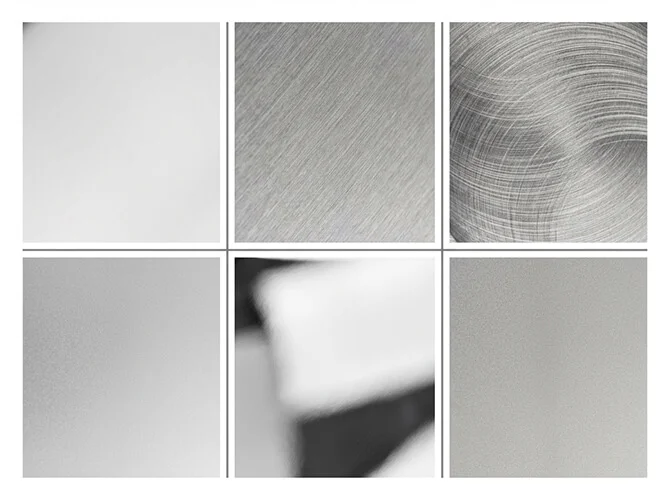
Surface finish options for stainless steel CNC parts: as-machined, bead blasted, brushed, polished, electropolished, and passivated surfaces.
DFM Guide: Machining Stainless Without Work Hardening
Austenitic stainless steels can harden rapidly when tools rub instead of cut. Design choices and machining strategy can reduce tool wear, stabilize tolerances, and improve surface finish.
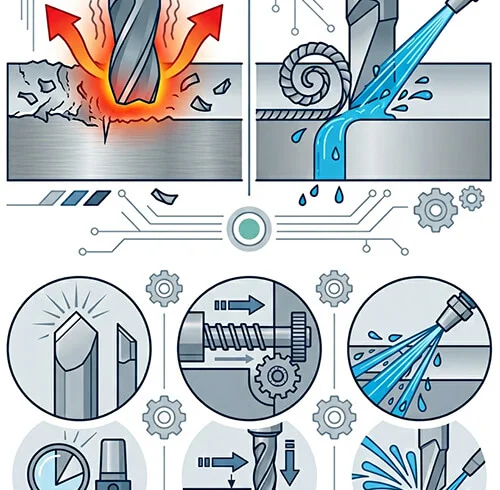
Keep Chip Load Positive
Avoid light skimming passes that rub and heat the surface. Use sharp tools, proper engagement, and consistent feeds.
Control Thermal Drift
Plan sequences to manage heat input, stabilize datums, and hold tight tolerances on bores and sealing surfaces.
Deburr & Edge Break
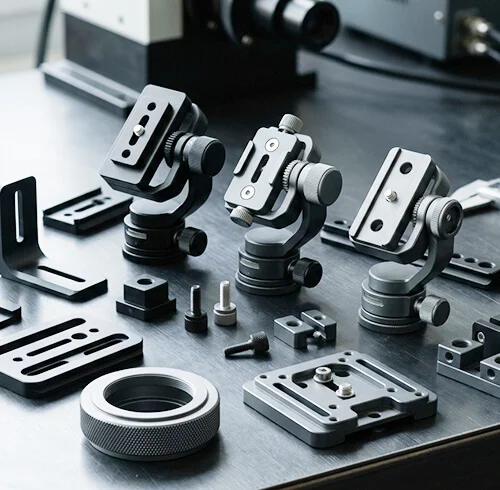
Stage carriages, housings, adapter plates, and vibration‑damped bases. Tight tolerance CNC machining services for bearing fits and alignment surfaces.
| Design Item | Recommendation | Why It Matters in Stainless |
| Minimum internal corner radius | Prefer radii ≥ tool radius; avoid sharp internal corners | Reduces tool load spikes, heat, and chatter; improves surface integrity |
| Thin walls | Increase wall thickness where possible; add ribs; choose stable datum faces | Stainless cutting forces are higher than aluminum; thin walls can deflect and spring back |
| Deep pockets | Limit depth-to-width ratio; add access for shorter tooling | Long tools amplify vibration, heat, and work hardening risk |
| Threads | Provide generous lead-in chamfers; specify thread class and gaging | Stainless can gall; proper chamfers and surface finish help assembly reliability |
| Sealing surfaces | Specify Ra target and datum scheme; consider lapping/polish if needed | Surface finish directly impacts leak rate and cleanability |
DFM Tips for Stainless Steel CNC Machining
For precipitation-hardening stainless, the manufacturing route often determines whether you hit tolerance. A typical strategy is to rough machine, heat treat to the required condition (H900/H1025), then finish machine critical datums to correct distortion.
Work Hardening Prevention
How to prevent work hardening when machining stainless – use sharp carbide tools, maintain constant feed, avoid dwelling, and apply adequate coolant. We employ high‑pressure through‑spindle coolant and optimized toolpaths.
Work Hardening Prevention
How to prevent work hardening when machining stainless – use sharp carbide tools, maintain constant feed, avoid dwelling, and apply adequate coolant. We employ high‑pressure through‑spindle coolant and optimized toolpaths.
Tolerance & Thermal Growth
Stainless steel tolerance challenges thermal growth – stainless expands more than aluminum. We plan cuts in temperature‑controlled environments and use finishing passes after material stabilizes.
Surface Finish Quality
Stainless steel surface finish options Ra from 0.4μm (mirror) to 3.2μm (as‑machined). Specify functional or cosmetic requirements – we deliver consistent Ra per your print.
Stainless Steel Finishes & Post‑Processing
Passivation ASTM A967 stainless steel, electropolishing vs passivation stainless steel, stainless steel surface finish options Ra, bead blasting vs polishing.
| Finish | What It Does | Best For | Notes |
| As-machined (Ra target) | Maintains toolpath texture; controlled roughness | Functional components, internal features | Best for tight tolerances; minimal dimensional change |
| Bead blasted | Uniform matte appearance | Cosmetic housings, glare reduction | Can slightly soften sharp edges |
| Brushed / polished | Directional or mirror-like cosmetics | Visible parts, consumer-facing stainless | Mask critical datums if tight tolerance is required |
| Passivation (ASTM A967) | Removes free iron; improves corrosion behavior | General corrosion assurance | Specify method and verification per your spec |
| Electropolishing | Smooths micro-peaks; can improve cleanability | Hygienic designs, reduced particle retention | May affect dimensions—plan allowances |
Heat Treatment & Process Planning (17-4 PH)
For precipitation-hardening stainless, the manufacturing route often determines whether you hit tolerance. A typical strategy is to rough machine, heat treat to the required condition (H900/H1025), then finish machine critical datums to correct distortion.
Rough → Heat Treat → Finish
Leave stock on critical features for post-heat-treat finishing. This is common for precision bores, mating faces, and alignment datums.
Dimensional Stability
Choose the heat-treat condition based on strength needs and tolerance risk; tighter datums often benefit from conservative finishing allowances.
Documentation
When required, provide heat-treat certifications, lot traceability, and inspection data tied to your drawing revision.
Quality Documents for Stainless Steel Parts
Stainless components often require traceability and inspection evidence, especially for regulated industries and critical assemblies. We can align deliverables to your supplier quality requirements.
Material Traceability
MTR / mill certs, heat/lot tracking, and grade confirmation when required.
Inspection Evidence
FAI packages, dimensional reports, CMM inspection, and gage strategy tied to datums.
Process Certifications
Passivation (ASTM A967) documentation and external process certs as requested.
Quality Assurance & Traceability
Material Test Report (MTR)
Full traceability with certified MTRs per EN 10204 3.1. Batch‑level material certs for every order.
CMM & FAIR
Coordinate Measuring Machine (CMM) reports and First Article Inspection Reports (FAIR) available upon request.
Dimensional Inspection
Inspection plan aligned with CTQ features – flatness, true position, concentricity, and surface finish.
Clean Packaging
Oil‑free parts, ESD bags, and custom packaging to prevent surface damage during transit.
Industries We Serve with Stainless Steel CNC Machining
Medical & Life Sciences
Surgical instruments, orthopedic trial components, dental tools, sterilization‑ready parts.
Food & Beverage
Pump housings, valve bodies, conveyor parts, sanitary fittings.
Marine & Offshore
316 stainless components, propeller shafts, deck hardware, corrosion‑critical parts.
Industrial Automation
Sensor housings, pneumatic cylinders, guide rails, heavy‑duty brackets.
Complete CNC Machining Materials Guide
Explore our comprehensive range of materials. From lightweight aluminum to high-performance plastics, find the perfect material for your precision machining project. All materials are machined in‑house with tight tolerances, inspection reports, and full traceability.
Metals & Alloys
High strength · Excellent machinability · DurableEngineering & High‑Performance Plastics
Lightweight · Wear resistant · High temperature stabilityMaterial Selection Guide
Need help choosing the right material? Compare strength, cost, machinability, and finishing options for your application.
Browse All Materials →Surface Finishes & Post‑Processing
From anodizing to passivation, bead blasting to electropolishing – see which finish matches your performance requirements.
Explore Finishes →Precision CNC Capabilities
3‑axis, 4‑axis, 5‑axis milling, Swiss turning, tight tolerances down to ±0.005mm, CMM inspection, and fast lead times.
View CNC Services →RFQ Readiness Checklist
| • 3D Model – STEP (.stp), IGES (.igs), or SolidWorks (.sldprt) |
| • 2D Drawing (PDF) – Critical dimensions, tolerances, GD&T, surface finish |
| • Material Specification – Exact alloy (e.g., 6061-T6 vs 7075) |
| • Finish Requirements – Anodize (Type II/III), Bead Blast, As-Machined, etc. |
| • Special Processes – Heat treatment, plating, passivation, welding, or secondary operations |
| • Inspection Level – CoC, Standard Report, CMM, or FAI |
| • Quantity – Prototype (1–10) or production (100–10k+) |
| • Special Instructions – Edge breaks, thread class, cosmetic zones, packaging needs |
| • Target Lead Time – Standard or expedited (rush orders) |
| • DFM Feedback Request – Request for design optimization or cost reduction |
Please provide all core information when submitting your RFQ to receive an accurate, fast quote.
Case: Scrap Rate Reduced from 28% to 0.7%
Alex Rivera,
Product Design Lead, Apex Motion Controls
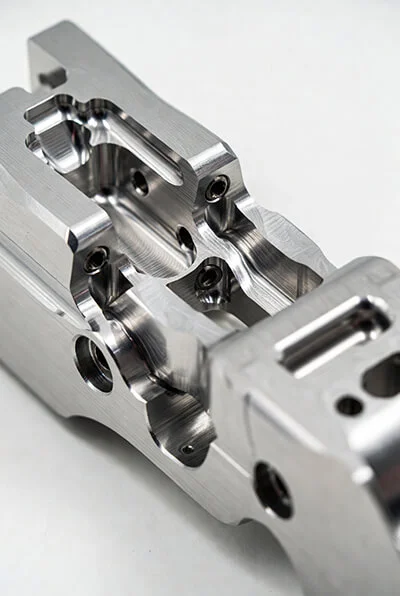
Challenge:
A medical device client struggled with high scrap rates on complex 316L stainless steel surgical instrument jaws. Issues included work hardening during machining, inconsistent surface finish after passivation, and difficulty holding tight true position tolerances on jaw pivots.
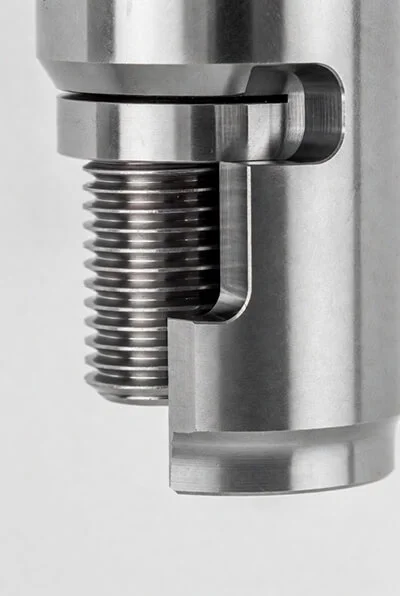
Our Solution:
We applied a dedicated DFM review focusing on toolpath strategy, optimized feeds & speeds, TiAlN-coated carbide tools, and custom soft-jaw fixturing. All parts received full passivation per ASTM A967 and light electropolishing for cleanability.
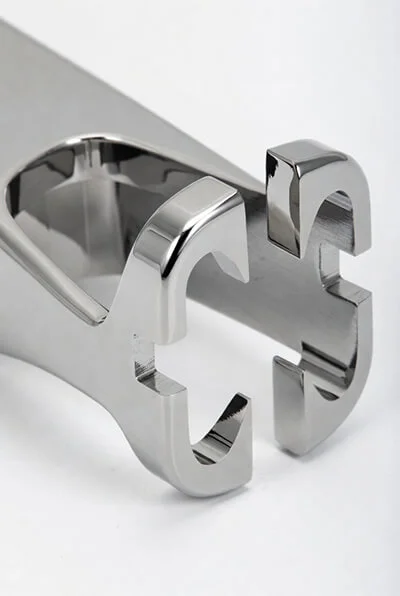
Results:
- Scrap rate reduced from 28% to 0.7%
- Achieved consistent Ra 0.2 µm surface finish
- True position tolerance held at ±0.008 mm
- Delivered 1,200 parts with full material traceability and inspection reports
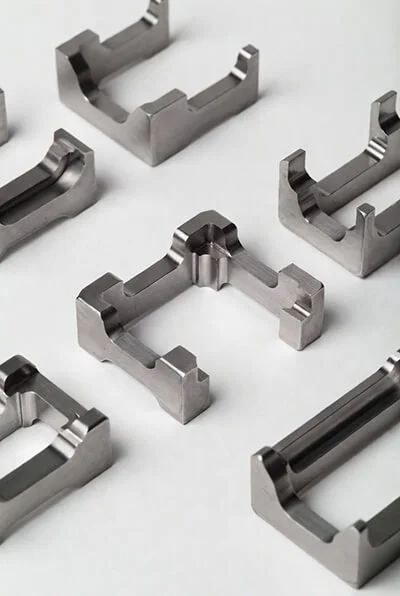
Impact:
Enabled the customer to meet their product launch deadline with zero field failures related to the jaws, while significantly improving production yield and cost efficiency.
Your CNC Machining Questions, Answered
No MOQ, ISO9001 certified, and precision down to ±0.005mm/0.00019in –
everything you need to know before your first quote.
Which stainless steel grade is best for CNC machining—304 or 316?
304 is the general-purpose default for many stainless components. Choose 316 when chloride exposure, marine service, or aggressive cleaning chemicals are expected, because molybdenum improves resistance to pitting corrosion.
Is 303 stainless easier to machine than 304/316?
Yes. 303 is designed for improved machinability and chip control. If weldability and corrosion requirements allow, 303 can reduce cycle time and tool wear compared with 304/316.
What is 17-4 PH stainless (AISI 630) used for?
17-4 PH is selected when you need high strength with good corrosion resistance—common for load-bearing brackets, shafts, and structural components.
What do H900 and H1025 mean for 17-4 PH?
They are heat-treatment conditions that tune properties. H900 typically targets higher strength/hardness; H1025 shifts the balance toward improved toughness and (often) better dimensional stability. Choose based on your load case and tolerance risk.
How do you prevent work hardening when machining stainless steel?
Prevent rubbing: keep a positive chip load, use sharp tooling, avoid dwell, reduce re-cutting, and manage heat via a suitable coolant strategy—especially for austenitic grades like 304 and 316.
Do you offer passivation per ASTM A967?
Yes. Passivation per ASTM A967 can be included to remove free iron and enhance corrosion performance. For cleanability and cosmetics, electropolishing may also be appropriate depending on your design.
Can you provide MTR/CoC and inspection reports?
Yes. We can provide material test reports (MTR/mill certs), certificates of conformance (CoC), and inspection data (FAI/CMM reports) as requested—aligned to your supplier quality plan.
What stainless parts are a good fit for CNC machining?
Manifolds, brackets, valve bodies, pump components, sensor housings, fixture plates, optical mounts, and corrosion-resistant interfaces are all good fits—especially when tight tolerances, GD&T, and controlled surface finish are required.
Turn Your Design Into Reality — Fast & Accurately
Upload your CAD. Get a fast online quote in 12h.
STEP / IGES / SLDPRT / PDF accepted
CNC parts for S.Steel
Batnon provides stainless steel CNC machining services for CNC machining stainless steel parts in 304 stainless steel machining, 316 stainless steel machining, 303 stainless steel machining and 17-4 PH stainless machining. Services include passivation ASTM A967 stainless steel, custom stainless steel prototypes, stainless steel milling services and stainless steel turning services with full traceability and material test report MTR.
- stainless steel CNC machining services • CNC machining stainless steel parts • 304 stainless steel machining • 316 stainless steel machining • 303 stainless steel machining • 17-4 PH stainless machining • passivation ASTM A967 stainless steel • custom stainless steel prototypes • stainless steel milling services • stainless steel turning services
- 304 vs 316 stainless steel machining differences • how to prevent work hardening when machining stainless • best cutting tools for stainless steel machining • stainless steel surface finish options Ra • electropolishing vs passivation stainless steel