Content Table List
- My controversial take from the CNC engineering side
- Look past the machine
- Datum strategy: where precision is born or dies
- Fixturing: the silent precision killer
- Material behavior: the part has opinions too
- Geometry: some features are precision bait
- Tool wear and cutting strategy
- Post-processing: precision does not end at the last toolpath
- So what really controls machining precision?
- Open question for engineers and buyers
I’m going to say the quiet part out loud — and yes, it may annoy a few people: most “precision problems” are not machine problems.
Not because machines do not matter. They do.
But the way we talk about precision online is often backwards. We act like buying a fancier 5-axis machine magically fixes bad parts. In real shops, the machine is often the least interesting variable because it is the most stable one.
What usually controls precision is the stuff that is harder to put on a brochure: datum thinking, fixturing discipline, material behavior, geometry choices, tool wear strategy, and what happens after you “finished” machining.
And if you are a CNC engineer, you already know the uncomfortable truth: precision is a process outcome, not a machine spec. That is also why precision CNC machining is a full-process discipline, not only a machine-capability claim.
My controversial take from the CNC engineering side
If you want better precision, do not start by asking:
“How accurate is your machine?”
Start by asking:
“How inaccurate is your process when nobody is watching?”
Because plenty of people run tight tolerances on average machines, and plenty of people scrap parts on top-tier machines.
Let’s talk about the real levers.
1) Look past the machine — seriously
Yes, machine geometry, thermal stability, control tuning, probing, and spindle condition matter.
But in day-to-day production, a capable machine gets dragged down by sloppy fundamentals. Or worse, it hides them.
A stable machine will happily repeat the same mistake all day with beautiful consistency.
2) Datum strategy: where precision is born or dies
This is the most common “it measured good but it doesn’t assemble” story.
If your machining datum does not match functional assembly reality, and your inspection datum does not match either, you can get perfect CMM reports and still ship junk.
For buyers, this is exactly the type of issue that should be clarified before quoting. A good CNC machining RFQ checklist should not only ask for STEP files and 2D drawings. It should also push you to mark CTQ features, datum logic, inspection needs, and assembly context.
Case: the “CMM-green, assembly-red” part
We once had a part that passed inspection clean. Looked great on the table.
Then assembly started fighting it. Bolts felt tight. Alignment features were not happy. Everything felt like it was being forced.
Root cause was not mystical machine error.
Root cause was datum logic. We were referencing a surface that was easy to clamp and measure, not the surface the part actually “lived on” in the assembly.
So the inspection said “good.” The product said “nope.”
Controversial line here: if your datum strategy is wrong, your tolerance is basically a lie.
3) Fixturing: the silent precision killer
Fixturing is where a lot of engineers accidentally machine a deformed part, then act surprised when it relaxes.
Clamp pressure, contact points, sequence, soft jaws, parallels, and support under thin sections are not just setup details. They are precision variables.
Case: the clamp-and-springback trap
Thin-wall part. Looked rigid enough in your hand.
We clamped it a little too confidently. During cutting it behaved. After unclamp, it moved.
So we tried compensation in CAM.
It got worse.
Because we were compensating for a deformation that was not consistent across batches. Temperature, material lot, clamp feel, operator mood — pick your poison.
The fix was not a new toolpath. The fix was support + clamp strategy and, this matters, agreeing on what “stable” means before metal gets cut.
4) Material behavior: the part has opinions too
Materials are not passive.
Aluminum, stainless steel, titanium, plastics — each one has its own way of punishing your assumptions.
- Heat moves things.
- Residual stress moves things.
- Cutting force moves things.
And here is the spicy version: two bars with the same grade stamp can still cut like different personalities.
So if you are chasing microns while ignoring stress relief, roughing strategy, and time between operations, you are gambling.
5) Geometry: some features are basically precision bait
Design choices can make precision easy or make it a daily fight.
Thin walls, deep pockets, long flats, interrupted cuts, and tiny corner radii invite:
- vibration
- deflection
- thermal distortion
- stress release
Sometimes the correct “precision solution” is not a better machine or a smarter toolpath.
Sometimes it is telling the designer:
“This geometry is expensive to hold stable. Do you want precision, or do you want this shape?”
Uncomfortable conversation, yes. But it saves scrap.
6) Tool wear + cutting strategy: boring stuff that decides your bore
The machine can be perfect and still cut the wrong size if:
- the tool is worn
- the toolpath loads the tool unpredictably
- you are finishing with a tool that already did “one more part” too many
For bores, bearing seats, and assembly-critical features, process control beats wishful thinking.
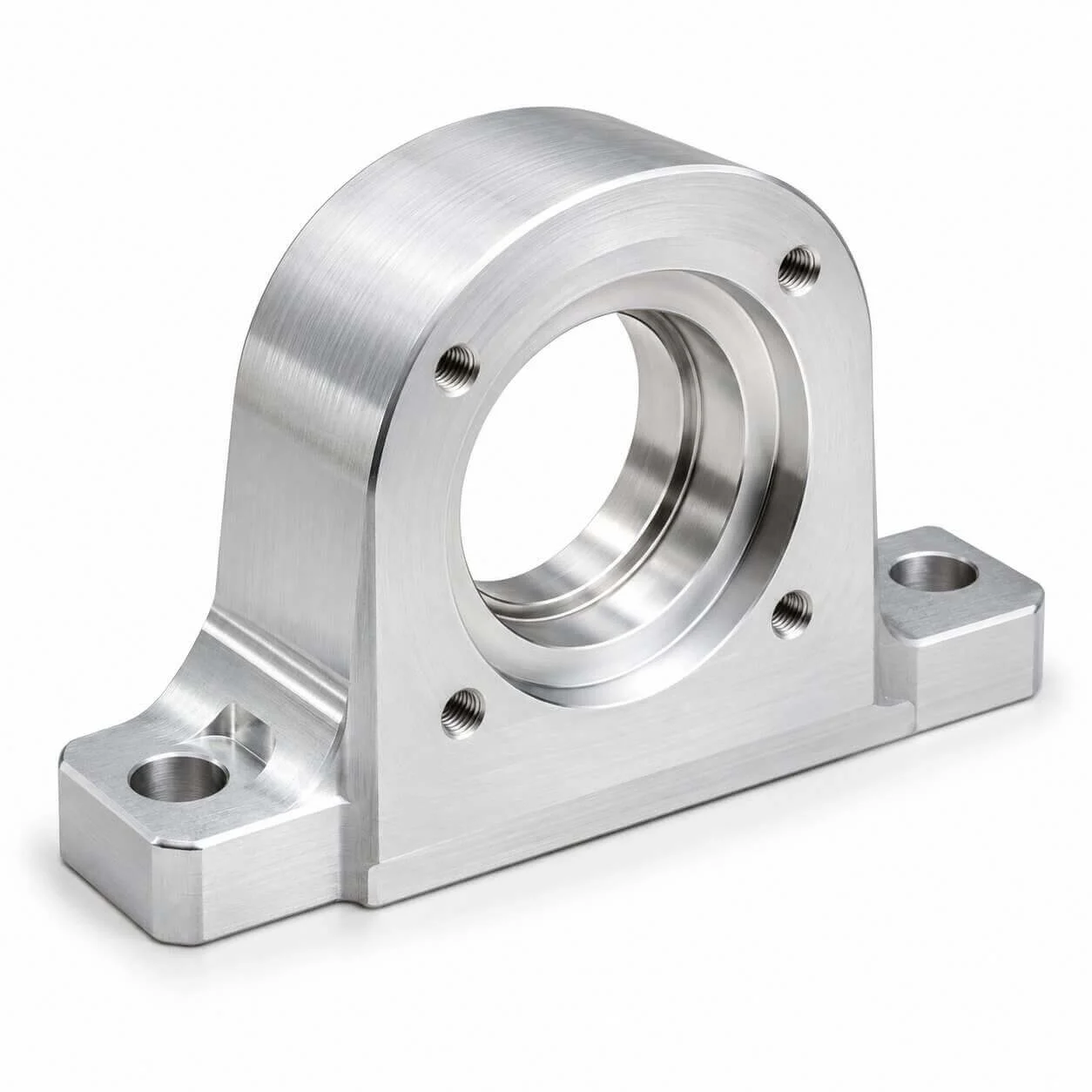
A bore is a good example because it looks simple on a drawing, but it can control alignment, bearing fit, motion quality, noise, and assembly life. That is why we also wrote about why one bore can stop a production line.
My rule of thumb: if a dimension matters to assembly, it deserves a wear plan and a verification plan.
7) Post-processing: precision doesn’t end at the last toolpath
Anodizing, plating, heat treatment, and even aggressive deburring can shift geometry.
I have seen people argue for hours about machine accuracy while ignoring that heat treatment is bending their parts like a slow-motion prank.
Case: we stopped blaming the machine and fixed the flow
We had a tolerance stack that was getting “random” failures.
Everyone’s first instinct was to blame the machine, recalibrate, argue about backlash, and chase ghosts.
Instead, we mapped the full chain:
- roughing strategy
- stress relief timing
- how long parts sat before finishing
- post-process steps
- inspection datum alignment
We changed two things:
- Separated rough and finish with a controlled rest/stabilization step and standardized it.
- Aligned inspection datum to functional assembly datum.
Scrap dropped hard.
Same machine.
That is why I am skeptical when people say “Brand X guarantees precision.”
No. Process guarantees precision.
For inspection-heavy parts such as fixture plates, datum blocks, probe holders, sensor mounts, and precision frames, industrial metrology CNC machining makes this even more obvious. The part is not just measured after machining; the measurement logic should shape the machining plan.
So what really controls machining precision?
If you want my blunt ranking from the shop floor:
- Datum strategy + inspection alignment
- Fixturing / part constraint / deformation control
- Material stress + heat management
- Geometry choices — design-for-machining reality
- Tool wear + finishing strategy
- Post-processing and handling
- The machine — still important, just not your first excuse
And yes, you can disagree. You should. That is the point.
If you are preparing a tolerance-critical part for RFQ, send the STEP/STP file, 2D drawing, material requirement, surface finish, post-processing notes, and any assembly-critical CTQ features. Batnon’s precision CNC machining services team can review the manufacturing risk before the part becomes a production problem.