If you source precision parts long enough, you stop being impressed by fast quotes.
You start asking the harder question:
Fast based on what?
That question matters even more when the supplier is overseas, the part has a few tight features, and your own team still has unresolved assumptions hiding inside the file package.
Most quote problems do not begin with an impossible geometry.
They begin when two sides are pricing two slightly different versions of the same part.
One side thinks the bore is just a bore. The other side knows it is a bearing seat. One side reads the anodize note as cosmetic. The other assumes final dimensions are before finish. One side sees a prototype. The other sees a repeat program with annual demand.
That is where quote spread starts. Not only in price, but in risk.
If you want to evaluate how a supplier thinks before the first PO, it helps to review how they explain their own RFQ, Quality, and Capabilities as well. Good suppliers usually make their process logic visible before production starts.
Quick answer: what should be included in a CNC machining RFQ?
A working CNC machining RFQ checklist or CNC machining quoterequest checklist should usually include:
- 3D CAD model, typically a STEP/STP file
- 2D PDF drawing with dimensions, tolerances, thread callout details, notes, and GD&T where needed
- clear revision level across model and drawing
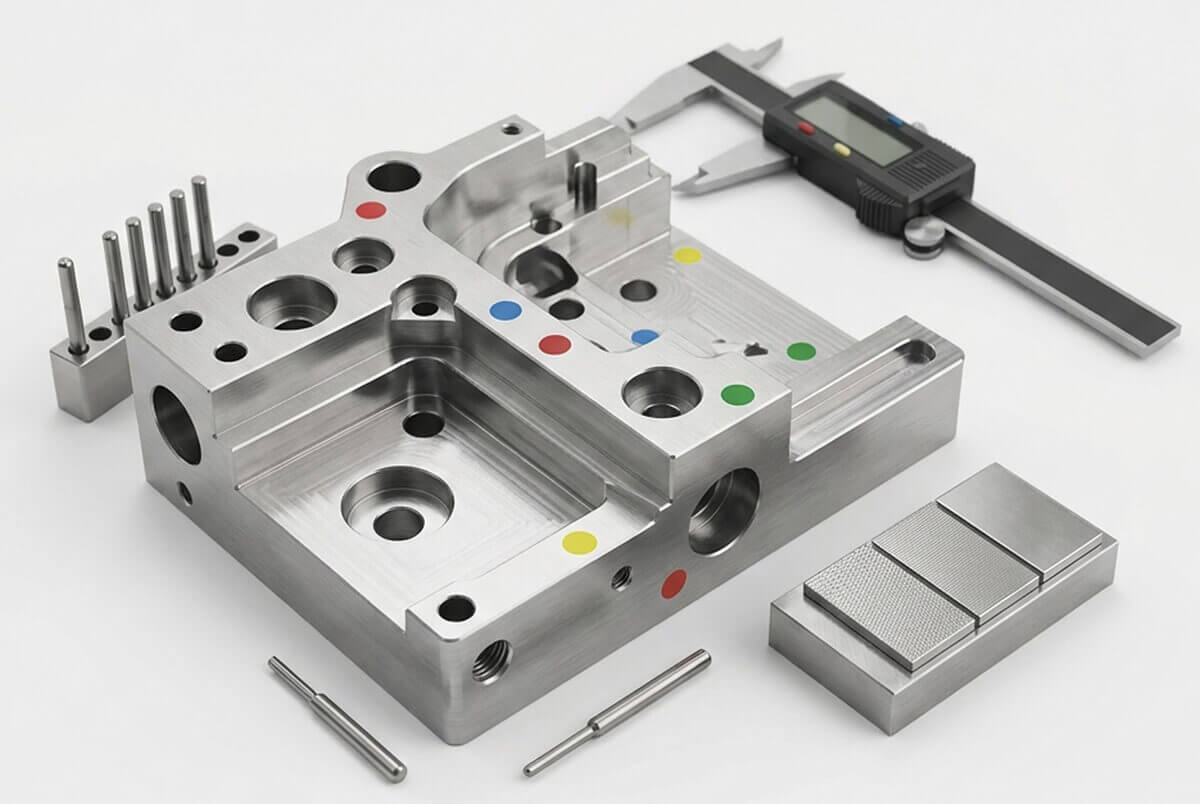
- critical-to-quality (CTQ) features visibly marked
- material grade, temper, and applicable specification
- surface finish requirements and any post-processing notes
- prototype quantity, batch quantity, annual volume, and target lead time
- inspection requirements such as CMM inspection, dimensional report, or first article inspection (FAI)
- documentation requirements such as material certification, COC, RoHS compliance, or part marking
- packaging or protection requirements if surfaces or edges are sensitive
- short application context if the functional risk is not obvious from geometry alone
A better RFQ does not just get a faster CNC machining quote.
It gets a quote with fewer hidden assumptions.
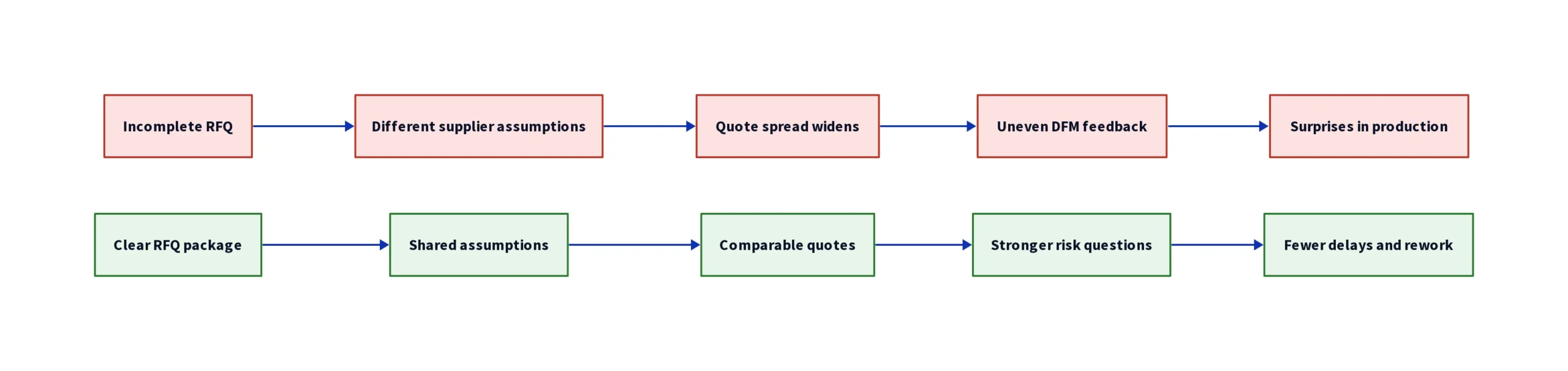
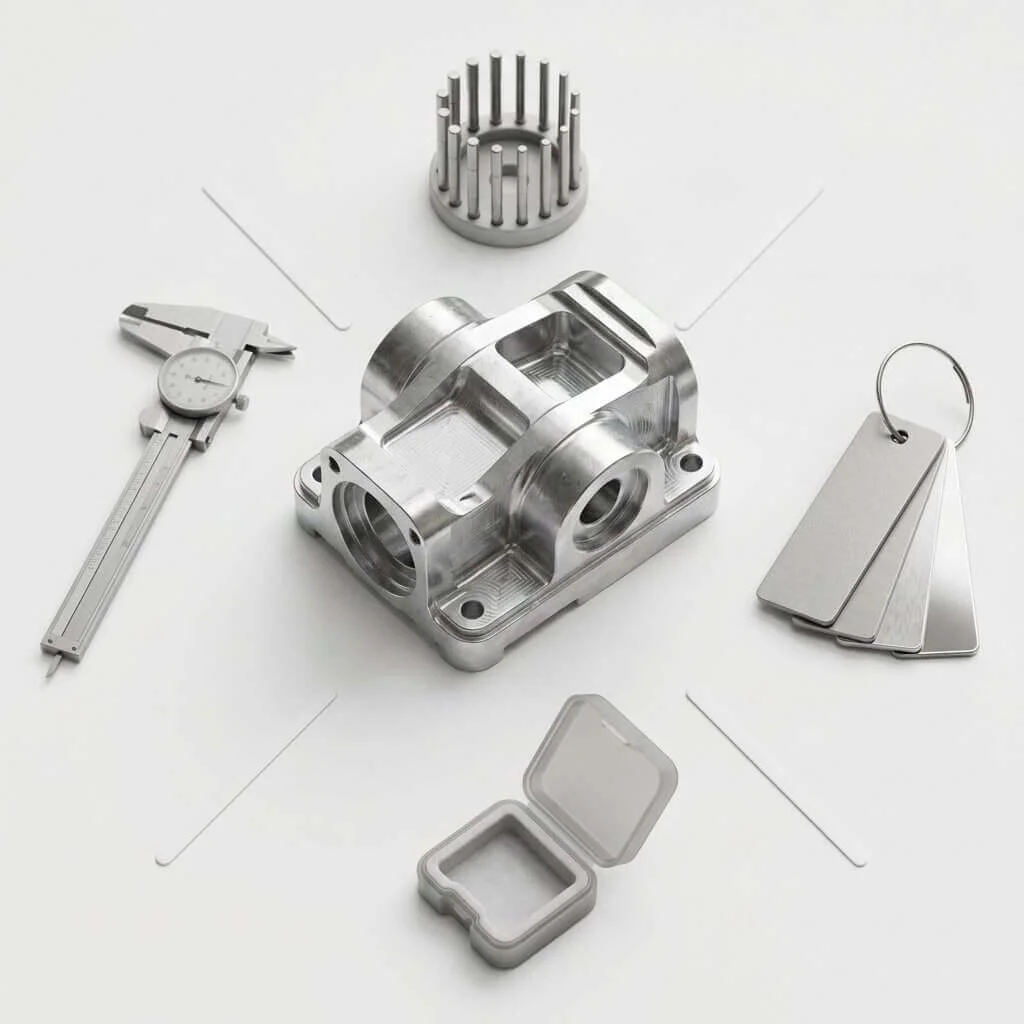
Visual: clear RFQ package vs incomplete RFQ. Useful near the top because it explains why quote spread widens before buyers compare suppliers.
The quote is a mirror of assumptions
Here is the uncomfortable truth.
When three suppliers quote the same part from three different assumptions, you are not comparing suppliers.
You are comparing three different mental versions of the part.
That is why a low quote is not always a good quote. Sometimes it is simply the quote with the most missing interpretation work hidden inside it.
There’s more to a machine shop quote than the number on the PDF. A serious buyer should care about whether the supplier understood:
- what controls function
- what drives cost
- what must be inspected
- what can stay standard
- what cannot be guessed
A real example outside machining, but exactly the same failure pattern
NASA’s Mars Climate Orbiter was lost in 1999 because one part of the system used English units while another side expected metric units. According to NASA’s own mishap report, the spacecraft ended up about 170 kilometers lower than planned during Mars insertion, and the mission was lost after launch on December 11, 1998 and signal loss on September 23, 1999. Different teams were working from different assumptions, and the mismatch survived until it became expensive in a very final way. Source: NASA LLIS.
Your RFQ is not a spacecraft, obviously.
But the same logic applies. If assumptions are inconsistent at handoff, the damage shows up later: re-quotes, delayed clarification loops, scrap, rework, late finish problems, and internal arguments about who meant what.
1. Why a serious CNC RFQ matters
A good RFQ is not paperwork for paperwork’s sake.
It does three jobs at once:
- improves quote accuracy
- prompts better DFM feedback
- reveals supplier maturity before the first PO
That third point is the one buyers often underuse.
A shallow supplier sees an RFQ as a price request. A mature supplier sees it as a test of whether both sides are ready to build the same thing the same way.
If the reply comes back fast but asks nothing meaningful about datums, finish buildup, CTQ features, inspection logic, or annual volume, that is a signal too.
2. CAD files, 2D drawings, and revision control
The model shows geometry. The drawing shows what must be controlled.
Both matter.
For a reliable cnc machining quote request, your package should include:
- a clean CAD model in STEP/STP
- a released 2D drawing in PDF
- a visible revision level
- notes covering material, finish, deburring, part marking, and inspection if required
- GD&T callouts or CTQ notes where function depends on them
Why both files are needed
A model can show a bore. It does not tell the supplier whether that bore is:
- a loose clearance feature
- a bearing seat
- a sealing surface
- a datum reference
- a post-finish controlled interface
That difference changes process planning, inspection strategy, and cost.
Revision mismatch is one of the quietest ways to wreck a quote
A bad tolerance usually gets challenged. A revision mismatch can survive all the way into production.
That is why before sending CNC RFQ checklist work should start with file control, not price comparison.
A real case on version mismatch
Airbus’ A380 program ran into major wiring-installation problems when design work done in Hamburg did not align with the software and design environment used in Toulouse. Reuters reported that the aircraft carried about 500 km of wiring, deliveries were delayed by an average of two years, and the backlog was tied to about €5 billion in sacrificed profits. The technical story was more complex than “wrong file,” but the core lesson is very simple: when different teams are not working from the same released version logic, the penalty can be huge. Source: Reuters.
No RFQ is as large as an A380 program. The principle is the same.
If your 3D file and PDF drawing do not clearly agree, stop the RFQ. Fix that first.
3. Tolerances: critical vs standard
This is where buyers overpay all the time.
Tight tolerance is not automatically better. It is only better when it protects function.
Tolerance affects far more than acceptance. It affects toolpath strategy, fixturing, in-process gauging, inspection time, scrap risk, and the amount of engineering attention the part will need on the floor.
A practical CTQ split
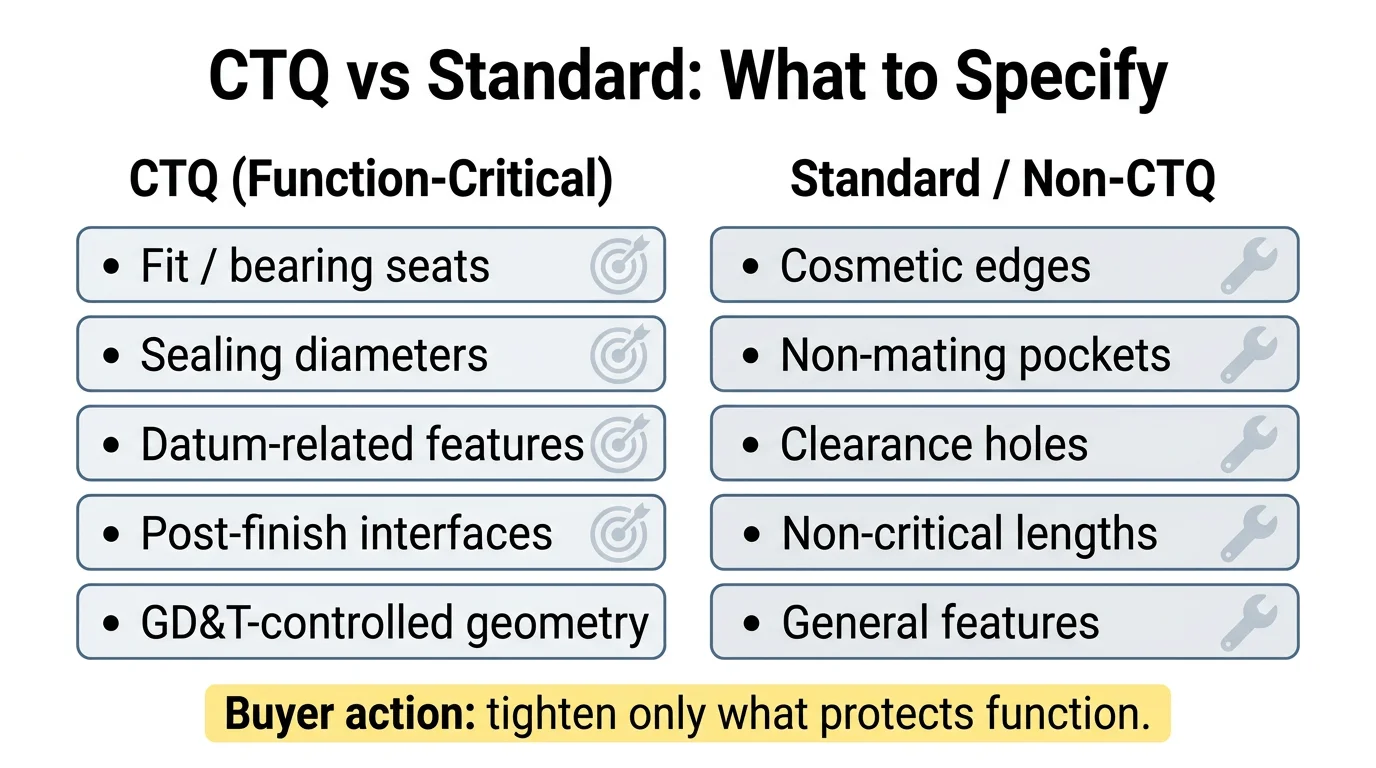
| Feature class | What it usually means | What your RFQ should do |
| Functional / CTQ | Drives fit, sealing, alignment, motion, or performance | Apply explicit tolerance and say how it will be verified |
| Process-sensitive | Affects cosmetic quality or assembly ease | Control realistically, not emotionally |
| Standard | Does not directly control function | Let general tolerance apply |
This is where CNC machining tolerances, tolerance stack up, and GD&T callouts should be used with judgment, not just caution.
What over-tolerancing really buys you
Usually more of the following:
- slower finishing passes
- more in-process checks
- extra fixturing effort
- longer inspection time
- more debate during quoting
- higher scrap exposure
If a feature is not function-critical, forcing blanket tightness into the drawing does not make the part “high precision.” It just makes the part expensive and harder to quote honestly.
Better buyer question
Do not ask only:
What tolerance can you hold?
Ask this instead:
Which features here are overspecified, and which ones areunderspecified for function?
That question tells you whether the supplier is thinking like an engineer or a form-filler.
4. Material, temper, and specification
“Aluminum” is not a usable instruction. Neither is “stainless.”
A workable RFQ should define the material grade / specification clearly enough that a buyer, estimator, machinist, and quality engineer would all read the same instruction from it.
At minimum, specify:
- alloy / grade
- temper or condition
- material standard if relevant
- whether material certification is required
For buyers comparing options, Batnon’s Materials pages can also help frame what questions belong in the RFQ and which questions should be resolved before quote.
Why this matters
Material affects:
- machinability
- tool wear
- burr behavior
- stress release after roughing
- deformation under clamping
- finish performance
- dimensional stability
- downstream compliance requirements
A thin-wall aluminum housing and a stainless component with cosmetic faces are not just two “metal parts.” They behave differently in machining, handling, and finishing.
If the geometry suggests distortion risk, ask for DFM comments before quote. Not after scrap.
5. Surface finish and post-processing
A lot of RFQs mention finish. Far fewer define it well enough to protect fit and quote stability.
In practice, surface finish requirements can mean several different things at once:
- machined roughness
- cosmetic appearance
- coating or treatment type
- masking requirements
- pre-coating preparation
- final dimensional condition
If the RFQ only says “black anodize,” the quote is still underdefined.
A serious buyer should think through:
- Type II or Type III
- cosmetic or functional
- coating thickness sensitivity
- masking on threads or bores
- whether dimensions apply before or after finish
- whether roughness matters before coating
Where buyers get hurt
Finishes do not just change looks. They change interfaces.
That is why bores, threads, sliding fits, sealing diameters, and precision mating faces should never be left to assumption when finish is involved.
If your part includes anodized bores, sealing lands, or post-plating fit features, say so directly. If needed, ask whether those dimensions should be machined to pre-finish or post-finish targets.
That is not overexplaining. That is how you avoid a quiet re-quote later.
For broader process context, this is also a good place to direct readers to CNC Machining Services or Precision CNC Machining when the article is published on-site.
6. Quantity, annual volume, and lead time
Quantity is not just a number on the RFQ. It tells the supplier what kind of manufacturing route makes sense.
The same drawing may be quoted one way as a one-off prototype and very differently as a recurring low-volume program.
A strong RFQ should state:
- prototype quantity
- batch quantity
- annual volume if known
- whether design changes are still likely
- target lead time
- whether partial shipments are acceptable
- whether this is sampling, ramp-up, or repeat production
A useful real case on speed and context
In a published partnership example, NASA Goddard had Protolabs machine a generatively designed aluminum 6061 component in 36 hours ahead of the PowerSource Global Summit. NASA engineer Matthew Vaerewyck said there was “no room for error or delay.” That is a useful reminder that urgent jobs are not defined by lead time alone. The supplier also needs to understand why the timing matters and what cannot slip. Source: Protolabs x.
That example is about speed. The hidden lesson is commercial intent.
If this RFQ is only a sample, say that. If it may become a repeat program, say that too. Good suppliers quote differently when they know whether they are looking at a one-off, a qualification path, or the start of a production relationship.
If your article needs a natural internal link here, Prototype CNC and Custom CNC Machining both fit without forcing the paragraph.
7. Inspection, metrology, and quality proof
This is usually where the buyer decides what they are actually buying.
Is it just parts? Or parts plus enough proof for engineering, quality, operations, and sometimes the end customer to sign off with confidence?
Common inspection requirements include:
- CMM inspection
- dimensional report
- first article inspection (FAI)
- certificate of conformance
- material certification
- lot traceability
- RoHS or other compliance statements
- part marking where needed
If the job requires those things, define them before quote. If you add them after the PO, you are not “clarifying.” You are changing scope.
Real example: FAI is not just paperwork
B&B Airparts, an aerospace manufacturer, reported handling upwards of350 FAIs per month. In a published customer case, the company said it achieved 50% time savings in creating AS9102 first article inspection reports after shifting report creation and issue discovery earlier in the process. One of the practical gains was catching tooling or measurement-resource problems before production moved ahead. Source: InspectionXpert customer.
That is the point buyers should remember.
Inspection should not be bolted on at the end to calm nerves. It should match functional risk from the start.
If the part is critical, ask not only whether the supplier can provide a report, but also:
Which features would you inspect, by what method, and why?
That answer often tells you more than the report title.
Readers who want to understand how a supplier frames this internally can be linked naturally to Batnon’s Quality page.
8. What overseas buyers worry about before the first PO
Before the first PO, buyers are usually screening for a pattern rather than one single promise.
They want to know:
- will the quote still mean the same thing after kickoff?
- will the supplier raise issues early?
- will the quality proof survive internal review?
- will communication stay clear when the topic gets technical?
- can the supplier move from sample to repeat production?
- do the commercial promises sound realistic, not eager?
That is why trust in overseas sourcing is rarely built by a glossy capability list alone.
It is built when the supplier asks specific questions about datums, finish interaction, CTQ features, revision control, and documentation. The same pattern is visible across Batnon’s Capabilities and Inspection content as well: clarity beats reassurance.
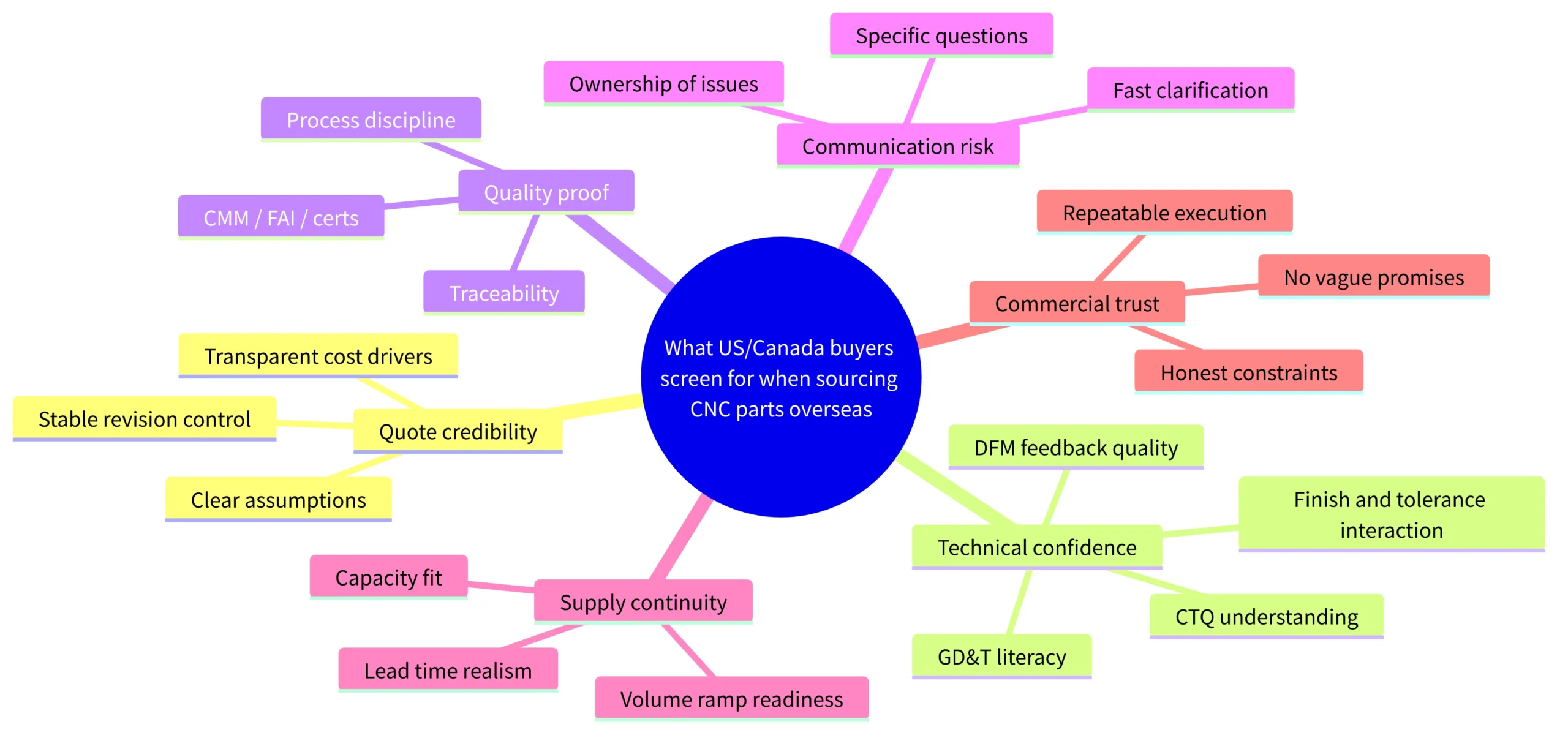
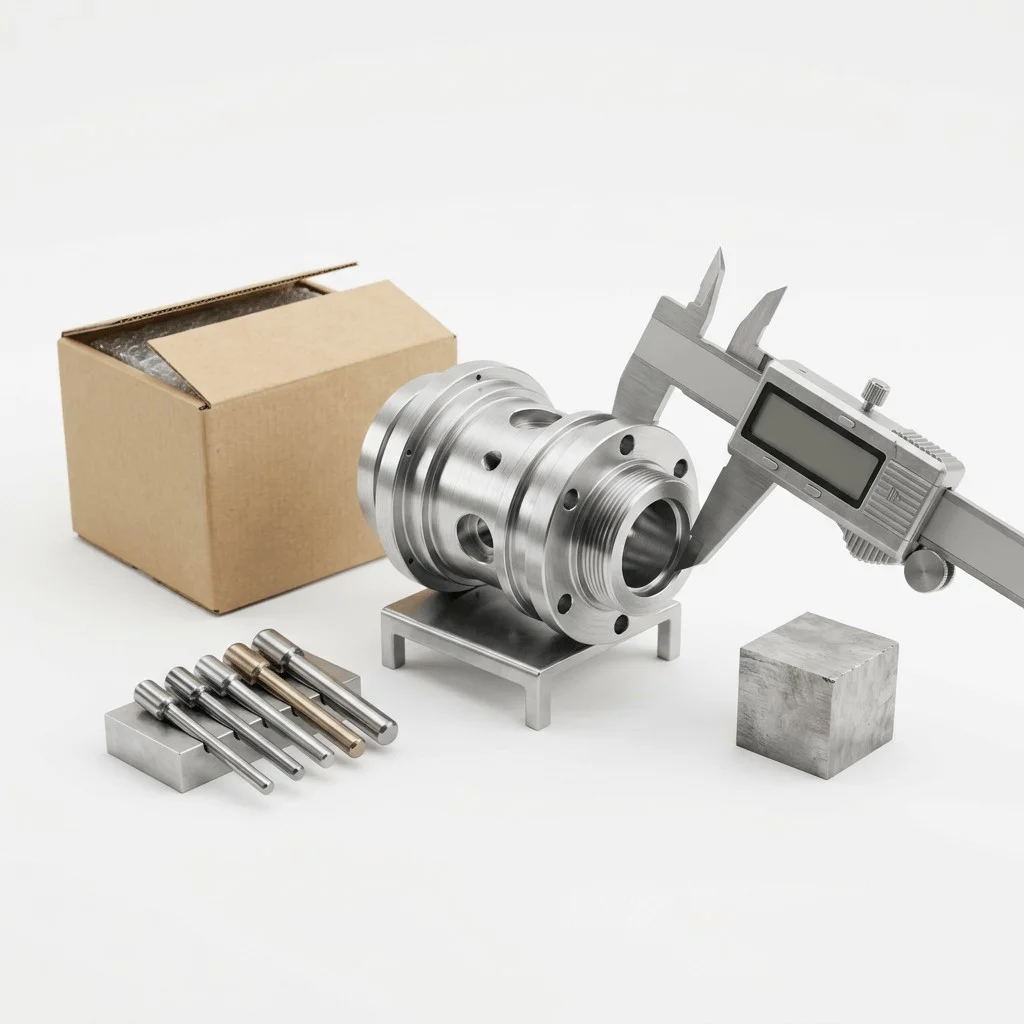
Visual: buyer-side screening logic for overseas CNC sourcing. Good fit before the supplier-verification section.
9. Supplier verification before sending the RFQ
A useful CNC machining supplier checklist is not just “can they make this part?”
Too many shops can make some version of the part. The real question is whether they fit this job, this tolerance level, this documentation burden, and this buying situation.
What serious buyers verify
| What to verify | What good looks like | Red flag |
| Capability fit | Process matches material, tolerance, finish, and geometry | Shop can machine simple parts but not this risk profile |
| DFM quality | Supplier points out hidden risk before quote | Supplier only repeats your wording back to you |
| Revision discipline | Model and drawing are checked against the same release | Nobody asks which file governs |
| Quality proof | Supplier can explain FAI/CMM/certs in practical terms | “We can provide any report” with no method behind it |
| Communication | Specific technical questions, fast clarification | Fast but vague reassurance |
| Production continuity | Clear thinking on prototype-to-production transition | Good on samples, weak on repeatability |
A good verification question to ask is this:
Which three details in this RFQ are most likely to create cost,timing, or quality risk if left as-is?
Weak suppliers usually answer with comfort. Strong suppliers answer with specifics.
10. Hidden RFQ fields that make buyers look sharper than average
These are the details that often separate experienced buyers from average ones.
Packaging and protection
If the part has cosmetic faces, fragile edges, coated surfaces, or sealing areas, say how it should be protected.
A part can be made correctly and still arrive wrong.
Mating-part context
If one feature matters because it locates, seals, or aligns with another part, state that in one plain sentence.
The drawing may be technically complete and still not tell the full manufacturing story.
Datum of use
Sometimes the drawing datum is correct for drafting, but the real datum of use tells the supplier more about setup and inspection logic.
When that matters, mention it.
Change-risk status
If the design is still evolving, say so.
Revision churn changes fixture planning, setup assumptions, and inspection logic. It should not surprise the supplier after they quote.
Commercial intent
If this RFQ is part of supplier selection for future work, not just a one-time buy, make that visible.
A good supplier will respond differently when they know they are quoting for a relationship instead of a one-off transaction.
Image not found: media/image4.jpeg
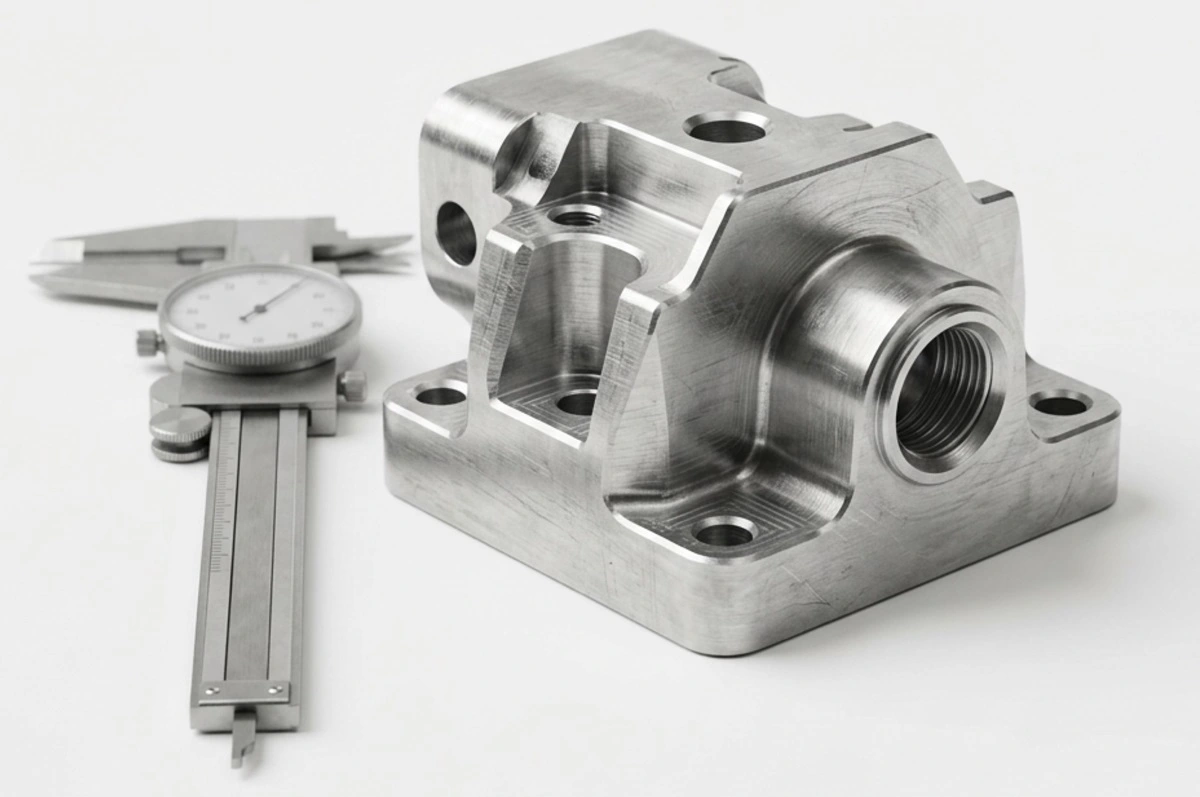
Visual: RFQ package comparison. Works well before the final checklist because it turns abstract advice into a quick scan.
11. A practical RFQ checklist buyers can actually use
CNC machining RFQ template checklist
Use this as a working CNC RFQ template checklist or precision CNCmachining RFQ checklist before you ask for a quote.
| RFQ item | What good looks like | Why it matters |
| 3D model | Latest STEP/STP file | Gives suppliers usable geometry |
| 2D technical drawing | PDF with dimensions, notes, thread callout, and GD&T where needed | Defines what must be controlled |
| Revision level | Model and drawing clearly match | Prevents quote drift |
| Critical features | CTQ features flagged on the print or in notes | Focuses attention where function lives |
| Material specification | Alloy, grade, temper, and standard are explicit | Prevents wrong assumptions or substitution |
| Surface finish | Finish type, thickness, masking, and timing of dimensions are defined | Avoids fit problems and re-quotes |
| Quantity and annual volume | Prototype, batch, and annual demand are stated | Changes process route and pricing logic |
| Lead time requirement | Date and flexibility are both clear | Helps suppliers quote honestly |
| Inspection requirements | CMM, FAI, dimensional report, certs, or traceability specified | Prevents late scope change |
| Packaging | Protection method defined for sensitive parts | Reduces transit or handling damage |
| Application context | Short note on assembly or function if needed | Converts geometry into manufacturing logic |
Copy-and-send RFQ form
Buyers who want a cleaner starting point can use a short form like this in email or in an RFQ sheet:
| Field | Fill in |
| Part name / part number | Yes / No |
| Revision | Yes / No |
| 3D file included | Yes / No |
| 2D drawing included | Yes / No |
| CTQ features called out | Yes / No |
| Material grade / temper | Yes / No |
| Finish / post-processing | Yes / No |
| Prototype quantity | Yes / No |
| Annual volume | Yes / No |
| Target lead time | Yes / No |
| Required inspection docs | Yes / No |
| Packaging / marking notes | Yes / No |
| Assembly or function notes | Yes / No |
If you want to support this section with internal links, RFQ, Contact, and CNC Machining are the most natural placements.
12. Silent red flags when evaluating quotes
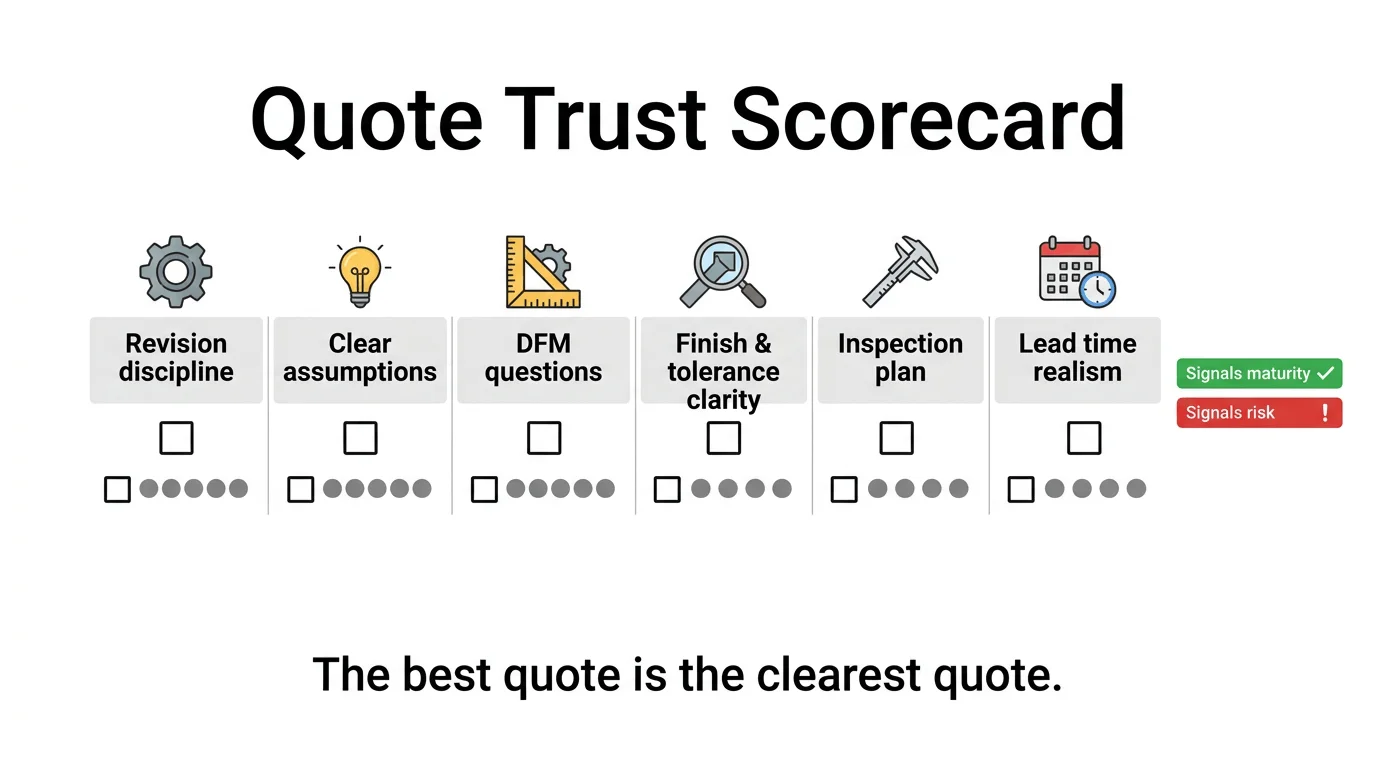
Be careful when suppliers:
- reply quickly but ask no meaningful technical questions
- accept ambiguous tolerance and finish combinations without challenge
- promise any report but cannot explain inspection logic
- quote aggressive lead times without discussing revision control or inspection burden
- say “no problem” to everything
- talk broadly about experience but cannot identify feature-specific risk
One signal by itself may not mean much. A pattern usually does.
Mature suppliers make two things clear at the same time:
First, they understand the part.
Second, they understand what could go wrong.
That is what trust sounds like in manufacturing. Not enthusiasm. Not slogans. Not a low quote alone.
13. Final thought
The best RFQ is not the longest one.
It is the one that removes the right ambiguity.
Experienced buyers know what must be explicit, what can stay standard, and what should trigger a conversation before production starts. That is how you get more comparable quotes, better DFM feedback, fewer surprises in production, and more internal confidence when it is time to approve the supplier.
In overseas sourcing, that clarity matters even more.
Distance makes every hidden assumption more expensive.
14. Action
If you want a quote that reflects the real manufacturing requirement, not a bundle of hidden assumptions, send your drawing package for review.
A serious RFQ deserves a serious response.
For readers ready to move from checklist to action, the most natural next steps are Contact, RFQ, or the core CNC Machining page.
15. FAQ
Is a STEP file enough for a CNC machining quote?
For rough budgetary pricing on a simple part, it may be enough to start the conversation. For a reliable quote on a precision part, buyers should usually provide both the CAD model and a 2D drawing. The model shows geometry. The drawing shows tolerances, finish, notes, datums, and inspection requirements.
What should buyers highlight first on the drawing?
Start with CTQ features. Then make sure the revision level, material specification, finish notes, and any inspection requirements tied to functional features are easy to find.
Why do two suppliers quote the same part very differently?
Because they may not be quoting the same assumptions. One supplier may assume heavier inspection, more conservative fixturing, or more finish-related risk. Another may be pricing the job with a lighter interpretation.
What quality documents should be defined before quote?
If the job needs FAI, CMM inspection, dimensional reports, material certification, COC, traceability, or compliance statements, define that before the supplier quotes. If you wait until later, price and lead time may both have to move.
What is the biggest mistake in a CNC machining RFQ?
Leaving functional intent implicit. When the supplier has to guess what really matters, the quote becomes less reliable and supplier comparisons become harder to trust.
Source notes for inserted real cases
- NASA Mars Climate Orbiter mishap summary:
https://llis.nasa.gov/lesson/641 - Airbus A380 wiring/design-version issue reported by Reuters:
https://www.reuters.com/article/business/autos-transportation/wiring-fixed-for-first-a380-only-airbus-idUSL26784850/ - NASA Goddard / Protolabs rapid-machining example:
https://www.protolabs.com/resources/partnerships/nasa/ - B&B Airparts FAI process example:
https://www.inspectionxpert.com/customers/bbairparts