
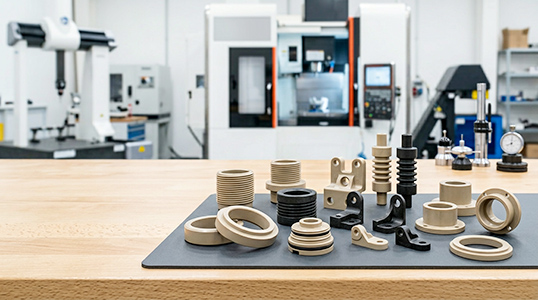
PEEK CNC Machining Services
Batnon provides PEEK CNC machining services for parts that must keep performance when heat, chemicals, and long-term load would push standard plastics out of spec. If you need peek cnc machining for wear parts, seals, insulators, or sterilizable components, we build a process plan around stress control (including peek annealing before machining when needed) and CTQ-driven inspection—so your custom peek machined parts assemble cleanly and stay cost-predictable.
Comparisons: PEEK vs Delrin CNC machining · PEEK vs Ultem / PEI machining
Plastic Material Pages
Same structure across materials—different machining physics. Use these pages to compare DFM, tolerances, and cost drivers.
Engineering Plastics
Low friction, toughness, and cost control:
High Performance Plastics
When temperature/chemicals/purity drive the spec:
PEEK · Ultem / PEI · PTFE · Vespel / PI
Fast selection hint
PEEK is often chosen when you need high temperature capability plus chemical resistance and creep / wear performance in one material. The “gotchas” are cost and stress: PEEK stock is expensive, and distortion can appear if you remove large volumes without stress control. If you have tight datums or thin walls, request peek machining tolerances on CTQs only—and consider stress relief.
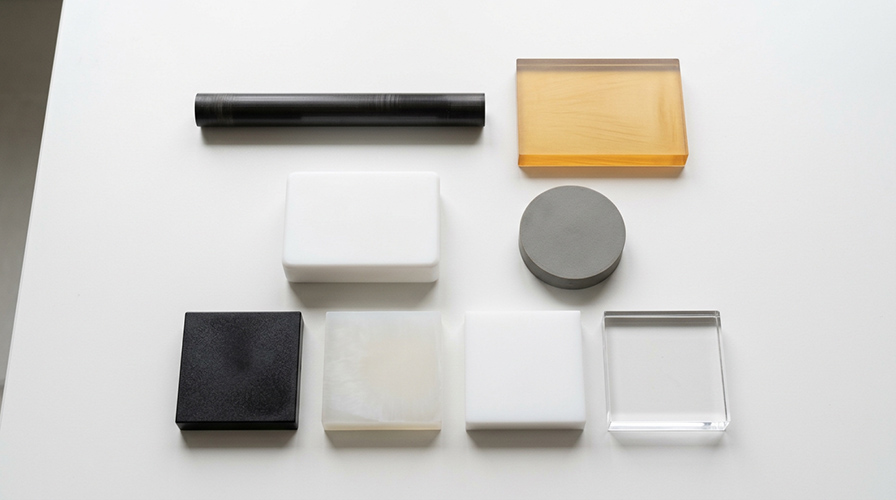
Tip: share your failure mode (creep, wear, chemical attack, sterilization, temperature) and we’ll confirm the right plastic before you spend on high-cost material.
What PEEK Is — and When to Choose It
PEEK (polyether ether ketone) is a semicrystalline high-performance thermoplastic used for parts that must keep mechanical integrity under heat, chemicals, and long-term load. Successful cnc machining peek plastic is less about “maximum speed” and more about stress control, tool sharpness, and chip evacuation—because poor heat dissipation can release internal stress and move critical dimensions. If your use case involves hot fluids, aggressive cleaners, fuels/oils, or sterilization cycles, peek cnc machining is often a safer long-term choice than engineering plastics.
Use case 1: Wear parts & low friction interfaces
Bearings, bushings, thrust washers, and wear rings where abrasion and PV load matter. PEEK’s wear grades can extend service life in dry or marginally lubricated conditions.
Use case 2: High temperature + chemical exposure
Valve seats, seals, pump components, and fixtures exposed to aggressive fluids. PEEK is known for broad chemical resistance and thermal stability.
Use case 3: Medical / lab components
Sterilizable fixtures, insulating parts, and instrument components where repeated cleaning cycles and dimensional stability are critical.
Key PEEK Properties That Affect CNC Machining
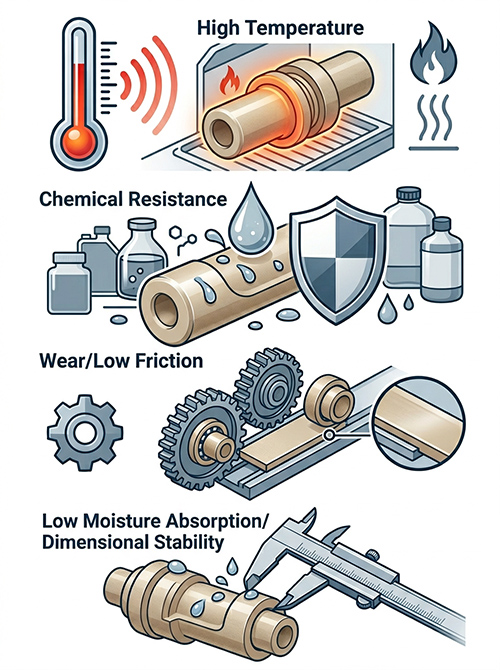
PEEK is engineered for environments where temperature and chemistry are the real constraints. Reference guides commonly cite a glass transition around ~143–162°C and melting temperature around ~343–387°C (grade dependent). Many suppliers cite continuous operation up to ~260°C for suitable grades and conditions. For machining, the important implication is dimensional stability under heat and load—plus low moisture absorption compared to hydrophilic plastics like nylon.
| Property driver | What it means for your part | Why it matters in machining |
|---|---|---|
| High-temperature performance | Parts maintain stiffness and strength at elevated temperature | Heat at the cutter can still move dimensions; sharp tools and chip evacuation reduce thermal stress. |
| Chemical resistance | Handles fuels, oils, many solvents, and aggressive media better than most plastics | Material selection must match your chemical list and temperature—share both in the RFQ. |
| Low moisture absorption | Dimensional stability in humidity/wet service | Reduces fit drift vs nylon; still plan for thermal expansion in tolerance stacks. |
| Creep resistance | Less time-dependent deformation under load | Useful for load-bearing plastic components—define load + temperature + lifetime early. |
| Wear / friction behavior | Strong for bearings and sliding interfaces | Surface finish, edge break, and fiber-filled grade choice determine real wear life. |
Machining Notes (DFM): Stress, Annealing, Thin Walls, Threads & Inserts
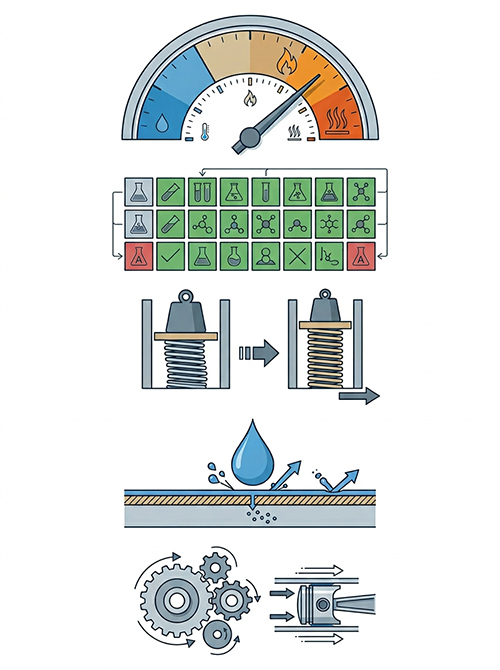
PEEK can machine cleanly, but it is sensitive to heat and internal stress release during cutting. Industry machining guides for engineering plastics emphasize that dimensional stability depends on stress-relieved stock and that heavy material removal may require intermediate stress relief. For tight tolerance parts, a staged route—rough first, stabilize, then finish CTQs—reduces warping and scrap.
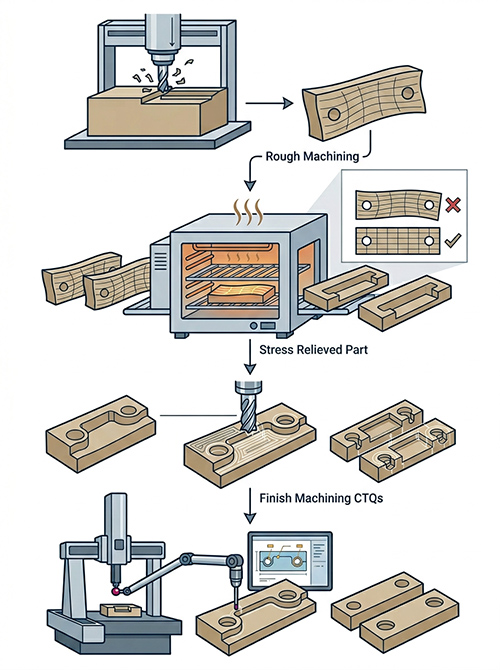
Anneal when it reduces risk
Request peek annealing before machining or intermediate annealing when large stock removal, thin walls, or tight datums are present. It can lower internal stress, reduce distortion, and prevent cracking—often reducing total cost by lowering scrap rate.
Plan inserts and threads
For repeated assembly, metal inserts can improve thread life. If you need directly machined threads, use generous lead-ins and avoid knife edges to reduce stress concentration.
Use the right PEEK grade
Glass filled PEEK machining improves stiffness and dimensional stability; carbon fiber PEEK CNC machining can enhance wear and reduce thermal expansion in some directions. Reinforcements can be more abrasive—finishing expectations should be aligned early.
Practical “no regrets” specs to include in your RFQ
To make PEEK CNC machining services quoting accurate and fast, specify:
- Grade: unfilled vs glass-filled vs carbon-filled; color requirements
- Environment: temperature range, chemicals/solvents, steam/autoclave cycles
- CTQs: which bores/datum faces gate assembly vs non-critical geometry
- Wear intent: sliding contact, PV load, lubrication, and expected lifetime
If you’re unsure, tell us the failure mode (creep, wear, chemical attack, heat) and we’ll recommend the right plastic and process route.
Tolerances & Surface Finish Guidance for PEEK CNC Machining
PEEK can be machined precisely, but “tight everywhere” is rarely the best value. The most robust route is CTQ-driven tolerancing paired with an inspection plan that matches risk. If you need peek machining tolerances on critical bores and datums, we recommend defining those CTQs explicitly and keeping other features on standard tolerances to control cost.
| Spec goal | What to expect | How to get it |
|---|---|---|
| General dimensions | Standard tolerances for non-critical features | Use your house general tolerance for non-CTQs; reserve tight callouts for fits and sealing faces. |
| Critical bores / datums | Tight fits can be achieved when geometry is stable | Rough → stabilize → finish CTQs; specify gaging method if needed (plug gage, CMM, etc.). |
| Surface finish (wear parts) | Finish affects friction and wear | Define functional surfaces and target roughness only where it matters; avoid polishing the whole part by default. |
| Warp control | Depends on stock stress and removal volume | Use annealed stock and staged machining; consider intermediate anneal for high-removal parts. |
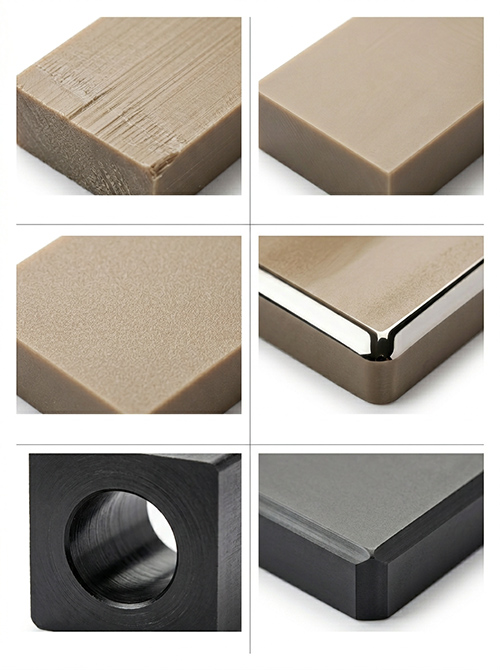
Post-Processing, Cleaning & Packaging (As Required)
PEEK is often used in assemblies where cleanliness, particle control, and reliable edges matter. We treat deburr intent, edge break, and packaging as part of the manufacturing plan—especially for medical/lab and wear-part programs.
Deburr + edge control
Define “break sharp edges” versus controlled chamfers. Stable edges reduce stress concentration and help parts assemble predictably.
Clean handling for functional surfaces
Wear and sealing surfaces are sensitive to nicks and contamination. Protective separators and clean packaging keep performance surfaces intact.
Traceability (when needed)
For regulated programs, we can support material traceability and inspection records aligned to your supplier quality plan.
Common PEEK CNC Machining Applications
These are typical RFQs for custom PEEK machined parts—where heat, chemical resistance, wear, or sterilization drive selection.
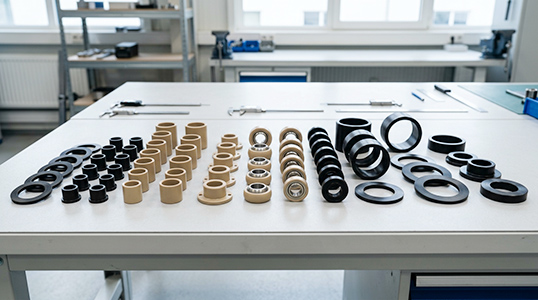
Wear parts & bushings
Bearings and wear rings designed for long service life under friction and temperature. Surface finish and grade choice drive real wear performance.
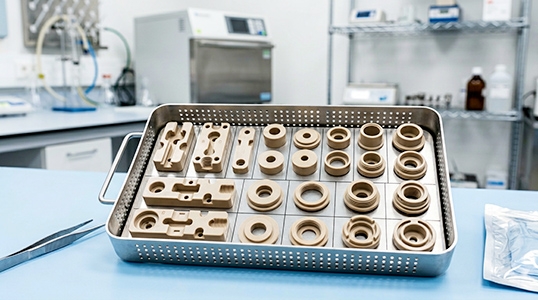
Medical / life science fixtures
PEEK CNC machining medical programs often involve sterilization cycles. CTQ-first tolerancing helps maintain fit and function after repeated cleaning.
High temperature + chemical service
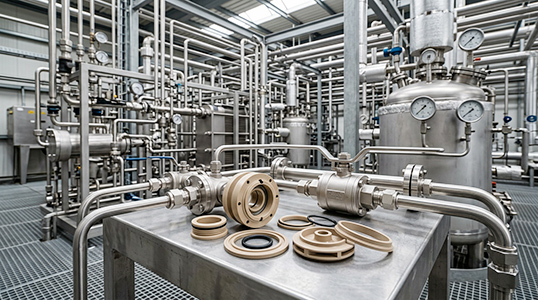
PEEK CNC machining aerospace and industrial programs often need thermal stability and chemical resistance for seals, insulators, and hot-fluid components.
PEEK Grades (If Specified)
PEEK is available in unfilled and reinforced grades. Grade selection changes stiffness, wear behavior, and dimensional stability. If you already have a spec (e.g., glass-filled, carbon-filled, or wear grade), we’ll match it. If not, we can recommend based on temperature, chemicals, wear mode, and tolerance risk.
How to specify quickly
When requesting PEEK CNC machining services, include:
- Grade intent: unfilled vs glass-filled vs carbon-filled (and why)
- Environment: temperature range and chemical list
- Wear mode: sliding contact, PV load, lubrication, mating material
If you’re unsure, tell us what failed (wear, creep, chemical attack, heat) and we’ll recommend the grade.
FAQ: PEEK CNC Machining
Common questions about annealing, tolerances, grade selection, and when PEEK is the right upgrade.
Is annealing required for PEEK CNC machining?
Not always, but it’s a powerful risk reducer. For high stock removal, thin walls, or tight datums, peek annealing before machining (or intermediate stress relief) can reduce warping and cracking—often lowering total cost by reducing scrap and rework.
Can you machine reinforced PEEK (glass-filled or carbon-filled)?
Yes. Reinforced grades are common when stiffness or wear is critical. Tooling and finishing strategies are adjusted to manage abrasiveness and surface finish expectations.
What tolerances are realistic for PEEK machining?
PEEK can be machined accurately, but the most robust method is CTQ-first tolerancing. Define tight datums/bores only where they gate function, and use standard tolerances elsewhere to keep cost and scrap risk under control.
PEEK vs Delrin: when should I choose PEEK?
Choose Delrin for cost-effective low-friction mechanical parts in moderate environments. Choose PEEK when temperature, chemical exposure, sterilization, wear, or creep resistance is the gating requirement.
How do you keep PEEK machining cost-competitive?
PEEK material is expensive, so the biggest cost levers are DFM and scrap prevention: choose the right grade, avoid over-tolerancing, stage machining for stability, and use annealing when it reduces distortion risk.
PEEK CNC Machining for Prototypes and Production
Batnon supports PEEK CNC machining for engineering teams worldwide—from rapid prototypes to repeat production. Share your environment (temperature + chemicals), wear mode, CTQs, and quantity, and we’ll build a stress-aware machining and inspection plan so parts stay stable and cost-predictable.
For related plastics, see: High Performance Plastics CNC Machining.
Explore Other Plastic Materials
Compare machining behavior, tolerances, and DFM notes across plastics:
- Engineering plastics: Delrin / POM · Nylon / PA · ABS · Polycarbonate / PC
- High performance plastics: PEEK · Ultem / PEI · PTFE · Vespel / PI
If you’re unsure where to start, tell us the failure mode (creep, wear, chemical attack, sterilization, temperature, purity) and we’ll route you to the right material page.