
ABS CNC Machining Services
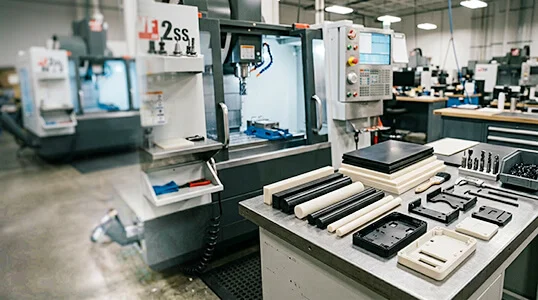
Batnon provides ABS CNC machining for durable prototypes and production-ready plastic parts—especially housings, covers, brackets, and fixtures. ABS (acrylonitrile butadiene styrene) is a workhorse resin because it’s cost-effective, tough, and easy to finish (bead blast, vapor smoothing, paint). The machining reality is heat: stable chip formation and sharp tools matter to prevent smearing, melted edges, and dimensional drift on thin walls.
Need higher stiffness and optical clarity? Compare with Polycarbonate / PC CNC machining. Need lower friction and better dimensional stability? See Delrin / POM CNC machining.
Plastic Material Pages
Same layout across materials—different machining physics. Use these pages to compare DFM, tolerances, and cost drivers.
Engineering Plastics
You are here: ABS. Explore the other engineering plastics pages:
High Performance Plastics
When temperature/chemicals/purity drive the spec:
PEEK · Ultem / PEI · PTFE · Vespel / PI
Fast selection hint
ABS is often chosen when you need impact resistance, cost-effective prototypes, and an easy-to-finish surface (paint, texture, cosmetic work). For thin cosmetic walls, design to avoid heat build-up during machining.
- Best at: enclosures, covers, functional appearance prototypes
- Watch: heat/smear, thin-wall distortion, high CTE
- Cost lever: tolerance strategy + cosmetic finish level
What ABS Is — and When to Choose It for CNC Machining
ABS is a mainstream thermoplastic combining toughness (butadiene), rigidity (styrene), and chemical resistance (acrylonitrile). In machining ABS plastic, the value proposition is speed: it’s a go-to for ABS prototype machining and low-volume runs when you want molded-like geometry feel without mold lead time. Published references commonly cite ABS glass transition around ~105°C, so heat-aware toolpaths and sharp tools are key to avoid rubbing and surface smearing.
Use case 1: Enclosures & housings
ABS is widely used for electronics enclosures, instrument covers, and protective housings. It’s impact-resistant and takes paint well—ideal for appearance prototypes and pilot builds.
Use case 2: Automotive interior prototypes
For bezels, trim brackets, and functional fit-check parts, CNC machined ABS offers fast iteration while keeping a material feel similar to many molded interior plastics.
Use case 3: Jigs, fixtures & test tools
ABS fixtures and drill guides are common when you need a durable, non-marring tool that can be revised quickly as the assembly evolves.
ABS Properties That Affect CNC Machining Results
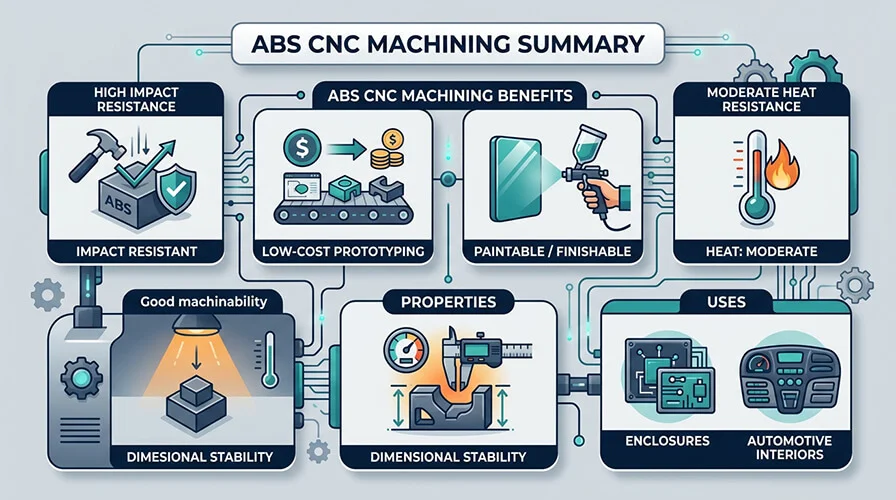
ABS is forgiving—until heat and thin geometry amplify its thermal expansion. This table focuses on the property drivers that affect tolerance, finish, and stability in real assemblies.
| Property driver | What it means for your part | Why it matters in machining |
|---|---|---|
| Impact resistance | Good toughness for housings and protective parts | Handles drops and vibration; design still needs fillets and ribs to avoid stress risers. |
| Paintability & finishability | Cosmetic finishes are common (paint, texture, smoothing) | Finishing level is a cost driver—define what surfaces are cosmetic vs functional. |
| Thermal behavior (Tg ~105°C) | Softens as temperature rises; not a high-temp resin | Avoid rubbing passes; sharp tools + chip evacuation prevent smear and edge melt. |
| CTE (thermal expansion) | Dimensions move more with temperature than metals | Thin walls and long parts can drift—tolerance only what matters (CTQs) and fixture correctly. |
| Moisture absorption | Generally lower than nylon; more stable in humidity | Good choice when nylon’s moisture-driven size change would be a risk, but ABS is less wear-focused. |
DFM Guide for ABS CNC Machining (Heat, Walls, Inserts)
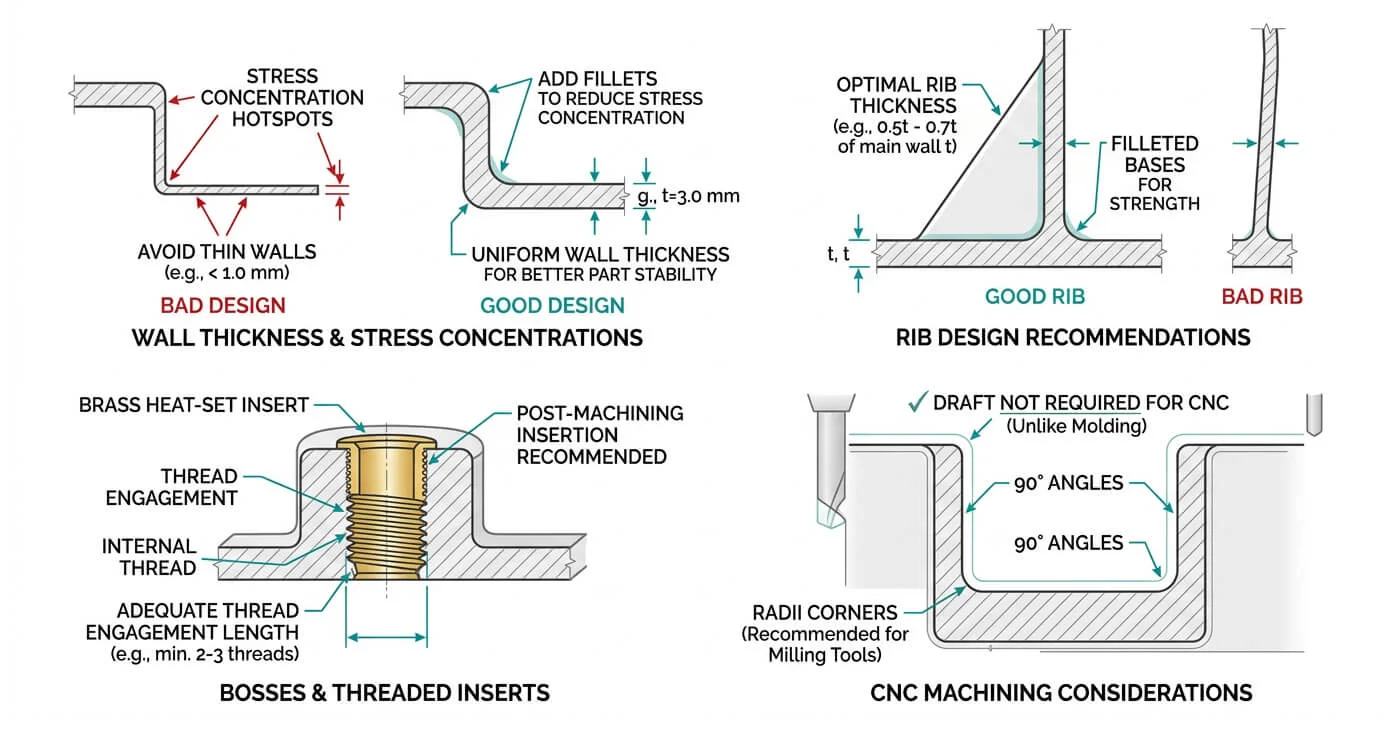
ABS machines cleanly with sharp tooling, but it punishes rubbing. The best DFM for precision ABS plastic machining is to design geometry that stays stiff in workholding and avoids thin sections that heat up and chatter.
Thin walls & large flats
ABS can flex under cutting forces. If you need thin cosmetic walls, isolate CTQs (datums/bores) in reinforced zones and accept looser walls where appearance allows.
Heat-set inserts (recommended)
For assembly threads, brass heat-set inserts are common in CNC machined ABS parts. Plan boss OD, wall support, and insertion access—this prevents cracking and improves repeatability.
Chip evacuation & tool sharpness
Smearing typically means rubbing. Use sharp cutters, proper chip load, and air blast/vac to clear chips—especially in pockets and deep cavities.
When to consider stress relief (annealing)
If you remove a lot of material from extruded ABS stock (deep pockets, thin walls), stress can release as warp. Some ABS suppliers publish stress-relief guidance such as heating to ~220°F (≈104°C) with a controlled heat-up and slow cool-down schedule. If your part is warp-sensitive, we can discuss a stress-relief step before final CTQ finishing.
- Best practice: rough → stabilize → finish critical features
- CTQ protection: machine datums/bores last when possible
- Communicate: tell us environment + inspection state (assembled, painted, etc.)
Tolerances & Surface Finish for CNC Machined ABS Parts
For custom ABS CNC machining service work, the winning strategy is not “tight everywhere.” It’s selecting CTQs, then using standard tolerances elsewhere to keep cost and lead time predictable. A common reference point in CNC machining is an as‑machined finish around Ra 3.2 μm (125 μin), with smoother finishes available when required.
| Requirement | What’s realistic | How to design/spec it |
|---|---|---|
| General dimensions | Standard tolerances (often ISO 2768 medium for non-CTQ) | Use general tolerances on non-critical features; reserve tight callouts for fits and datums. |
| CTQ bores / mating datums | Tighter tolerances are achievable on supported geometry | Add bosses, fillets, and tool access. Avoid extremely thin surrounding walls that can deflect and heat. |
| Cosmetic surfaces | Matte to glossy depends on process & finishing | Mark cosmetic faces and specify finish method: as-machined, bead blast, vapor smoothing, paint. |
| Threads | Inserts recommended for durability | Use brass heat-set inserts for repeatable torque and long thread life in ABS. |
Post‑Processing Options for ABS (Cosmetic & Assembly Ready)
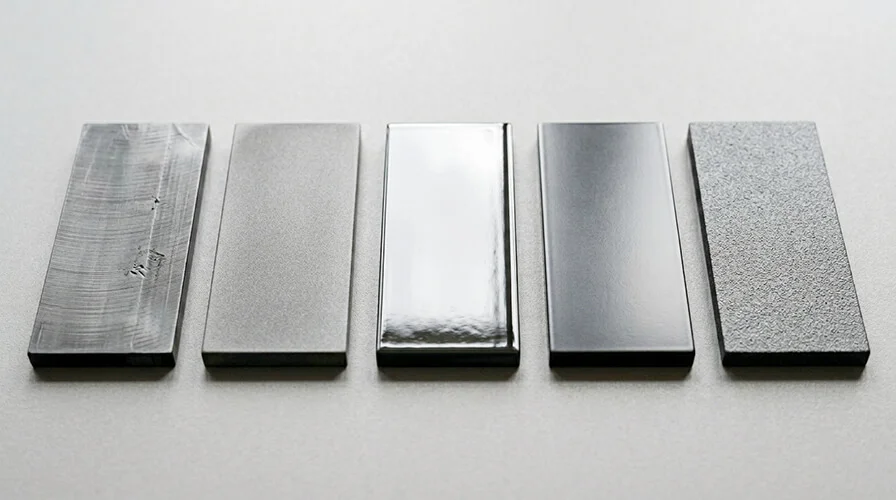
ABS is popular because it supports a wide range of secondary operations. If you need a “molded look” for a demo or pilot build, we’ll align machining + finishing to your cosmetic expectation.
Bead blasting
Creates a uniform matte appearance and reduces visible tool marks. Good for housings and covers when you want an even cosmetic texture.
Vapor smoothing
Used to reduce layer-like machining texture and approach a glossier surface. Best when appearance matters more than micro-texture on functional faces.
Painting / textured coating
ABS takes paint well. Define the coating type (matte/satin/gloss) and masking requirements for inserts, gaskets, and precision interfaces.
Common ABS CNC Machining Applications
ABS shows up where you need “tough + affordable + finishable.” These examples reflect typical RFQs we see for CNC machined ABS plastic parts.
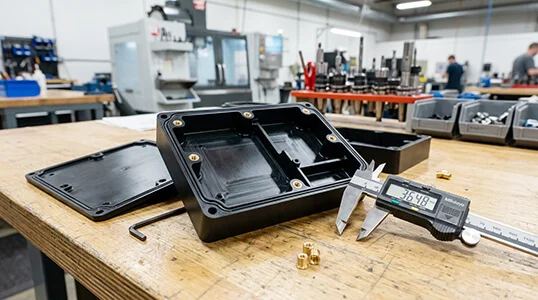
Enclosures & covers
Split housings, lids, and functional appearance prototypes with insert-ready bosses and gasket features.
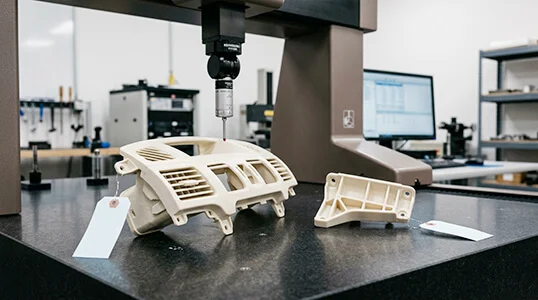
Automotive interior prototypes
Trim brackets, bezels, vents—fast fit and finish iteration before committing to tooling.
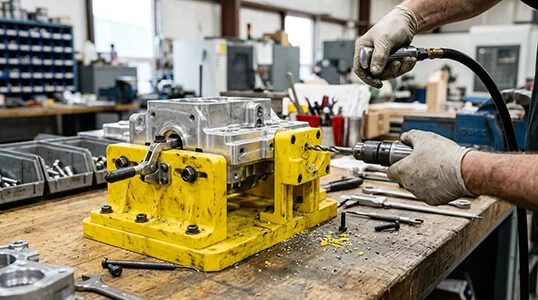
Jigs & fixtures
Durable, non-marring fixtures and guides that can be revised quickly as your assembly evolves.
ABS Grades We Commonly Machine
ABS family performance varies by grade and filler. Tell us your environment and cosmetic goals, and we’ll suggest a fit‑for‑purpose stock.
| Grade type | Why engineers pick it | Typical use |
|---|---|---|
| General purpose ABS | Balanced toughness + machinability + cost | Enclosures, brackets, prototypes |
| Flame-retardant ABS (FR) | Compliance-driven applications | Electronics housings (when specified) |
| Filled / reinforced ABS | Higher stiffness and lower movement in some cases | Fixture elements, structural covers (grade-dependent) |
Note: Availability varies by region and supplier. If you require UL files, certifications, or a specific brand/grade, include it in your RFQ.
ABS CNC Machining FAQ
Quick answers for design reviews, sourcing, and DFM discussions.
What tolerance should I call out for ABS plastic machining?
Start by identifying CTQs (mating bores, datums, sealing interfaces). Apply tight tolerances only where they protect function. For the rest, use a general tolerance standard (often ISO 2768 medium). This keeps machining time and scrap risk under control.
Do you recommend threads directly cut into ABS?
For light-duty or occasional assembly, tapped threads can work. For repeated assembly, torque requirements, or thin walls, brass heat-set threaded inserts are usually the better engineering choice.
Can ABS be bead blasted, vapor smoothed, or painted?
Yes. ABS is one of the most finish-friendly plastics. Define the cosmetic faces and the finish method so we can optimize machining (tool marks direction, allowances, masking for inserts/gaskets).
ABS vs Polycarbonate—what’s the difference for machining?
ABS is typically chosen for cost-effective, impact-resistant prototypes with great finish options. Polycarbonate (PC) is often chosen when you need higher toughness at temperature, transparency, or higher stiffness—but it can be more demanding to machine and finish depending on the geometry.
ABS vs Nylon—when should I choose ABS?
Choose ABS when you need a stable, finishable housing material and you want to avoid nylon’s moisture-driven size change. Choose nylon when wear and abrasion dominate and you can plan around conditioning state.
Get a Quote for ABS CNC Machining
To quote quickly and protect your schedule, send (1) 3D CAD + 2D drawing (or CTQ notes), (2) quantity, (3) finish requirement, and (4) where the part will live (temperature, assembly, cosmetic expectations). We’ll reply with DFM feedback and a lead-time/cost path.
What we need
STEP/IGES, CTQs, quantity, and any insert/paint specs. Mark cosmetic faces.
What you get
CTQ-driven plan, finish/tolerance guidance, and a quote aligned to your real requirements.
Next steps
Use your RFQ form or email us your package—ABS is ideal for rapid iteration.
Explore the hub: Engineering Plastics CNC Machining. Steel page: Steel CNC Machining.