
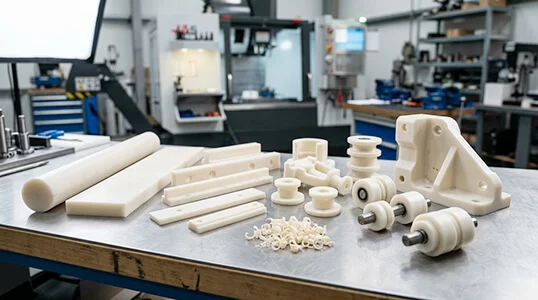
Nylon / PA CNC Machining Services
Batnon provides nylon cnc machining for functional parts that need toughness, abrasion resistance, and impact performance. The engineering reality with nylon (PA6/PA66) is moisture: it absorbs water from air and coolants, which can change dimensions over time. Our process plans for conditioning state, chip control, and CTQ-first inspection—so you get strong parts that stay predictable in assembly.
Need higher dimensional stability with low moisture impact? Compare with Delrin / POM CNC machining.
Plastic Material Pages
Same structure across materials—different machining physics. Use these pages to compare DFM, tolerances, and cost drivers.
Engineering Plastics
You are here: Nylon / PA. Explore the other engineering plastics pages:
High Performance Plastics
When temperature/chemicals/purity drive the spec:
PEEK · Ultem / PEI · PTFE · Vespel / PI
Fast selection hint
Nylon is often chosen when you need toughness and abrasion resistance. If your CTQs are tight fits in a humid environment, Delrin/POM is often more stable; for optical clarity or guards, Polycarbonate is a common pick.
- Best at: wear strips, guides, impact-prone parts
- Watch: moisture-driven size change, fuzzing on thin walls
- Cost lever: define conditioning state + CTQs
What Nylon (PA6 / PA66) Is — and When to Choose It
Nylon (polyamide) is a tough, wear-oriented engineering plastic. In nylon cnc machining, the key design variable is moisture: at typical indoor conditions, nylon absorbs water and can expand. For example, published polymer data shows equilibrium water absorption around 3.5% for nylon 6 and 2.5% for nylon 66 at 23°C/60%RH—often translating to ~0.2–0.3% dimensional change per 1% absorption. That’s why nylon selection is best when you value toughness and wear more than absolute dimensional stability.
Use case 1: Wear strips & guides
Choose nylon for sliding wear in automation and industrial equipment—especially when parts see abrasion, impact, and repeated contact.
Use case 2: Tough brackets & housings
For impact-prone components where brittle plastics crack, nylon’s toughness is often the differentiator—plan ribs and uniform walls to reduce movement.
Use case 3: Rollers & bushings
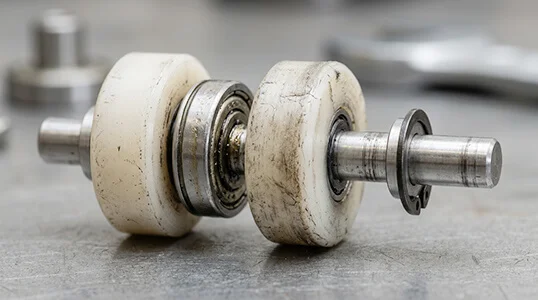
Nylon is commonly used for rollers and bushings where noise reduction and wear matter, but you must tolerance for humidity and conditioning state.
Key Nylon Properties That Affect CNC Machining
Nylon’s strength is toughness and wear—but moisture is the hidden variable that changes stiffness and size. This table focuses on what affects machining outcomes and assembly fit.
| Property driver | What it means for your part | Why it matters in machining |
|---|---|---|
| Toughness | Absorbs impact energy better than many engineering plastics | Good for clips, guards, and impact-prone parts—geometry should still avoid stress risers. |
| Abrasion resistance | Strong wear performance in many sliding applications | Often used for wear strips, guides, rollers—finish can be tuned for friction faces. |
| Moisture absorption | Hygroscopic—absorbs water from air/coolant, changing size and stiffness | Defines whether you machine “dry” or “conditioned” and how you tolerance CTQs. |
| Dimensional stability | Depends strongly on environment and conditioning state | Critical fits require a moisture plan; consider Delrin or PEEK if stability dominates. |
| Creep / long-term load | Can deform under sustained load (grade dependent) | Threads, bosses, and clamped joints often benefit from inserts and load spreading. |
Nylon vs Delrin (quick decision)
If you’re deciding “nylon vs delrin,” use this rule-of-thumb:
- Choose Nylon/PA for toughness and abrasion resistance—especially for wear and impact.
- Choose Delrin/POM for low moisture absorption and dimensional stability when fit is CTQ.
Deep dive: Delrin / POM CNC Machining Services.
Machining Notes (DFM): Moisture, Chip Control, Thin Walls, Threads & Inserts
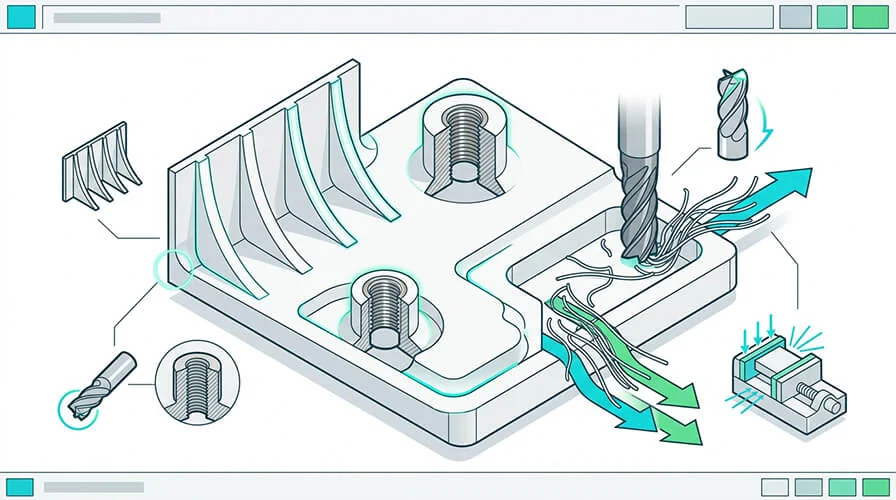
Nylon can produce long, stringy chips and it can “move” as humidity changes. Great nylon parts come from two decisions: moisture plan + chip plan.
| DFM item | Recommendation | What it prevents |
|---|---|---|
| Moisture plan | Define “as-machined dry” vs “conditioned” state for CTQ fits | Post-machining size drift and assembly mismatch in humid environments. |
| Chip control | Sharp tools, correct chip load, and good evacuation to avoid wrapping chips | Stringers that mar surfaces, heat buildup, and re-cutting. |
| Workholding | Avoid over-clamping; support thin features; use sacrificial support when needed | Oval bores, distortion, and chatter on thin walls. |
| Thin walls | Add ribs; maintain uniform wall sections; avoid tall thin webs | Fuzzing, vibration, and inconsistent finish. |
| Threads & inserts | Use inserts for repeated torque, high clamp loads, or creep-sensitive joints | Stripped threads and long-term loosening. |
Cost control (DFM-led)
For nylon cnc machining, cost is commonly driven by rework (from fuzz and movement) and by over-tolerancing. The fastest wins are: define CTQs, define conditioning state, and avoid thin, unsupported features.
- Conditioning state: “dry” vs “conditioned” changes how you tolerance fits
- CTQ-only tolerances: tighten bores/datum features; relax hidden faces
- Geometry: ribs and support reduce chatter and finish problems
Tolerances & Surface Finish Guidance for Nylon CNC Machining
Nylon can hold practical tolerances, but you’ll get the most reliable assembly if you connect tolerance strategy to humidity exposure and the intended conditioning state.
| Topic | What’s realistic | Where it fails |
|---|---|---|
| CTQ bores & datums | Achievable with stable geometry and a moisture-aware plan | Fits can drift if the part absorbs moisture after machining—define the state. |
| Thin, tall features | Possible with ribs and conservative geometry | More likely to fuzz, chatter, and distort under clamping. |
| Surface finish | As-machined satin is common; deburr and edge break improve assembly | Over-finishing can round edges and change fit—identify cosmetic faces. |
Post-Processing, Conditioning & Packaging (As Required)
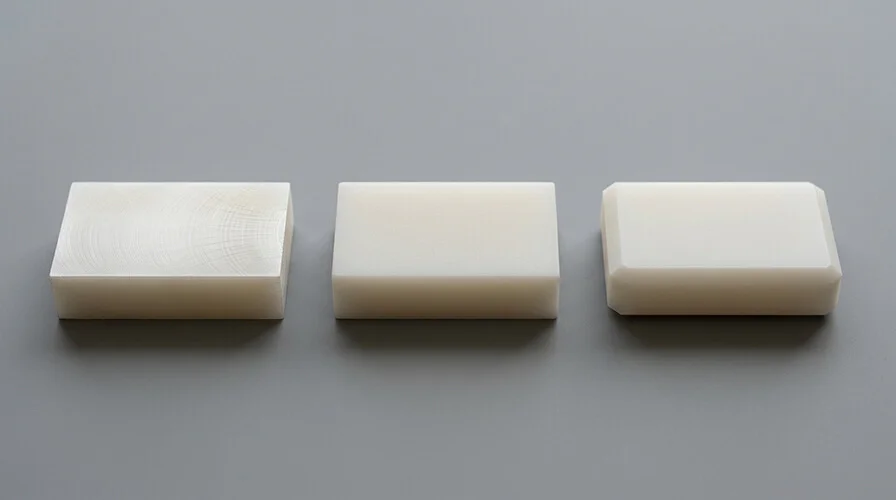
With nylon, post-processing is often about two things: edge quality and moisture state. If your assembly depends on fit, define whether parts should be delivered dry/as-machined or pre-conditioned.
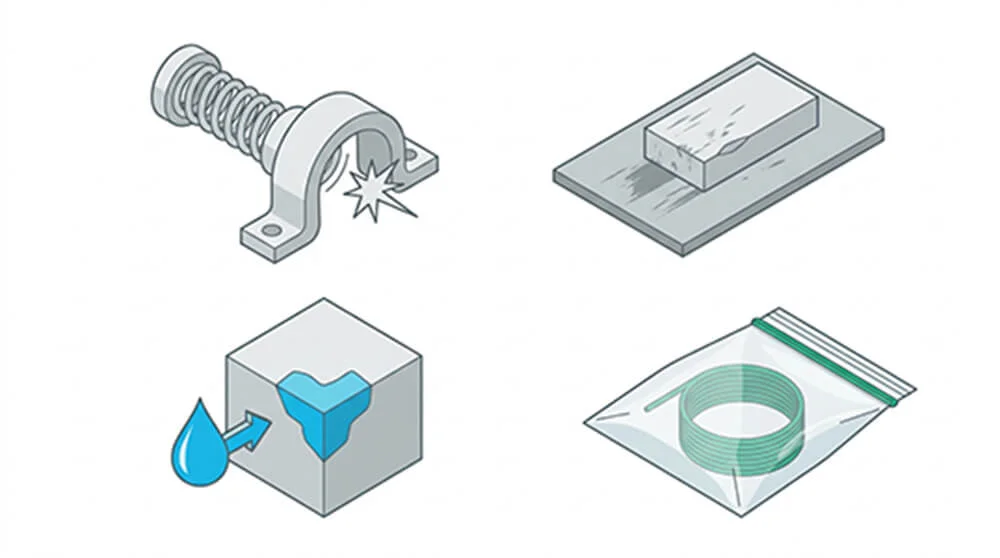
Deburr + edge break
Reduces shaving and improves assembly feel, especially on snap features and sliding interfaces.
Conditioning control
For fit-critical builds, we can plan delivery state (dry vs conditioned) so you’re not surprised by humidity-driven size change.
Packaging (by request)
Protects surfaces and keeps kits organized for line-side assembly and repeat builds.
Common Nylon CNC Machining Applications
Nylon is common in automation, industrial equipment, and motion assemblies where wear and toughness matter more than perfect dimensional stability.
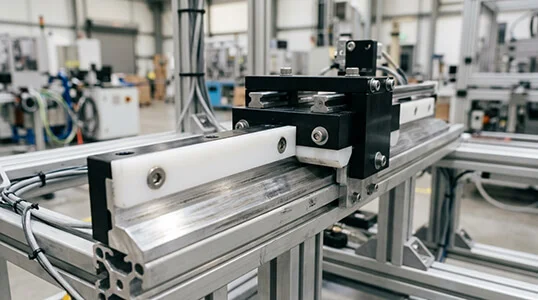
Wear strips & guides
Sliding wear components designed for abrasion and repeated motion—CTQs are usually thickness and mounting pattern.
Rollers & bushings
Quiet motion and good wear behavior—tolerance strategy should account for humidity exposure.
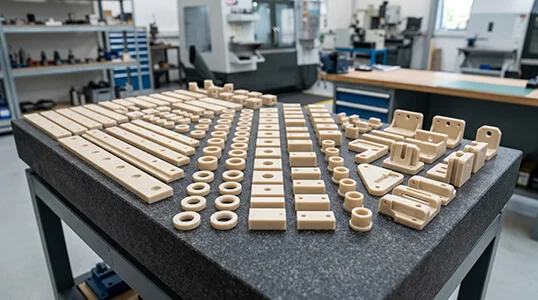
Production-ready parts
Inspection aligned to CTQs (bores/datum features) so you get evidence where it reduces risk.
Typical parts we see
- Wear strips, slide pads, guides, gripper jaws
- Rollers, bushings, spacers, impact-prone brackets
- Fixture components and protective covers
- Machine guards and handling parts where toughness matters
Nylon Grades (If Specified)
If you already specify PA6, PA66, cast nylon, or a filled grade, we’ll match it. If not, we can recommend based on humidity exposure, wear mode, and whether stiffness or toughness is the priority.
How to specify quickly
When requesting nylon cnc machining, include:
- Grade intent: PA6 vs PA66 vs cast nylon vs filled
- Conditioning state: dry/as-machined vs conditioned (for CTQs)
- Environment: humidity, water contact, lubrication, temperature
If you’re unsure, tell us the failure mode (wear, impact, fit drift) and we’ll recommend.
FAQ: Nylon / PA CNC Machining
Common questions about moisture, tolerances, and material selection for nylon cnc machining.
Nylon vs Delrin for CNC machining—what should I choose?
Use Delrin/POM when dimensional stability and low moisture absorption are critical for fit. Choose Nylon/PA when toughness, abrasion resistance, and impact performance are the priority—and plan for moisture-driven size change through conditioning and pragmatic tolerancing.
Why do nylon parts change size after machining?
Nylon is hygroscopic and absorbs moisture from air and coolants, which can change dimensions and stiffness. For precision fits, it helps to define the conditioning state (dry/as-machined vs conditioned), avoid water-based coolant exposure when possible, and tolerance CTQs accordingly.
Can nylon hold tight CNC tolerances?
Yes—on the right geometry and with a moisture-aware plan. The most reliable approach is CTQ-driven tolerancing: hold tight bores and datums, and use standard tolerances elsewhere. For very tight fits, consider conditioned nylon or a more dimensionally stable resin like Delrin or PEEK.
PA6 vs PA66—what’s the machining difference?
Both machine well, but they behave differently with moisture and toughness. PA66 is often stiffer and can have lower equilibrium moisture uptake than PA6, while PA6 is often tougher and more forgiving. The right choice depends on humidity exposure, wear mode, and the CTQs you need to protect.
How do you prevent fuzzing and poor surface finish in nylon CNC machining?
Fuzz and roughness usually come from dull tools, rubbing, or chip re-cutting. Sharp tooling, correct chip load, good chip evacuation, and stable workholding (especially on thin walls) improve edge quality and surface finish.
Is nylon good for sliding wear parts?
Often yes—nylon’s abrasion resistance can perform well in wear applications, especially when paired with appropriate surface finish and lubrication conditions. The right grade and mating material selection matters for long-term wear.
Nylon CNC Machining for Prototypes and Production
Batnon supports Nylon/PA CNC machined parts for engineering teams worldwide—from rapid prototypes to repeat production. Share your humidity exposure, conditioning state intent, CTQs, and quantity, and we’ll build a moisture-aware machining and inspection plan so parts assemble predictably and remain cost-competitive.
For higher temperature or aggressive chemistry, use: High Performance Plastics CNC Machining.
Explore Other Plastic Materials
Compare machining behavior, tolerances, and DFM notes across plastics:
- Engineering plastics: Delrin / POM · Nylon / PA · ABS · Polycarbonate / PC
- High performance plastics: PEEK · Ultem / PEI · PTFE · Vespel / PI
If you’re unsure where to start, tell us the failure mode (wear, impact, fit drift, temperature, chemicals, purity) and we’ll route you to the right material page.