
High-Performance Plastics CNC Machining
Batnon provides high performance plastics CNC machining services for buyers who need predictable fit, stable tolerances, and dependable documentation. This page focuses on CNC machining high performance plastics parts—including precision CNC machining PEEK parts, Ultem PEI CNC machining service, PTFE Teflon CNC machining supplier, and Vespel polyimide CNC machining—with DFM decisions that protect both part performance and pricing.
Already have a material decision? Explore sub-pages: PEEK · Ultem / PEI · PTFE · Vespel
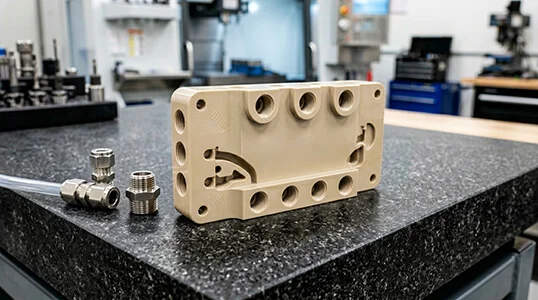 Inspection Mindset
CTQ-first inspection planning supports tight tolerance plastic CNC machining and cleaner first-pass approvals.
Inspection Mindset
CTQ-first inspection planning supports tight tolerance plastic CNC machining and cleaner first-pass approvals.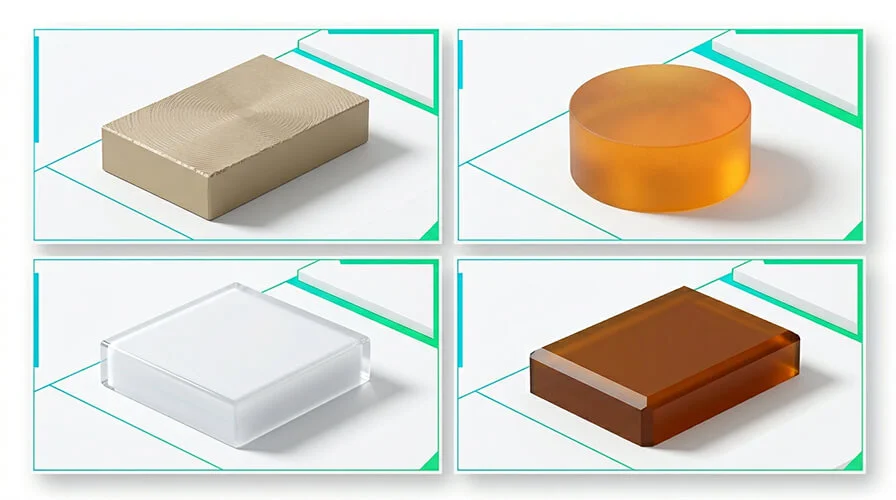 Material Breadth
Engineered thermoplastics machining across grades, fillers, and performance requirements—priced by real manufacturability.
Material Breadth
Engineered thermoplastics machining across grades, fillers, and performance requirements—priced by real manufacturability.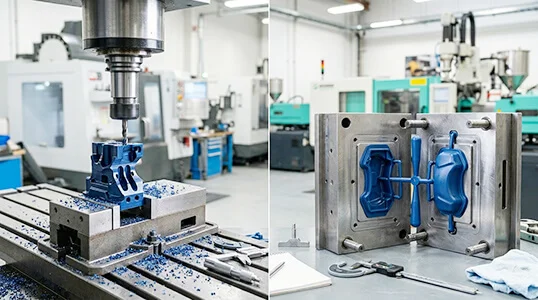 Decision Support
DFM support for machined plastic parts helps your team choose tolerances, radii, walls, and finishes without hidden cost traps.
Decision Support
DFM support for machined plastic parts helps your team choose tolerances, radii, walls, and finishes without hidden cost traps.How Buyers Evaluate High-Performance Plastics Parts
Most RFQs fail at the same points: unclear CTQs, unspecified grades, and geometry that quietly drives cycle time. Use this framework to align performance first, then cost.
| Decision Step | What To Specify | Why It Impacts Performance And Cost |
|---|---|---|
| Material Intent | Exact grade (e.g., PEEK, PEI/Ultem, PTFE, polyimide) and any fillers/ESD/purity needs | Different grades machine differently and can change stability, wear, and outgassing behavior |
| CTQs | Datums + features that gate assembly (bores, true position, sealing faces) | CTQ-driven tolerancing avoids over-tolerancing non-critical features that inflate inspection cost |
| Geometry Risk | Thin walls, deep pockets, deep holes, sharp internal corners | These drive heat, deflection, and tool reach limits—raising cycle time and warp risk |
| Finish + Handling | Surface finish targets and sensitive faces that must be protected | Finishes can add steps; protective handling prevents rework |
| Evidence | Inspection level (standard checks vs dimensional/CMM evidence) | You buy confidence—evidence should match what actually matters for assembly |
High-Performance Plastics We Machine
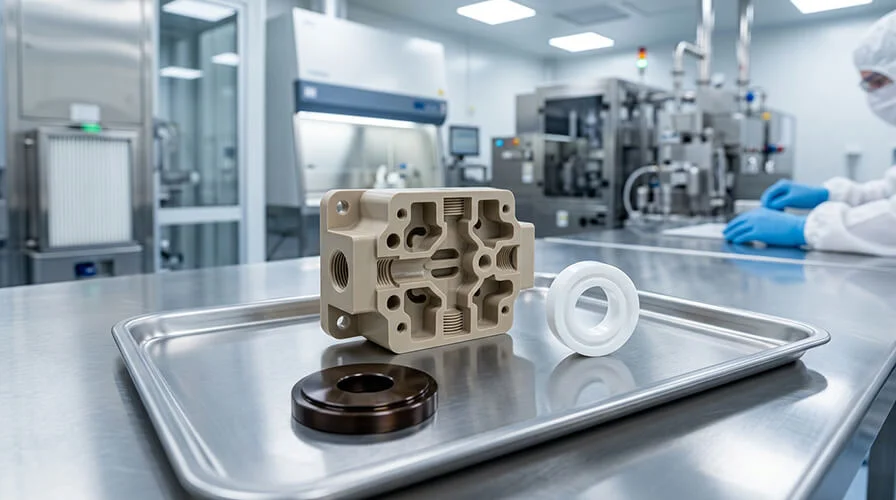
These materials are selected for heat, chemicals, wear, purity, vacuum/outgassing, or ESD needs. For accurate quoting, specify the exact grade and any compliance constraints.
Where High-Performance Plastics Win
They often replace metal where corrosion, friction, weight, electrical insulation, or process cleanliness matters.
| Material | Best For | Common Buyer Triggers | Notes For Machining |
|---|---|---|---|
| PEEK | High heat + chemical resistance, wear, dimensional stability | Semiconductor equipment, medical devices, aerospace/energy components | Available in reinforced grades; specify grade/condition for stable tolerances |
| Ultem (PEI) | High stiffness, heat resistance, electrical applications | Fixtures, insulators, housings where stability matters | Good option when performance is needed with cost awareness |
| PTFE (Teflon) | Chemical resistance, low friction, sealing | Wet processes, aggressive chemicals, seals, washers | Soft material—workholding and inserts often matter more than “tight threads” |
| Vespel (Polyimide) | High temperature, vacuum/outgassing, wear, demanding environments | Semiconductor/vacuum hardware, high-temp insulators, wear parts | Published guidance recommends roughing then conditioning/equilibrating before finish machining for stability |
Reference notes are consistent with published guidance from Protolabs (PEEK overview), DuPont (Vespel machining guide), Ensinger and Xometry (DFM rules for machined plastics).
DFM Support For Machined Plastic Parts
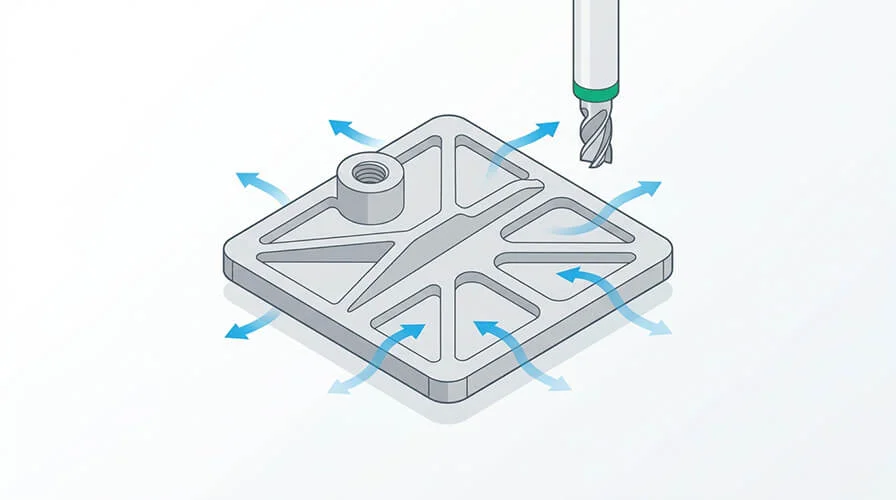
Competitive pricing comes from reducing cycle time and inspection load without compromising CTQs. These are the most common cost levers for DFM support for machined plastic parts.
Why Plastics Need Different DFM Thinking
Heat, stress relief, and wall stiffness affect stability. DFM should protect function first, then remove unnecessary cost drivers.
| DFM Lever | Recommendation | Why It Helps |
|---|---|---|
| Wall Thickness | Keep walls thick enough for stiffness; published guidance often cites ~1.5 mm minimum for machined plastics | Thin walls soften/warp from heat and chatter, reducing accuracy and increasing scrap risk |
| Internal Radii | Add radii and avoid sharp corners; guidance commonly recommends inner radius ~1.3× tool radius | Larger tools reduce time and improve surface quality; sharp corners force tiny tools and long cycles |
| Deep Features | Avoid deep narrow pockets and keep hole depth/diameter ratios reasonable | Tool reach limits raise time and deflection; chip evacuation becomes a stability issue |
| CTQ-Driven Tolerances | Hold tight tolerances only where they gate assembly/performance | Reduces inspection overhead and makes pricing more competitive |
| Threads And Inserts | Consider inserts in softer materials instead of deep tapped threads | Improves durability and repeatability in assembly |
Tight Tolerance Plastic CNC Machining With Evidence
If you need tight tolerance plastic CNC machining with inspection report, define CTQs and the evidence level. We build inspection around what gates assembly, not around measuring everything.
CTQ Alignment
Call out the datums and features that matter—bores, true position, sealing faces, and critical flatness—so inspection matches risk.
Stability Planning
For certain polymers and geometries, roughing then conditioning/equilibrating before finishing improves dimensional stability and repeatability.
Documentation Options
Choose standard checks or a dimensional report. The goal is decision-grade evidence that the part will assemble and perform.
| Inspection Level | Best For | What You Receive |
|---|---|---|
| Standard Inspection | Non-critical parts, early prototypes | Visual + dimensional checks on key features |
| Dimensional Report | Assemblies with defined CTQs | Measured results tied to datums/CTQs (method depends on geometry) |
| Traceability Package | Compliance-sensitive programs | Material/lot traceability evidence when requested + inspection evidence |
Surface Finish And Handling For Plastic Parts
Finish is functional: it affects friction, sealing, cleanliness, and wear. Specify the faces that matter to keep cost controlled.
Functional Surfaces
Sealing faces, bearing seats, and sliding surfaces should be called out clearly. If only one face matters, don’t “polish everything.”
Handling Protection
Many polymers scratch more easily than metals. Define sensitive faces so packaging and handling prevent cosmetic rework.
Case Study: High-Performance Plastics Part Family
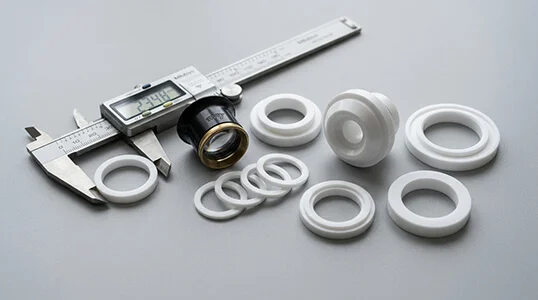
A typical plastics program isn’t one part—it’s a small family with different CTQs, finishes, and inspection needs. Here’s how we structure it to reduce risk and protect schedule.
Custom PEEK Components For Semiconductor Equipment
Case structure: problem → solution → result → impact, with CTQ-first inspection planning.
Problem
Mixed CTQs across a part family, tight fits on key features, and a need for confidence before scaling.
Solution
CTQ-driven tolerancing, stability-aware machining plan, and inspection evidence aligned to datums.
Result
Cleaner first-pass approvals with fewer revisions and reduced quote friction.
Impact
Faster decision-making for engineering and procurement, with a repeatable path from prototype to production.
Note: this is a template. Share your real program details and we’ll replace it with a true Batnon case story.
Request A Quote: Faster RFQ For Machined Plastic Parts
For the fastest quote, include STEP + 2D drawing, material grade, quantities, finish requirements, and inspection level. This is the cleanest path to prototype to production plastic CNC machining.
Upload Your CAD File For Quote
Form fields (per your rules): Name (required), Email (required), Message, Attachment (optional). Messages should route to sales@batnon.com using your Easy WP SMTP setup.
| RFQ Item | What To Send | Why It Speeds Quoting |
|---|---|---|
| Geometry | STEP model + 2D drawing | Prevents ambiguity in datums, notes, and CTQs |
| Material | Exact grade + condition | High-performance plastics vary by grade, fillers, and stability |
| Quantity | Qty tiers (e.g., 1 / 10 / 100) | Setup amortization changes unit cost and lead time |
| Finish | Functional surfaces + sensitivity | Protects cosmetic/functional faces and avoids rework |
| Evidence | Inspection level + CTQs | Aligns inspection effort to what gates assembly |
After submit success: /thank-you. If submit fails, show an error message in your form plugin.
High-Performance Plastic Parts
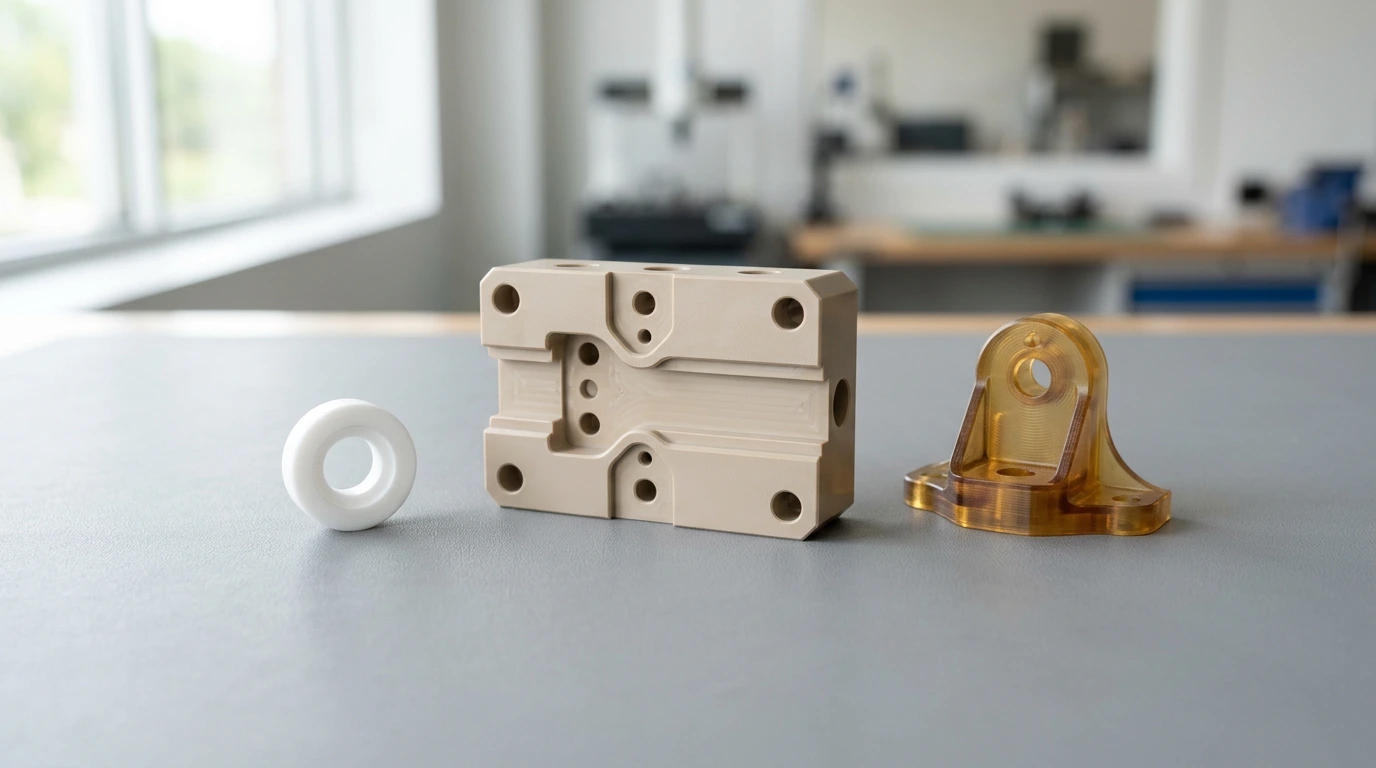
A representative set of machined PEEK and PEI parts with clean edges and stable features—ideal for RFQ-ready drawings and inspection planning.
Image note: hpp-rfq-plastic-part.webp (served from WordPress Media Library).
FAQ
Common questions about high-performance plastics CNC machining services, material selection, DFM, and inspection evidence.
What are high-performance plastics in CNC machining?
They are polymers chosen for high temperature, chemicals, wear, purity, vacuum/outgassing, or electrical/ESD constraints (examples include PEEK, Ultem/PEI, PTFE, and Vespel polyimide). Machining is common for complex geometry and low-to-mid volume parts.
Can you CNC machine PEEK parts for demanding applications?
Yes. We support precision CNC machining PEEK parts and can recommend DFM changes that reduce cycle time while protecting CTQs and stability.
Do you offer Ultem (PEI) CNC machining service?
Yes. We support Ultem PEI CNC machining service for fixtures, housings, and high-temperature electrical applications where stability matters.
Can you machine PTFE (Teflon) for chemical resistance?
Yes. As a PTFE Teflon CNC machining supplier, we plan workholding and thread strategy carefully because PTFE is soft and can deform if the process is not designed for it.
Do you machine Vespel polyimide parts?
Yes. For Vespel polyimide CNC machining, stability planning matters—published guidance recommends roughing and conditioning/equilibrating before finish machining for certain geometries.
What tolerances can you hold on machined plastic parts?
Tolerances depend on geometry and material behavior. The best approach is CTQ-driven tolerancing: hold tight only where it gates assembly or performance, and allow standard tolerances elsewhere.
How do you prevent warping in plastic machining?
We manage heat and stress during machining, avoid overly thin walls when possible, choose appropriate tooling/workholding, and apply conditioning where needed for stability.
How do I get a fast quote for high performance plastics CNC machining services?
Send STEP + 2D drawing, exact grade, quantities (tiers if possible), finish requirements, and inspection level. Highlight CTQs to reduce quote friction and avoid rework.
High-Performance Plastics CNC Machining
If you’re searching for high performance plastics CNC machining services, CNC machining high performance plastics parts, tight tolerance plastic CNC machining with inspection report, or DFM support for machined plastic parts, this page is built as a buyer-first decision path. You’ll see material intent → CTQs → DFM cost levers → inspection evidence → RFQ checklist, so your team can move from review to shipped parts with less friction.
Popular sub-topics: PEEK CNC Machining, Ultem / PEI CNC Machining, PTFE CNC Machining, Vespel CNC Machining.