
- ISO 13485 • AS9100 • On-Demand Manufacturing for Engineers
Precision CNC Machining for Critical Industries
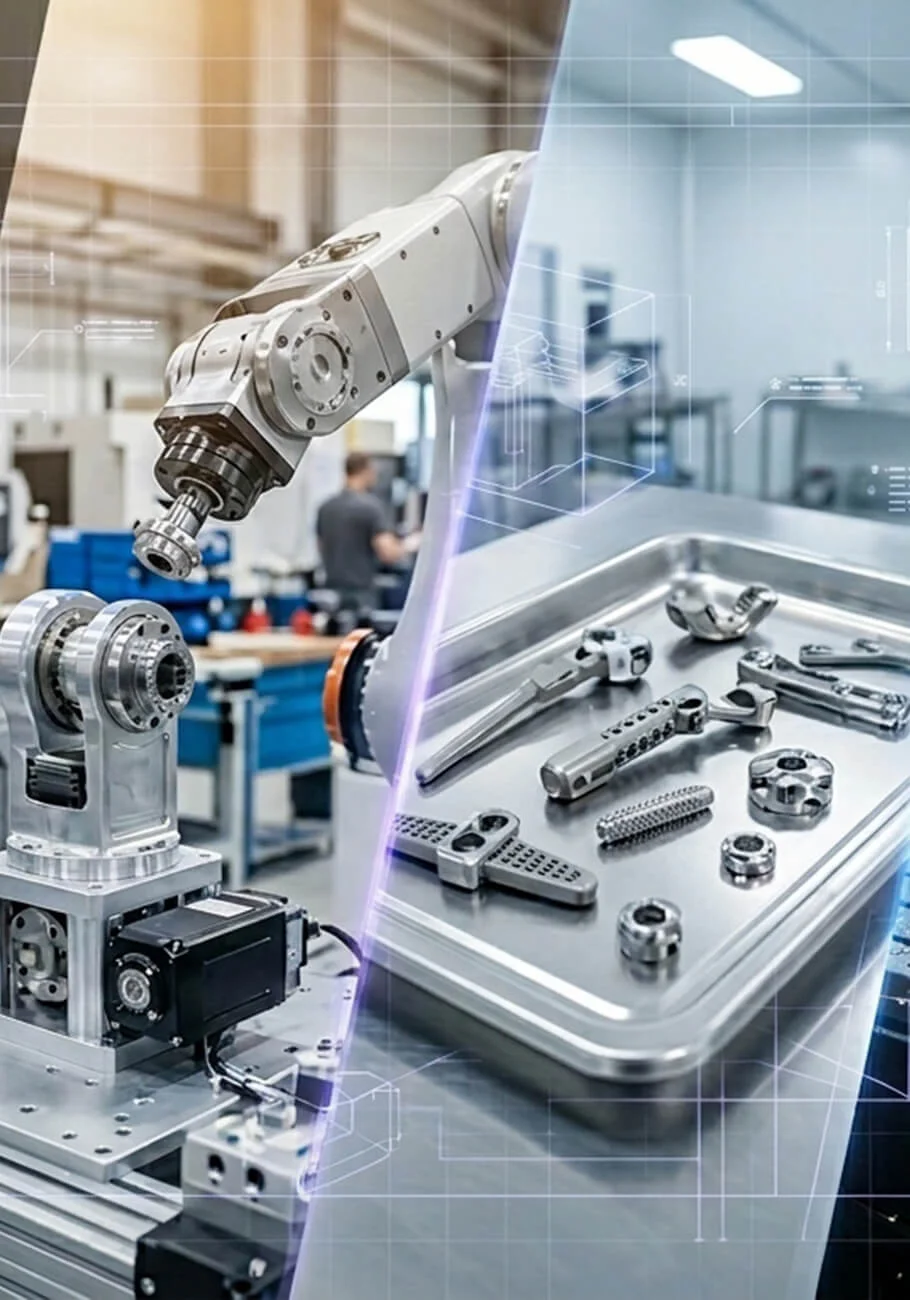
We deliver high-precision components for cnc machining for medical devices, robotics cnc machining, battery manufacturing equipment, industrial metrology, semiconductor cnc machining, and premium consumer electronics. From rapid prototyping to production manufacturing with tight tolerances ±0.001″.
ISO 13485 Capable
Free DFM Review
Prototype-to-Production
No MOQ

ISO 9001 & 13485

Material traceability

CMM reporting

Revision Control
Industry Lanes
We specialize in fit-critical assemblies, regulated industries, and on-demand manufacturing for engineers across six key sectors.
Medical Devices & Life Sciences
Medical programs optimize for: documentation clarity, repeatability, sterilization-ready materials, and risk-managed inspection scope. Align CTQ features early to avoid remakes late in validation.
✔ Common parts: housings, diagnostic fixtures, instrument components, wearables hardware
✔ Materials: 316L, titanium (Gr2/Gr5), PEEK/PEI (Ultem) (application-dependent)
✔ Quality: CoC + CTQ FAI; CMM reports when risk is high
Robotics & Automation
Robotics speed is usually a fit problem: bearings seat, holes align, joints move without binding. The biggest win is reducing setup count and defining CTQ surfaces that actually control motion.
✔ Common parts: end-effectors, arm frames, linkages, sensor mounts, jigs & fixtures
✔ Workflow: cnc machining for robotics automation often starts with prototypes, then bridge production
✔ Quality: targeted FAI for alignment features; cosmetic finishes optional early
Battery & Energy Storage Equipment
Equipment builders care about repeatable interfaces: datum consistency, sealing surfaces, and fast spare-part iteration. Treat fixtures and tooling as a system, not one-off parts.
✔ Common parts: tooling plates, brackets, manifolds, inspection fixtures, actuator mounts
✔ Prototype loop: cnc machining for battery equipment prototypes to validate stations quickly
✔ Quality: CoC plus CTQ checks on leak paths, alignment dowels, threads
Industrial Metrology & Inspection Automation
Metrology hardware is where tolerance stackups become product performance. Focus on datum strategy, surface finish intent, and inspection evidence that matches how your system verifies reality.
✔ Common parts: fixturing systems, probe mounts, calibration artifacts, sensor housings
✔ Quality: dimensional inspection report DIR and certificate of conformance CoC (as needed)
✔ Finishes: control Ra where measurement repeatability matters
Semiconductor Equipment & Advanced Packaging
Consumer electronics programs fight two battles at once: mechanical reliability and cosmetic expectations. Prototype fast, validate feel/fit, then tighten cosmetics and finishing as you converge.
✔ Common parts: enclosures, brackets, thermal components, camera/optics fixtures
✔ Finishes: bead blast, anodize, brushing, laser marking (application-dependent)
✔ Workflow: rapid prototyping to production manufacturing with clear revision control
Consumer Electronics
This lane is listed for completeness. Many programs require precision fixtures, frames, and vacuum/thermal interfaces. As requested, it is ranked lowest in priority for the Batnon industry focus.
✔ Common parts: tooling plates, alignment fixtures, component frames, test hardware
✔ Risk: surface finish, flatness, cleanliness, and documented inspection requirements
✔ Note: confirm any special standards during RFQ
Quick comparison: what each lane optimizes
| Lane | Optimizes for | Typical CTQ focus | Common evidence |
| Medical devices | Compliance + repeatability | Fit, sealing, alignment, sterilization surfaces | CoC, material certs, CTQ FAI, CMM (as needed) |
| Robotics & automation | Iteration speed + assembly fit | Bearing seats, alignment holes, mating faces | Targeted FAI, functional checks, finish notes |
| Battery equipment | Uptime + interface consistency | Leak paths, threads, datum faces | CoC + CTQ checks, revision discipline |
| Industrial metrology | Measurement repeatability | Datums, flatness, surface finish (Ra) intent | DIR, CMM report, calibration artifacts (project-dependent) |
| Consumer electronics | Cosmetics + fast convergence | Critical interfaces + cosmetic surfaces | Finish samples, CTQ list, revision control |
| Semiconductor equipment | Precision fixtures + cleanliness needs | Flatness, surface finish, alignment | Inspection evidence per program requirement |
This matrix is a planning aid for your RFQ. It’s not a capability claim.
How Engineers Choose a CNC Supplier
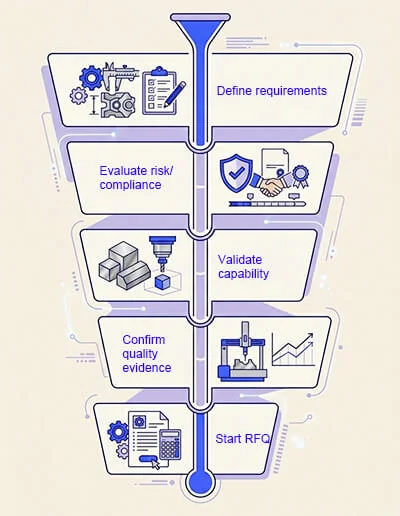
Define requirements
Material, function, and the few CTQ features that decide pass/fail. This is where most RFQs break: missing drawings or unclear datums.
Evaluate risk/compliance
For regulated programs (e.g., cnc machining for medical devices), define what documentation you actually need: CoC, material certs, traceability, and inspection scope.
Validate capability
Does the supplier support the necessary process route (milling, turning, multi-axis), materials, and finishes? Use DFM feedback to remove geometry traps.
Confirm quality evidence
Evidence beats marketing: first article inspection FAI, CMM reports, dimensional inspection report DIR, and clearly scoped CTQ verification.
Start RFQ
RFQ should specify: files, CTQ list, cosmetic surfaces, quantity, target date, and inspection deliverables. The goal is zero clarification emails.
Quality Documentation Ladder
In regulated and high-risk builds, quality is the paper trail. Match documentation to risk to avoid paying for reports you won’t use—or skipping evidence you’ll need later.
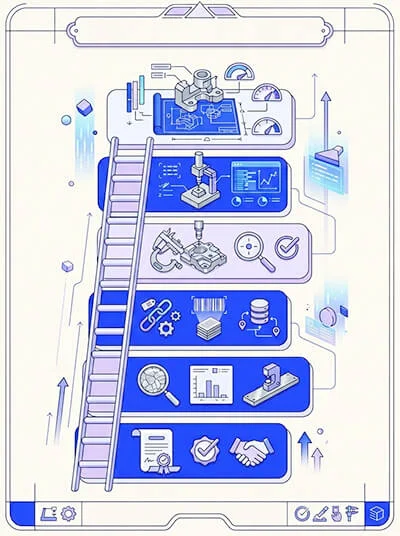
Documentation checklist (copy/paste into RFQ)
| Deliverable | What it answers | Typical usage |
| Certificate of Conformance (CoC) | Did you build to the order requirements? | Baseline for procurement and traceability requests. |
| Material certifications | Is the alloy/grade what we specified? | Regulated lanes; critical strength/corrosion programs. |
| Lot traceability (as applicable) | Can we trace back to material/process lots? | Programs with QA audits and formal change control. |
| CTQ First Article Inspection (FAI) | Do the CTQ features meet spec on first build? | Robotics fit; medical validation; fixtures with alignment constraints. |
| CMM report / inspection report | What are actuals vs nominals on selected features? | High-risk dimensions, tight tolerances, metrology hardware. |
| Full dimensional inspection | Do all measured features meet drawing requirements? | When failure cost is extreme or customer requires full evidence. |
From Prototype to Production (What Changes by Stage)
A fast program isn’t one quote—it’s a controlled learning loop. The same part will behave differently when you tighten tolerances, add finishing, or increase quantity.
Lifecycle snapshot
Use this to choose the right service page: prototype CNC machining services for speed, custom CNC machining services for complex geometry, and precision CNC machining services when verification is the product.
| Stage | Primary goal | What to lock down |
| Prototype | Learn fast (fit/function) | CTQ list, in-stock materials, minimal finishing |
| EVT / DVT | Validate design choices | Interfaces, stackups, inspection plan for CTQ |
| PVT / Bridge | Prove manufacturability | Revision control, stable suppliers, repeat routing |
| Production | Repeatable yield & cost-down | Process control, documentation scope, finishing consistency |
DFM levers that change lead time
These are the most common causes of quoting delays and schedule slips across cnc machining industries:
◆ Too many setups: each re-clamp adds time and risk. Favor tool access or multi-axis routing.
◆ Unnecessary tight tolerances: tighten CTQ only; loosen non-critical dimensions.
◆ Deep pockets / thin walls: slower toolpaths and higher scrap risk.
◆ Finishing surprises: anodize/plating/masking can add days; specify critical surfaces early.
◆ Missing intent: unclear datums, missing 2D drawing notes, no cosmetic surface definition.
LSI embedded: design for manufacturability DFM feedback, on-demand manufacturing for engineers.
Core CNC Machining Capabilities
Precision CNC Machining Services
Tight tolerances ±0.00019″, 5-axis CNC, Swiss machining for fit-critical assemblies.
Custom CNC Machining Services
Design for manufacturability (DFM) feedback, rapid prototyping to production manufacturing.
Prototype CNC Machining Services
Medical device prototyping cnc machining and cnc machining for battery equipment prototypes with fast turnaround.
RFQ Readiness Checklist
| RFQ checklist (fast-turn + quality-ready): |
| Files: STEP/STP preferred; include native CAD if available. |
| 2D drawing: tolerances/GD&T, CTQ marks, cosmetic surfaces. |
| Material: alloy/grade + temper; note substitutions allowed. |
| Finish: as-machined vs anodize/bead blast; note masking/critical surfaces. |
| Quantity: prototype qty (1–5, 10, etc.) + expected iteration count. |
| Target date: required-by date and whether partial shipment is OK. |
| Inspection: CoC, CTQ FAI, DIR/CMM report (scope/count). |
| Industry lane: select which lane you’re building for (medical/robotics/battery/metrology/consumer/semiconductor). |
🗣️ What Our Customers Say
Real feedback from engineers and operations leaders who made the switch to Batnon.
“We were looking for CNC machining for medical devices, but most suppliers treated it like a standard machining job. Batnon understood the importance of clean edges, consistent fit, and how the parts would be handled in assembly.”
Senior Product Engineer at MedCore Systems
“Our project required robotics CNC machining for multiple brackets and alignment components. Batnon didn’t just machine parts — they understood how everything comes together in the system, which made a big difference during integration.”
Lead Mechanical Engineer at MotionEdge Robotics
“We needed custom machined parts for battery manufacturing equipment, including guides and sensor mounts. Batnon paid attention to how the parts interact within the process, not just the drawing itself.”
Equipment Design Manager at Voltis Energy Solutions
Case: How Daniel Reduced Cobot Weight and Increased Line Speed
Product Design Lead, Global Automation Systems
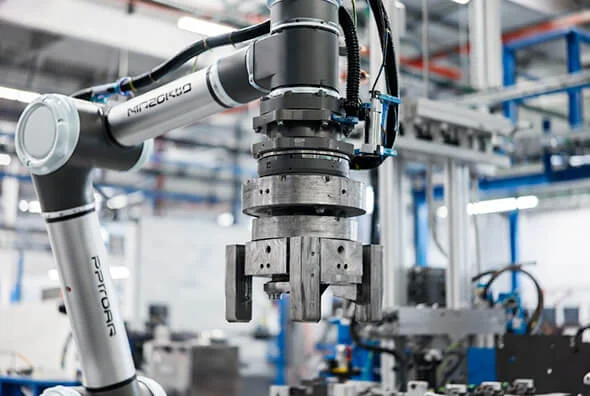
Challenge:
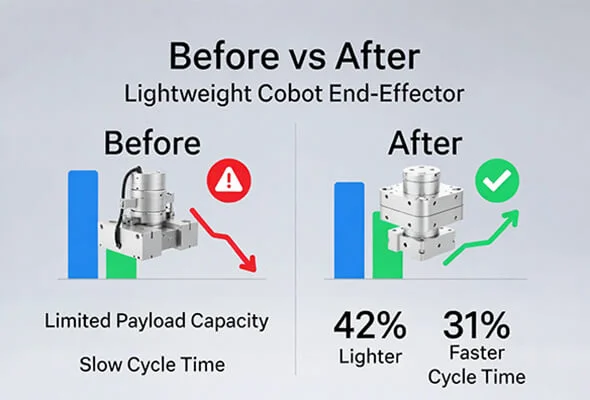
Heavy steel end-effectors exceeded cobot payload limits, restricted motion range, and slowed cycle times in high-volume assembly lines.

Our Solution:
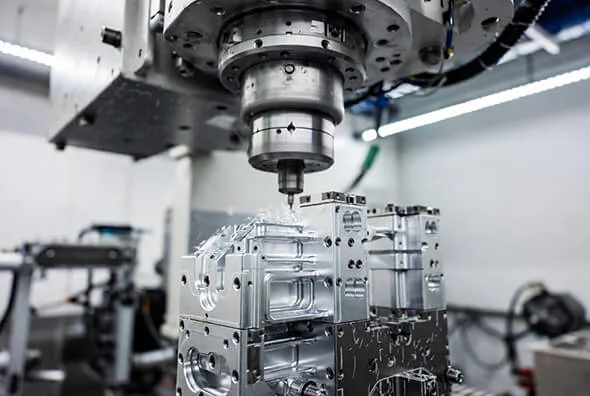
Switched to lightweight magnesium alloys and applied 5-axis CNC machining with in-process probing. Delivered custom end-of-arm tooling with integrated sensor mounts and precise alignment features.
Results:
• Weight reduced by 42% • Cycle time improved by 31% • Effective payload capacity increased by 55% • 250 parts delivered in 12 days
Impact:
Daniel successfully met aggressive production ramp-up targets.
Line throughput increased significantly with zero field failures reported.
Your CNC Machining Questions, Answered
No MOQ, ISO9001 certified, and precision down to ±0.005mm/0.00019in –
everything you need to know before your first quote.
How do I know which industry page fits my CNC machining project?
Choose based on how your part is used, not just what it looks like. The same geometry can belong to different industries depending on assembly function, environment, and performance requirements.
My part could fit multiple industries — what should I do?
That’s common. Many parts apply to robotics, battery equipment, or inspection systems at the same time. Send your CAD with application context, and we’ll route it to the most relevant machining approach.
Do you support both prototype and low-volume production across these industries?
Yes. Most projects start with prototype CNC machining and move to low-volume production. We structure processes to maintain consistency across iterations.
Do different industries require different machining approaches?
Yes. Medical devices often focus on clean edges and surface quality, while robotics emphasizes alignment and stiffness. Battery equipment may require attention to sealing and threads.
Can I request a quote if my design is still evolving?
Yes. Early-stage designs are common. We can review your files and suggest improvements to reduce machining risk before production.
How do I communicate which features are critical?
You can mark them in drawings or explain assembly function. Critical features often include bores, threads, sealing surfaces, and alignment interfaces.
Do you provide inspection reports for industry-specific parts?
Yes. We provide inspection data based on project needs, especially for features that affect assembly fit or performance.
What information helps you quote more accurately for my industry?
STEP files, drawings (if available), material, finish requirements, quantity, and a short description of how the part is used in your system.
Industries Served at Batnon
Batnon supports multiple CNC machining industries with an engineer-first workflow that emphasizes DFM feedback, CTQ definition, and the correct level of quality documentation for the program’s risk profile. Industries include cnc machining for medical devices, robotics cnc machining and automation fixtures, battery manufacturing equipment components, industrial metrology and inspection automation hardware, cnc machining for consumer electronics, and semiconductor cnc machining for equipment tooling.
Core entities and inspection deliverables: Certificate of Conformance (CoC), material certifications, lot traceability, First Article Inspection (FAI), CMM report, and full dimensional inspection. These deliverables help engineering teams confirm nominal vs actual dimensions, reduce assembly risk, and support procurement requirements.
In regulated programs, supplier evaluation commonly includes certification alignment (e.g., ISO 13485 for medical device manufacturing contexts) plus evidence-based inspection planning. Competitor industry pages frequently highlight the role of ISO certifications and quality documentation in medical and robotics manufacturing workflows.
Retrieval terms: CNC milling, CNC turning, 5-axis machining, DFM, CTQ, ISO 13485, CoC, FAI, CMM inspection, dimensional inspection report (DIR), anodizing, bead blasting, traceability.
Turn Your Design Into Reality — Fast & Accurately
Upload your CAD. Get a fast online quote in 12h.
STEP / IGES / SLDPRT / PDF accepted